Showing posts with label Appendix N. Show all posts

Friday, August 4, 2023

Lamentations of the Flame Princess and the Pulp Pedigree - Observations on Original Dungeons & Dragons 1974 game, Original Traveller, and Lamentations of the Flame Princess rpg

 Alright let's pick it up from here. One thing that I noticed about Lamentations of the Flame Princess and original Dungeons & Dragons is the fact that both games pull quite heavily from thier respective  Pulp pedigrees. And this isn't a bad thing at all. With original Dungeons & Dragons this is evident right from the get go. 


Because Lamentations pulls so heavily from it's Mentzer Dungeons & Dragons legacy the proof of the game is within it's editing by James Raggi the IV. And it's world setting is laid out within it's adventures. John Q Public within thier December 2019 Amazon  review sums up nicely some of the advantages of LoFP;"What you get is a clear and focused restatement of the Basic D&D rules focused on what those rules do best: survival horror. But unlike the high fantasy safari of Dungeons & Dragons, LotFP Weird Fantasy concentrates on desperate treasure hunters hailing from a grimy replica of our own planet in the Renaissance/early modern period, where magic is a dreadful aberration and ne'er-do-wells who rob tombs and chance brushes with unknown horrors are shunned.

"The "D&D" you get is a finely-crafted rendition of the classic game: 7 classes include the Cleric, Fighter, Magic-User, Specialist, Dwarf, Elf, and Halfling. Saving Throws are divided into 5 categories, and magic involves spellbooks, memorization, casting, and forgetting. Attacks are resolved with a d20 roll compared with a range of Armor Classes, modified by Dexterity. XP is earned almost entirely by recovering treasure from dangerous adventure sites.
Each place where Weird Fantasy differs from Mentzer's Basic D&D really doubles down on the game's weird survival horror vision. Characters have 3 Alignments as in Basic—Neutral, Law, and Chaos—but it represents your character's role in a cosmic conflict regardless of their moral outlook. Certain classes are polarized by Alignment: Clerics must be Lawful, and Magic-Users and Elves must be Chaotic. Furthermore, the rules otherwise treat Elves as inhuman monsters, making them vulnerable to holy water and certain spells cast by Clerics." 

"Another big player-facing difference is that only Fighters get better attack bonuses as they increase in level. This helps really set them apart from the other classes. The Specialist, which is the Weird Fantasy alternative to the Thief class in D&D, has a unique skill system that gives players the option to create a wide variety of characters by specializing in different adventuring skills."

Original Dungeons & Dragons plugs into the same flexibility of system as LoFP but in a different direction. This is evident within OD&D 1974's wargaming roots and implimations of system. 
And here's where Traveller comes in once again. Traveller's 2d6 original 1977 system was also born out of it's era and wargaming roots to a certain extent. It's very nature allows it's flexibility and service ability as a game. 
The players of these games can literally with a few rolls come up with a workable campaign on the fly. And these campaigns plug into the literary source material and this is something we see in original Dungeons & Dragons as well as Traveller. Both games ply from thier sources one being Sword & Sorcery and the other being Space Opera respectively both being sources from different aspects of the Pulp magazine era. And LoFP also pulling from the Weird Fantasy era of the you guessed it the Pulps. 
Why!? Because there's something very compelling about the Pulp asthetic as a role player and gamer. And this is one of the reasons why we keep coming back to the table top because it's within these rpg systems mathematics and make up. 

Thursday, August 3, 2023

Possibilities & Glory - Observations on Original Dungeons & Dragons 1974 game, & Original Traveller Rpg

If there's a game that is loved around the table top then we begin looking deeper into it. And with Gencon on this weekend it's no wonder that once again Original Dungeons & Dragons '74 is on the table top. So let's pick it up right from here on the blog. 


And weirdly enough there was a lot of push back on this last blog entry because of the mention of Lamentations of the Flame Princess Rpg and it was mentioned because it's a B/X clone. Original Dungeons & Dragons 1974 has own distinctive flavor all it's own. And a bunch of fans & players which is right in line with observations made in the Original Dungeons & Dragons wiki entry going back to the early days of Space Gamer magazine;" Tim Waddell reviewed the original Dungeons & Dragons in The Space Gamer #2.[7] Waddell commented that "The most stimulating part of the game is the fact that anything can happen. Nothing is impossible."[7] Andy Pudewa also reviewed the original Dungeons & Dragons in The Space Gamer #2.[8] Pudewa said that "As a game, D&D is a fantastical outlet for the imagination. It has the quality of being infinitely flexible, and with it comes the reality of impossibility. [...] There are drawbacks to the game however; as there are in any game. D&D cannot even begin to get interesting in less than 20 hours playing time. Hundreds of hours of work must be done ahead of time by the referee, and it takes a fairly long time to prepare on the part of the players."

My point here is the wide openness of the original Dungeons & Dragons system in lue of the more restrictive rpg systems of fifth edition Dungeons & Dragons of today. And please don't give me the fact that it's the same game. These are very different animals deriaved from different branches of the Original Dungeons & Dragons tree. Original Dungeons & Dragons is in a word infinitely flexible gaming. Or is it just one little aspect of the 'grand game'. And I personally think that this goes back to the wargaming roots of original Dungeons & Dragons. 
And other original Seventies era games such as Marc Miller's original Traveller rpg. And these two games can and have worked closely together in the past at the table top. An interesting insight was had by one of my players while searchingt through the Original Dungeons & Dragons forums on Traveller from 2010 member Slade wrote; "For what it's worth I believe En Garde! is to Traveller what Braunstein is to OD&D.


En Garde!
 is the char gen framework that inspired the char gen mini-game in Traveller." 
This style of mini game gives the characters background, skills, and gravitas that we see in both the Pulp stories of the 1930's through 1970's. A call back to the skilled and above average heroes of old. And this is something that both original Dungeons & Dragons and Original Traveller have in common. 


The possibilities that you can and will be able to do anything campaign wise with these two games is pretty mind blowing. And continue to play them since 1970's until now is pretty mind blowing. It's almost like that ulitity is design into these products. Endless possiblities in a hand full of dice! But how do they work together?! Next time we dive head first into these systems together! 

Tuesday, August 1, 2023

Lean & Mean - Observations on Original Dungeons & Dragons 1974 game, Original Traveller, and Lamentations of the Flame Princess rpg

 When it comes to original Dungeons & Dragons there's a bit of a sense of romance about the grand game. And while some players have dismissed the OD&D game. For myself it remains a timeless classic and this is because for me as a player there's something that sparks interest from the ground up.
Being on the otherside of the screen for me as a player has been a bit well, different.  


And one of those things that hits different is the fact of not how limited in scope Original Dungeons & Dragons is but how without all of the 'gaming dogma' the game handles itself like a well playing machine if you know what your doing with it as a DM. 
And the 'Reviews from Rlyeh blog hits this pattern on the head in thier Original Dungeons & Dragons 1974 review;  " Nicely though, the Foreword to ‘Volume 1: Men & Magic’ prefigures the famous ‘Appendix N’ in the Dungeon Master’s Guide for Advanced Dungeons & Dragons. It suggests Edgar Rice Burroughs’ Martian stories, Robert E. Howard’s Conan tales, Fritz Leiber’s Fafhrd and the Gray Mouser adventures as inspiration. These suggestions point to a more pulpy inspiration, but what is curious is an absence from the list—J.R.R. Tolkien. So no The Hobbit and no The Lord of the Rings. Their later inclusion as inspiration would arguably make Dungeons & Dragons a much drier game, but their influence is very, very much in evidence here in terms of the Classes and Races available to play, and then equally, if not more so, in later editions of Dungeons & Dragons"

 1974 Original Dungeons & Dragons feels far more wide open to me as both player and DM in a way. This is something that we see in original Traveller as well. The inclusion of too many gaming details and elements seems to take away from the actual play. And the reason for this maybe that too much gaming crunch and lore can actually hinder play. 
And yet there's something more of the wargame here as well as the blueprints for the grand game. Because at it's core that's what original Dungeons & Dragons is, the blue print and the grand game itself. 
The fact that original dungeons & dragons has such a 'nuts & bolts' approach to it's material means that literally other material can be used and you won't break original Dungeons & Dragons. 

And this in point of fact goes back to both Appendix N and original Traveller's Pulp roots. In Tales to Astound a wordpress blog this exact observation has been made back in 2015; "For years I was one of those people who had a “dissatisfaction with picaresque stories.” And for this reason, as Maliszewski properly guesses, I saw “D&D as lacking in some way.”

Unexpectedly, as I dig into (and enjoy immensely) the Lamentations of the Flame Princess game I’m running for my friends, I’m really coming to enjoy the pulp tales. I’m no longer dissatisfied with them, and really loving the rules for doing what they’re doing." What's interesting to me as both player & DM is the how and why everything always comes back down to the Pulps source material made these games great. And another reason why I think Lamentations of the Flame Princess needs more credit then it gets within the OSR. 

Saturday, June 17, 2023

OSR Commentary - The Alko Option Arthur Machen Mythological Campaign Madness

 “We lead two lives, and the half of our soul is madness, and half heaven is lit by a black sun. I say I am a man, is the other that hides in me?”

― Arthur Machen, The White People and Other Stories


Part of the problem with the OSR is staying fresh as every adventure idea, old school author, old module, etc. is snapped up & brought into another product, fan pdf, or other media for consumption. There are still there are Appendix N authors who are not well known or as well read at all today. Machen is key to helping me overcoming one of the great controversies of old school Dungeons & Dragons as well as its retroclone systems. No I'm not talking about pointless political bickering that seems all of the rage for marketing OSR products. First a bit of background on Arthur Machen.


"Arthur Machen (/ˈmækÉ™n/; 3 March 1863 – 15 December 1947) was a Welsh author and mystic of the 1890s and early 20th century. He is best known for his influential supernatural, fantasy, and horror fiction. His novella The Great God Pan (1890; 1894) has garnered a reputation as a classic of horror, with Stephen King describing it as "Maybe the best [horror story] in the English language."[1] He is also well known for his leading role in creating the legend of the Angels of Mons. " Arthur Machen is one of my all time favorites when it comes to dealing with the weird secret societies  & strange occult survivals specifically the realm of a particularly nasty family of fairies. Most have heard of  The Great God Pan which is his apocalyptic novel; "The novella begins with an experiment to allow a woman named Mary to see the supernatural world. This is followed by an account of a series of mysterious happenings and deaths over many years surrounding a woman named Helen Vaughan. At the end, the heroes confront Helen and force her to kill herself. She undergoes a series of supernatural transformations before dying and she is revealed to be the child of Mary and the god Pan. " This was novel is a classic of supernatural literature & horror without a doubt.
But the events that lead up to The Great God Pan can be traced to  The White People & The Three Imposters.  There had to be secret cult that was behind the events of The Great God Pan!? There was & we get a glimpse behind the curtain in the novel The Three Imposters. 


The Three Imposters reads like a Call of Cthulhu adventure & investigation game of grand proportions. Why? Because Arthur Machen is the father of the modern weird tale. HP Lovecraft borrowed many literary techniques & writing twists from Machen.
"His significance was recognized by H. P. Lovecraft, who in his essay "Supernatural Horror in Literature" named Machen as one of the four "modern masters" of supernatural horror (with Algernon Blackwood, Lord Dunsany, and M. R. James)"
The Three Imposters gives a birds eye view of how a cult & secret society can close a noose around a PC's neck easily in their quest for an artifact or item. "The novel comprises several weird tales and culminates in a final denouement of deadly horror, connected with a secret society devoted to debauched pagan rites. The three impostors of the title are members of this society who weave a web of deception in the streets of London—relating the aforementioned weird tales in the process—as they search for a missing Roman coin commemorating an infamous orgy by the Emperor Tiberius and close in on their prey: "the young man with spectacles""

This narrative setting  style also extends into the novel the White People where we get a glimpse into the deadly & dangerous world of these evil fairies;
"A discussion between two men on the nature of evil leads one of them to reveal a mysterious Green Book he possesses. It is a young girl's diary, in which she describes in ingenuous, evocative prose her strange impressions of the countryside in which she lives as well as conversations with her nurse, who initiates her into a secret world of folklore and black magic. Throughout, the girl makes cryptic allusions to such topics as "nymphs", "Dôls", "voolas," "white, green, and scarlet ceremonies", "Aklo letters", the "Xu" and "Chian" languages, "Mao games", and a game called "Troy Town" (the last of which is a reference to actual practices involving labyrinths or labyrinthine dances[1]). The girl's tale gradually develops a mounting atmosphere of suspense, with suggestions of witchcraft, only to break off abruptly just at the point where a supreme revelation seems imminent. In a return to the frame story, the diary's custodian reveals that the girl's body was later found dead near a seemingly pagan statue in the woods."

All of Machen's works shift around these strange occult & alien Fairy survivors from ancient Pre second Ice Age days. The deadliness of their relics & artifacts is detailed in
"The Red Hand" (1895). ""The Red Hand" (1895) — a short detective/horror story featuring the main characters from The Three Impostors. It focuses on a murder performed with an ancient stone ax. "We see even more of this in the "The Shining Pyramid" (1895);
""The Shining Pyramid" (1895) — short horror story. Strange arrangements of stones appear at the edge of a young man's property. He and a friend attempt to decipher their meaning before it is too late."
Finally Machen's  The Hill of Dreams (written 1895–1897; published 1907) details mostly everything we need to know about the family of fairies;
"The novel recounts the life of a young man, Lucian Taylor, focusing on his dreamy childhood in rural Wales, in a town based on Caerleon. The Hill of Dreams of the title is an old Roman fort where Lucian has strange sensual visions, including ones of the town in the time of Roman Britain. Later, the novel describes Lucian's attempts to make a living as an author in London, enduring poverty and suffering in the pursuit of art and history. Lord Dunsany admired The Hill of Dreams and wrote an introduction to a 1954 reprint of the novel.[1] In Henry and June, Henry Miller tells Anaïs Nin about The Hill of Dreams.[2]
According to the Friends of Arthur Machen website, the novel is
almost undoubtedly Machen's most important and moving work. Lucian Taylor, the hero, is damned either through contact with an erotically pagan "other" world or through something degenerate in his own nature, which he thinks of as a "faun". He becomes a writer, and when he moves to London he becomes trapped by the increasing reality of the dark imaginings of this creature within him, which become increasingly real. Machen drew copiously on his own early years in Wales and London, and the book as a whole is an exploration through imagination of a potential fate which he personally avoided. One of the first explorations in fiction of the figure of the doomed artist, who is biographically so much a part of the decadent 1890s."
Any contact with these fairies or their alien works is chaotic & utterly alien. A PC must make a save vs wands or be subject a random temporary insanity. Those who actually crossover into their astral fairy lands maybe subject to actual chaotic mutations or worse! I mentioned a controversy at the beginning of this blog entry & I can say that it has to do with how to deal with dealing with traditional Dungeons & Dragons Elves, Fairies, etc. with Sword & Sorcery elements. Rereading Arthur Machen over the last couple of days I came to the conclusion that these survivals are the key. There are things that the Fairy will not talk about at all & there was a war for the soul of all mankind. The Fairy don't talk about it but humanity was at its center & their allies during it.  "The Voor" were banished to the very edges of the planes but from time to time their world crosses over onto their ancient haunts. To say that there is enmity between the Fairy & the Voor is an understatement. These forces will kill each other on sight & there are frequent wars in the Deep Astrals.    
Castles & Crusades Codex Celtarum by Brian Young goes into the Celtic mythological conflicts that are the central piece of such a campaign. The Fairy don't talk about the Voor with their human allies. Druids may speak of such dark things if PC's are really lucky.


An Arthur Machen mythological campaign would be perfect for an epic   Mike Stewart Victorious rpg campaign. The age of the Arthur Machen  literature is perfect for a Victorious game campaign where the PC's are the play things of a secret society,a cult of the Voor or their human allies.


Amazing Adventures! Rpg maybe the best option for an Arthur Machen mythological adventures as the Voor infiltrate different levels of society on the fringes of reality. The Amazing Adventures Manual of Monsters actually has a number of creatures that could fit the bill for bringing the PC's into the realm of these malevolent fairies. the Amazing Adventures Manual of Monsters is also a solid option for use as a players guide to fighting these dangerous subtle menaces. Also the psion PC class from Amazing Adventures could be used as a powerhouse to help overcome the insane effects of these Fey monsters.


B3 Palace of the Silver Princess (Basic) By Tom Moldvay, & Jean Wells
might be one of the best modules to get the 
Arthur Machen treatment. The Palace of adventure might make an excellent Britain Roman Era castle & grounds. The chaos of the ruins could be directly related to a curse of the 'good neighbors'. B3 could be a solid choice because its a basic module & could get PC's into the deep end of things.

B3 Palace of the Silver Princess (Basic) By Tom Moldvay, & Jean Wells could be a proper adventure location within the Deep Astral. Sky Ships could stumble upon the place traveling between worlds & find themselves at the attention of these horrors from beyond. Some of the fairy gods & entities from the CC1 Calidar, Beyond the Skies by Bruce Heard may have the lowdown on certain aspects of these mysterious entities.


With the Invisible College rpg out this whole affair is easy to slide into the background of a game of the modern occult as the Fey make thier return into the world of man through the occult conspiracies presented in the Invisible College. Aklo would be a side or misunderstood inner mystery of one of the game's societies. 
Alko would also be a perfect add on for the Red Room's Wretchedverse games as a lost language or pre Adamic languages of the Beyond. 

Thursday, June 15, 2023

Appendix N - Strange Aeons of Frank Belknap Long & OSR Campaign Construction

 Sleep sometimes eludes me for days at a clip & when that happens I reach back to my days reading 'The Dragon' Magazine, my uncle's collection of Pulp magazines, & my thoughts of 'those things'. My own particular brush with the writings of  Frank Belknap Long came in the Fall of '86. I was sick with pneumonia & my uncle brought my folks a stack of Pulp magazines. In the stack was the July '37 issue sealed in it's acid free mylar bag. The cover art was by Virgil Finlay & by today's standards it doesn't seem like much. But the contents of this issue?


The contents of this issue of Weird Tales read like a whose who of the Lovecraft circle of writers;


You can read the July '37 issue of Weird Tales for free right over here. But let's get back to the fact that I was running a hundred plus temperature & had the most vivid dreams about the Hounds of Tindalos. On Youtube I came across a fantastic video on the Hounds of Tindalos from the folks at Pulp Crazy.


So what do the Hounds of Tindalos have to do with old school Dungeons & Dragons or its titular retroclones? Since I've been messing around with time travel as of late because of writing up & zipping around the Godbound Rpg & Venger's Cha'alt megadungeon/rpg. There's been a lot of thought about H.P. Lovecraft's Shadow Out of Time on my mind lately. This always brings me back to Star Trek especially the classic episode  City on the Edge of Forever.  Those damn time/space gates from City on the Edge of Forever leak & ooze Great Race of Yith technologies to me. Harlan Ellison once called this sort of thing,'f@#king nonsense'. But to a kid watching evening Star Trek episodes out of New York's channel eleven on Monday afternoon. The fannon connections were made. In my mind these Guardians were created to keep the Hounds of Tindalos at bay.


The Guardian straight from the Memory Alpha site. 

Not only were the 'Guardians of Forever' created to keep the local time space continuum's safe but for the Great Race of Yith to experiment on their own time & alternative world projects. We saw this sort of time alteration &  time manipulation happen in the  episode of Star Trek 's 
City on the Edge of Forever.  This sort of alteration seemed almost routine for the Guardian.
Which means could there be alternative alien time lines & worlds or mini planes created by the Great Race as means of experimentation?! Place & time so dangerous or weirdly immical to humanty or places where even the gods fear to tread?! These may be the hunting ground for the Hounds of Tindalos. This brings up Advanced Dungeons & Dragons  Kuntz & Ward's Deities & Demigods. 


If these sorts of trans cosmic time ghettos & dungeons do exist then perhaps part of the reason that the Godbound might be recruited to shut these places down before the Hounds of Tindalos invade the normal flow of space time. I can see the Egyptian patheon god Ptah doing exactly this sort of adventure hook.
Gotta love that classic Jeff Dee artwork here.


What makes the Hounds of Tindalos so utterly alien & dangerous? The wiki entry on the Hounds of Tindalos makes it utterly clear but doesn't do justice to the sheer terror of these horrors from beyond time; "In Frank Belknap Long's original story, which deals with the main character experimenting in time travel with the help of psychedelic drugs and esoteric artifacts, the Hounds are said to inhabit the angles of time, while other beings (such as humankind and all common life) descend from curves.

Though the Hounds are sometimes pictured as canine, probably because of the evocative name, their appearance is unknown, since neither Long nor Lovecraft describe them, arguing they are too foul to ever be described.[2] Long's story states that their name "veils their foulness". It is said that they have long, hollow tongues or proboscises to drain victims' body-fluids, and that they excrete a strange blue pus or ichor. They can materialize through any corner if it is fairly sharp—120° or less. When a Hound is about to manifest, it materializes first as smoke pouring from the corner, and finally the head emerges followed by the body. It is said that once a human becomes known to one of these creatures, a Hound of Tindalos will pursue the victim through anything to reach its quarry. A person risks attracting their attention by travelling through time." 
Seriously go read the original story by F.B. Long for the real impact of the sheer cosmic weirdness that the Hounds play. Even with the word of Time from Godbound I somehow doubt that the PC's might be able to handle the sheer alieness of the Hounds. They are & remain one of my favorite though feared creations of Mr.Long. 


An asside here for a moment to say that I'm eternally grateful to the fans & admirers of Mr.Long who made sure that he recieved a proper burial with his beloved wife after his passing in '94; "Long's literary output slowed down after 1977, with his gothic The Lemoyne Heritage. He published several scattered stories in the 1980s including the story chapbook "Rehearsal Night" (Pub: Thomas L. Owen,1981) and one episode in the round-robin sequence Ghor Kin-Slayer (Necronomicon Press, 1997). He and his wife lived in extreme poverty during the 1980s and 1990s in an apartment in Chelsea, Manhattan - a period documented in Peter Cannon's memoir Long Memories (1997).
In 1987, Long was awarded the Bram Stoker Award for Lifetime Achievement (from the Horror Writers Association).
Long, though confined to a wheelchair, was a Guest of Honour at the H.P. Lovecraft Centennial Conference in Providence, Rhode Island, in 1990, where he spoke on panels regarding his memories of his great friend and literary mentor.
Long died of pneumonia on January 3, 1994 at the age of 92 at Saint Vincent's Catholic Medical Center in Manhattan, after a seven-decade career as a writer and editor.[1] He was briefly survived by his wife, Lyda.
Due to his poverty, he was interred in a potter's field for indigents. Friends and colleagues, on learning of this indignity, had his remains moved and reinterred at New York City's Woodlawn Cemetery, in a family plot near that of Lovecraft's grandparents. A graveside ceremony on Nov 3 1995 was attended by such figures as Scott D. Briggs, Peter Cannon, Stefan Dziemianowicz, Ben P. Indick, S. T. Joshi, T.E.D. Klein and others and with a poignant homily delivered by the Rev. Robert M. Price. On Nov 17, 1995 the actual interment of Long's body took place, an event witnessed by Peter Cannon, Ben P. Indick and S. T. Joshi. Long's fans contributed over $3,000 to have his name engraved upon the central shaft of his burial plot.[9] Lyda died shortly after Frank;[9] her ashes were scattered on his grave." 

 But back to using the Hounds of Tindalos,many wizards who use divinitation to gaze into the far past at the creation of the planes & multiverse could attract the attention of the Hounds of Tindalos. The victim must save vs wands to avert the attention of the hounds when using his or her tool of divinitation.
The hounds themselves if they appear within the angles of a wizard's laboratory will level drain a victim every two or three rounds. Only a dispel creature of time & space or a Wish spell will banish the alien foulness of the hounds.


Hound of Tindalos miniature  by Reaper 


October seems like the proper month to be thinking of the dread Hounds of Tindalos & their creator. I'm thinking of releasing them onto an unsuspecting group of players very soon! Mr. Frank Belknap Long is gone but far from forgotten! 

Tuesday, July 26, 2022

Kingdoms of Sand & Death - "Empire of the Necromancers" By Clark Aston Smith & Zothique

 "The legend of Mmatmuor and Sodosma shall arise only in the latter cycles of Earth, when the glad legends of the prime have been forgotten. Before the time of its telling, many epochs shall have passed away, and the seas shall have fallen in their beds, and new continents shall have come to birth. Perhaps, in that day, it will serve to beguile for a little the black weariness of a dying race, grown hopeless of all but oblivion. I tell the tale as men shall tell it in Zothique, the last continent, beneath a dim sun and sad heavens where the stars come out in terrible brightness before eventide."
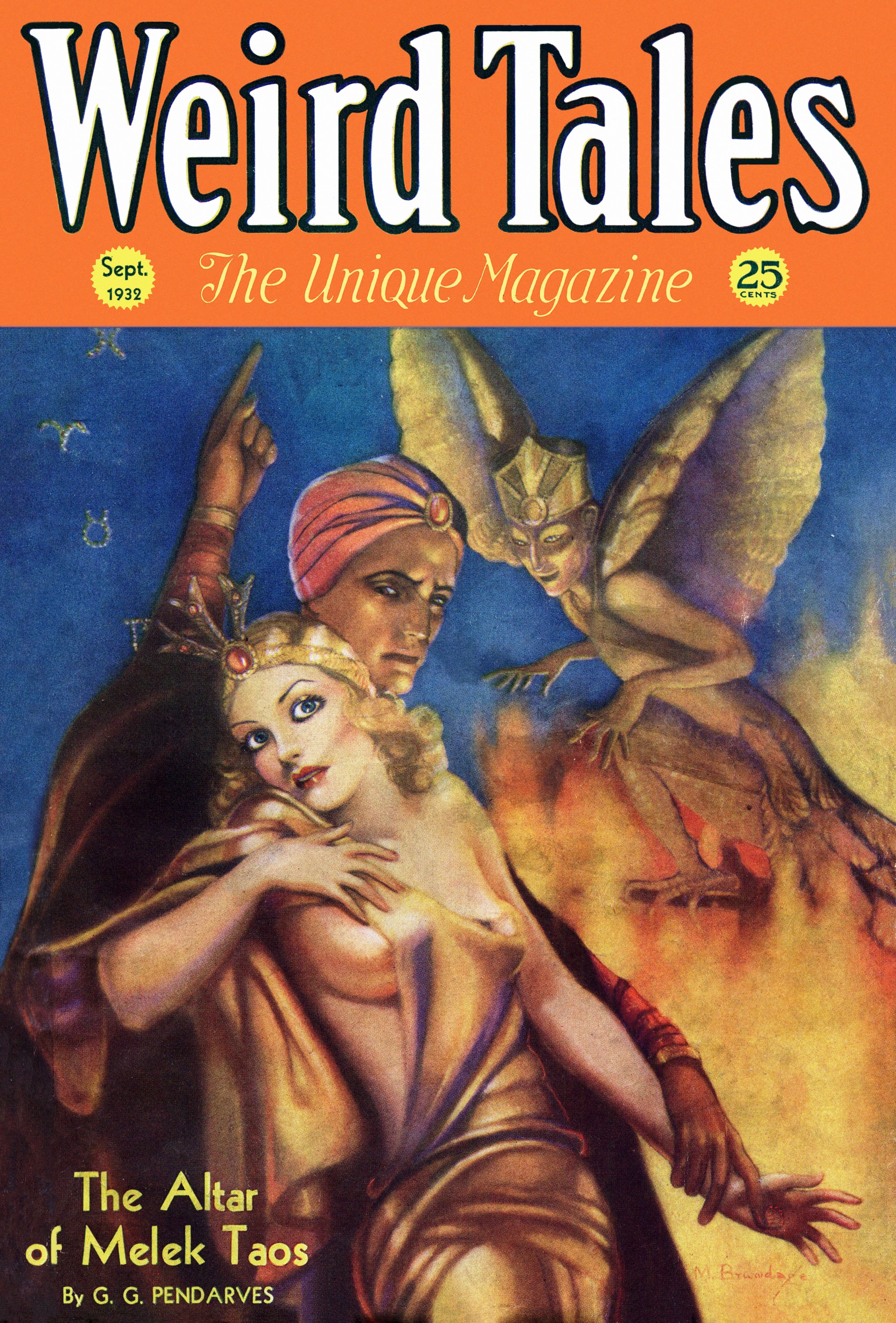
"Empire of the Necromancers" By Clark Aston Smith (Weird Tales, September 1932) 

Is there any other tale such as "Empire of the Necromancers" By Clark Aston Smith (Weird Tales, September 1932)?! No, the curtain is raised on our two necromancers from Naat who go about setting themselves up as the two kings in the mighty graveyard of an abandoned city of a not so forgotten empire. According to the wiki entry on Zothique the breakdown goes something like this; "Setting: The city of Yethlyreom in the realm of Cincor. Characters: Mmatmuor and Sodosma, necromancers; Illeiro and Hestaiyon, dead emperors of Cincor." 
The undead in CAS's Empire of the Necromancers are both ancient rulers & victims within their own realm. And it's the perversion of the state of undeath in this story that highlights the complete violation of the 
 dead emperors of Cincor. And it speaks volumes of the nature of Zothique itself as a setting.


 A world of tomb like ancient empires set amid the grand rot of the Earth on its last legs. 
 If your not farmiliar with Zothique let me enlighten you with a letter between Clark Ashton Smith & L. Sprague de Camp from the Zothique wiki entry;

"Clark Ashton Smith himself described the Zothique cycle in a letter to L. Sprague de Camp, dated November 3, 1953:
Zothique, vaguely suggested by Theosophic theories about past and future continents, is the last inhabited continent of earth. The continents of our present cycle have sunken, perhaps several times. Some have remained submerged; others have re-risen, partially, and re-arranged themselves. Zothique, as I conceive it, comprises Asia Minor, Arabia, Persia, India, parts of northern and eastern Africa, and much of the Indonesian archipelago. A new Australia exists somewhere to the south. To the west, there are only a few known islands, such as Naat, in which the black cannibals survive. To the north, are immense unexplored deserts; to the east, an immense unvoyaged sea. The peoples are mainly of Aryan or Semitic descent; but there is a negro kingdom (Ilcar) in the north-west; and scattered blacks are found throughout the other countries, mainly in palace-harems. In the southern islands survive vestiges of Indonesian or Malayan races. The science and machinery of our present civilization have long been forgotten, together with our present religions. But many gods are worshipped; and sorcery and demonism prevail again as in ancient days. Oars and sails alone are used by mariners. There are no fire-arms—only the bows, arrows, swords, javelins, etc. of antiquity. The chief language spoken (of which I have provided examples in an unpublished drama) is based on Indo-European roots and is highly inflected, like Sanskrit, Greek and Latin."

 "Empire of the Necromancers" By Clark Aston Smith is the a typical Zothique tale with it's haughty characters. Strange dark occult underpinnings and it's air of mystery. If you haven't read "Empire of the Necromancers" By Clark Aston Smith then I will not spoilt the ending. But needless to say that the tale is one of CAS's best tales. "Empire of the Necromancers" By Clark Aston Smith speaks volumes about what has been left behind in the wastelands of Zothique and what makes the setting so unique. For the dungeon master this is master class in adventure hooks scattered throughout the three or four page tale. From hints of extensive ruins and scattered dungeons "Empire of the Necromancers" By Clark Aston Smith drops them in spades. 

"Empire of the Necromancers" By Clark Aston Smith could be used as the basis for a Hill Canton's style point crawl where the PC's are hot on the trail of the necromancers after their dirty magicks in the wastelands of Zothique. Learning of their dark fate only seals the deal for the PC's. Because they will only have hints & rumors to help piece together the two necromancer's fates. There may indeed be treasure but would it be cursed by the dead emperors of Cincor themselves?

    Tuesday, August 10, 2021

    Free OSR Resource - The OSR Library's' Haunted Valley' : The Curse and The Tower For Your OSR Horror or Old School Campaigns.

     This blog entry picks right up from our last romp into 'The Haunted Valley' here on this blog. 
    The biggest factor in blogging is the time factor & this is especially true when one wants to return to an  OSR campaign set up that tugs at one's brain such as David Baymiller's Haunted Valley entries. And this brings up 'The Curse & The Tower' an adventure hook, encounter, & idea all in one.  'The Curse & The Tower'  its perfectly the parameters that David set out; "The setting itself is a small haunted French valley in the year 1627 AD. Originally I had intended to make the valley generic in descriptions of year and trappings so that it could be set anywhere from dark ages to the 1800's but I set that aside as I found setting in a specific year and location gave me more focus."
    And its this focus that translates so well into using   Clark Ashton Smith's  Averoigne stories & situate them on the far side of the valley. 
    The Haunted Valley could easily be added into the World of Greyhawk as a sort of buffer between Greyhawk &  Averoigne. 
    Greyhawk & Mystara have been under the influence of the wizard-noble Stephen Amber (Etienne d'Amberville). So that perhaps the Ambers own the Haunted Valley as a sort of run down supernatural piece of haunted noble holding. Reading through the Averoigne  stories  gives a good overview of such a haunted mini capmaign landscape. 

    'The Curse & The Tower' can be hooked up to back end of X2 Castle Amber by Tom Moldvay giving more credence to back end of X2 allowing some of the more robust end's the wizard-noble Stephen Amber (Etienne d'Amberville) or his family's holdings to come to light. And those holdings could provide as much adventure fodder as the known world material.