Showing posts with label David A. Hargrave. Show all posts

Sunday, April 12, 2026

Diving into the Arduin Underworld - OSR Commentary On House of the Rising Sun (Arduin Grimoire volume 6)

 The House of the Rising Sun is the sixth volume of the Arduin Grimoire series, released in 1980. Authored by David A. Hargrave, it is a seminal piece of the "Old School Renaissance" (OSR) DNA, known for its kitchen-sink fantasy style, high lethality, and unapologetic weirdness. This picks up from 

Diving into the Arduin Underworld - OSR Commentary On Winds of Chance (Arduin Grimoire volume 8) By David A. Hargrave


Like its predecessors, Volume VI is less of a cohesive rulebook and more of a chaotic, creative "data dump" intended to expand the Arduin Multiverse.


### Key Contents & Features

1. New Character Classes

Hargrave continued his trend of introducing highly specific, often overpowered or mechanically unique classes. Notable additions include:

  • The Amazon: A specialized warrior class with unique combat maneuvers and social restrictions.

  • The Medicine Man: A flavor of healer/shaman that operates differently from the standard Cleric or Druid.

  • The Wind-Walker: A high-mobility class focused on speed and aerial utility.

2. Expanded Combat & Critical Tables

Arduin is famous for its brutal critical hit and fumble charts. Volume VI introduced even more specific tables, including:

  • The "Social" Critical Table: Rules for critical successes or failures in social interactions.

  • New Melee and Missile Charts: Increasing the complexity and "gore factor" of combat results, which often included limb loss or instant decapitation.

3. Monsters and Bestiary

This volume introduced dozens of new creatures, ranging from high-fantasy tropes to sci-fi horrors. These included:

  • The Magno-Pede: A metallic, magnetic centipede-like creature.

  • Interdimensional Horrors: Various entities that leaned into the "Lesser Lovecraftian" vibe common in Arduin.

  • The "Rising Sun" Themed Foes: Creatures inspired by Eastern folklore (Oni, etc.), reflecting the title of the book.

4. Magic and Artifacts

The book added hundreds of new spells, many of which were designed to bypass traditional "Vancian" magic limitations. It also detailed several unique artifacts, often with extremely high power levels and devastating drawbacks for the user.


### Design Philosophy: "The Arduin Way"

The House of the Rising Sun exemplifies the Arduin philosophy that defined early tabletop gaming:

FeatureDescription
Multiversal ScopeIt assumes your campaign isn't just one world, but a nexus where sci-fi, horror, and fantasy collide.
LethalityDeath is frequent, and the rules are designed to make every combat encounter feel genuinely dangerous.
High DensityThe layout is famously cramped; Hargrave squeezed as much text, tables, and lists onto every page as possible.
IndependenceWhile designed to work with Dungeons & Dragons (specifically OD&D), it was part of Hargrave's push to make Arduin a standalone entity.

### Historical Context

By the time Volume VI was released, Arduin was at the center of a legal and cultural tug-of-war with TSR (the makers of D&D). The House of the Rising Sun represents a bridge between the early "zines" and the more professionalized Arduin Adventure boxed sets that would follow.

Monday, December 15, 2025

Combining David Hargrave's Arduin (specifically, the proposed or developing ruleset of Bloody Arduin) with the streamlined, sci-fi O.G.R.E.S. rules engine of Jason Vey's 13 Parsecs Part II

 Combining the chaotic, high-fatality, multiverse-spanning fantasy of Dave Hargrave's Arduin (often associated with the "Bloody Arduin" moniker due to its lethal nature) with the adaptable, sci-fi-focused, OSR-inspired rules of Jason Vey's 13 Parsecs creates a truly unique Space Fantasy experience. This blog post picks right up from December 8th's post here. 


The synergy works well because Arduin already embraced genre-bending, mixing classic fantasy with elements of science fiction and super-science (like laser pistols and gates to other dimensions). 13 Parsecs is designed to be a versatile science fiction game, and its core system, O.G.R.E.S., is often compatible with OSR-style mechanics, making a mashup much smoother than trying to blend two wildly different rulesets.


The Arduin/13 Parsecs Hybrid Concept

The core idea is to frame the multiverse of Arduin's Khaas as a section of space that can be reached, explored, or even threatened by the futuristic elements of 13 Parsecs.

1. The Setting: Gonzo Space Fantasy

  • The World of Khaas: The traditional fantasy realms of Arduin exist, but they are now accessible via Jump Gates, ancient portals, or even time travel (rules for which are mentioned in 13 Parsecs). The setting embraces Arduin's "everything goes" philosophy, meaning Elves with laser rifles, psychic Mystic Knights facing off against Chaos Lords, and starships stumbling across forgotten dungeons.

  • The 13-Parsec Frontier: This is the realm of starships, alien species, high-tech gear, and interstellar conflicts. The characters might start here, only to find themselves accidentally shunted into the Arduin dimension, or they could be mercenaries specifically hired to explore the bizarre, dangerous Khaas Sector.

  • The Tone: Maintain the high-risk, high-reward, and highly lethal nature of Arduin (especially its infamous Critical/Fumble tables), but temper it with the pulpy sci-fi adventure of 13 Parsecs.

2. Rules Mashup: Using O.G.R.E.S. as the Foundation

Since 13 Parsecs is Powered by O.G.R.E.S. and is designed to integrate with other games (like Wasted Lands for fantasy elements), it provides the perfect structure.


Feature13 Parsecs (O.G.R.E.S.)Arduin Bloody Arduin ElementsIntegration Suggestion
Core MechanicClass/Level, d20 + mods vs. DC 20 (Attribute/Save), Roll-under % (Class Abilities)d20 and d100 rolls are common.Use the O.G.R.E.S. core mechanics entirely, replacing Arduin's disparate rules for consistency.
Classes/ArchetypesAugmented, Blaster, Mystic Knight, Slicer, etc.Classes like the Assassin, Chaos Lord, Shaman, or Rune-Caster.Re-skin/Reflavour: Mystic Knights become your Rune-Casters, Diplomat skills could cover Arduin's unusual interactions, and the Blaster class is perfect for using Arduin's super-science weapons. You can port in specific Arduin Classes as Heroic Touchstones or prestige classes.
Combat/LethalityStandard combat, Fate Points for agency.Brutal Critical/Fumble Tables for maximum chaos and lethality.MUST HAVE: Integrate Arduin's Critical and Fumble tables (perhaps triggered by a natural 20 or 1 on the d20 roll for attack/saves) to keep the "Bloody Arduin" feel. Allow Fate Points to mitigate or avoid the worst effects.
Magic/PsionicsPsionic/Mystical Powers rules.Extensive, sometimes bizarre spell lists, powerful artifacts.Use the 13 Parsecs system for Psionics/Powers to handle Arduin's spells, possibly requiring a new Mystic Warrior subclass dedicated to arcane Runes and Chaos Magik.
EquipmentTech, Starships, Custom Gear rules.Lasers, Power Armour, and ancient artifacts right next to swords.Use the 13 Parsecs gear chapter to classify all weapons and armor (whether tech or magic) with relevant stats. Starships become essential for getting to/from Arduin's dimensional gates.

3. Campaign Hook Ideas

  • The Lost Starship: A starship from the Solar Frontier crashes on the world of Khaas, and the crew must navigate the treacherous, magic-infused landscape to find a way to repair their jump drive or open a new gate home.

  • The Dimensional Incursion: A powerful Chaos Lord from Arduin's darkest corners discovers a permanent gate to the 13 Parsecs universe and begins to conquer a star system with his armies of Troll-kin and mutated horrors. The players are an interstellar defense force sent to stop the Arduin invasion.

  • The Artifact Hunters: The players are members of an interdimensional salvage crew, using their sci-fi gear to dive into the most dangerous and forgotten realms of Arduin in search of the potent super-science and arcane artifacts left behind by its original creators.


Monday, December 8, 2025

Combining David Hargrave's Arduin (specifically, the proposed or developing ruleset of Bloody Arduin) with the streamlined, sci-fi O.G.R.E.S. rules engine of Jason Vey's 13 Parsecs

 Combining the "gonzo," genre-bending, and famously lethal fantasy of David Hargrave's Arduin (specifically, the proposed or developing ruleset of Bloody Arduin) with the streamlined, sci-fi O.G.R.E.S. rules engine of Jason Vey's 13 Parsecs creates a game of chaotic, multi-dimensional, high-risk, "kitchen-sink" science-fantasy.


Since 13 Parsecs is already designed to be highly customizable and runs on the modular O.G.R.E.S. system, and Bloody Arduin is an attempt to create a cohesive, modern (but still brutal) Arduin ruleset, the combination should focus on integrating the flavor and lethality of Arduin into the framework of 13 Parsecs.

Here is a proposed framework for the Bloody Parsecs (or Arduin's Solar Frontier) RPG:


 Bloody Parsecs: Arduin's Solar Frontier

1. Core Rules: Powered by O.G.R.E.S. (13 Parsecs)

You would use the core mechanics of 13 Parsecs, which is a Class-and-Level system with three main checks:

  • Class Abilities/Skills: Roll a percentage (d100) and try to roll under your percentage chance.

  • Attribute Checks (Including Combat & Saves): Roll a d20, add your attribute bonus/mods, and try to roll 20 or better.

  • The Rule of 2 (GM Tool): For quick, non-critical checks, roll a die (like a d6) and a 1 or 2 is a success.

The Key Arduin Injection (Lethality):

The most iconic element of Arduin is its lethality. This is best integrated by modifying the d20 combat and saves:

  • Critical Hits/Fumbles: Use the infamous, highly detailed, and often deadly Arduin Critical Hit and Fumble tables from Bloody Arduin (or a streamlined version thereof). A Natural 20 on an attack roll results in a Critical Hit roll, and a Natural 1 is a Fumble roll. This introduces the chaotic, visceral violence Hargrave was known for.

  • Wounds and Damage: Retain 13 Parsecs' vitality (HP) system, but make saves more difficult and failure more punishing (e.g., using a modified Constitution Save from Arduin to resist poisons, radiation, or being instantly killed by a massive Critical Hit).

2. Character Creation: The Gonzo Multiverse

Combine the options, with an Arduin bent:

ComponentBloody Parsecs IntegrationSource Priority
AttributesUse the standard 6 (Str, Dex, Con, Int, Wis, Cha) and add Arduin's 7th attribute: Ego (for psychic/willpower saves).Arduin/D&D style
Races/SpeciesBlend them! Include the 13 Parsecs species (Androids, Felis, Saurians, etc.) alongside classic Arduin races (Deodanth, Great Grey Beasts, Lizard Men, etc.). Assumption: Any species can take any class (a core 13 Parsecs philosophy).Mixed
Classes/ArchetypesBlend the lists. 13 Parsecs archetypes (Augmented, Blaster, Psychic, Slicer) become the core framework. Integrate Arduin classes (Star-Powered Mage, Tekno, Martial Artist, Assassin, Runelord) as specialized subclasses or "Advanced Training" options.Mixed
Skills & TrainingUse the 13 Parsecs Skill System (percentile rolls), allowing players to train Skills from both a fantasy-magic base and a sci-fi/tech base.13 Parsecs

3. Magic, Psionics, & Technology: The Kitchen Sink

This is where the Arduin flavor truly shines in a sci-fi setting.

  • Magic and Psionics: Use the 13 Parsecs rules for Psionics and Mystical Powers. The spell lists, however, should be the famously voluminous, chaotic, and often strange spells from the Arduin Grimoires. A Star-Powered Mage might cast a spell called "Greg Stafford's Dismay" right after a Psychic attempts to hack a starship computer.

  • Gear: Blend the tech lists. The players will have access to both laser blasters, energy shields, and advanced cybernetics from 13 Parsecs, as well as the unique, often cursed or insanely powerful magical/technological artifacts of Arduin (like the "Tekno" gear or unique Arduin armors).

4. Setting & Campaign Tone

The setting becomes a "Gonzo Science-Fantasy Multiverse."

  • The World: Arduin itself is just one highly-magical, dimensionally-unstable planet within the Solar Frontier (the setting of 13 Parsecs). Characters move between high-tech space stations and deep-fantasy dungeons, often within the same session.

  • Tonal Goal: Gritty Sci-Fi Fantasy. The system is rules-light and fast-playing like O.G.R.E.S., but the high chance of a devastating Critical Hit or a disastrous Fumble maintains the unpredictable, high-stakes chaos and danger that defines the Bloody Arduin experience. Death is always a roll away.


Tuesday, October 28, 2025

OSR Campaign Commentary On House of the Rising Sun (Arduin Grimoire volume 6) By David A. Hargrave - Dragon's Graveyard & Bloody Arduin's Dragon Magick


 Let's talk about House of the Rising Sun there's some of the great Arduin world building in this Arduin supplement. I've been working with Mathew Tapp's Barrows & Borderland rpg and I wanted to add a section of the Dragon's Graveyard too the wilderness. Now in the past I've looked into Arduin's House of The Rising Sun back in Jan 13th in 2024. Now this is based on the classic Dungeons & Dragons S02E07 The Dragon's Graveyard - Oct 20, 1984. Now Tiamat guards the graveyard and could it be that she actually guards the ancient secrets of Dragon magick. And this ties into our plans for Arduin's Portal to Adventure Kickstarter. 


What did the dragon magick actually do and according to Arduin's House of the Rising Sun?! According to Brave's A.I. Leo; "House of the Rising Sun (Arduin Grimoire Volume 6)  Dragon Magick"

House of the Rising Sun, the sixth volume of the Arduin Grimoire series by  David A. Hargrave, includes a dedicated section on  Dragon Magic, spanning  four pages. This section presents a collection of powerful and perilous spells attributed to dragons, most of which are extremely dangerous for non-dragons to attempt.

The spells are described as being so potent and inherently draconic that only dragons can reliably cast them. The section concludes with a list of additional dragon-exclusive spells, noted only by name and a brief effect description, emphasizing their inaccessibility to other spellcasters.

Key aspects of the Dragon Magic section include:

  • Spells that reflect draconic nature, such as breath weapons, regeneration, and elemental control.

  • High risk for non-dragons, often resulting in severe backlash or death.

  • Integration with the broader Arduin magic system, yet distinct in power and origin

Since Tiamat is the final guardian of the ancient dragonic magicks and artifacts then it makes sense then that she also guards the deepest secrets of dragon magick! 

Thursday, March 20, 2025

OSR Thoughts on David A. Hargrave's Arduin Triliogy by Empire's Choice Games


One of the things that David A Hargrave did was to bring a ton of optional rpg systems that can be used with both classic 'worlds most popular fantasy role playing' game & your modern OSR rpg's. Why because the Arduin trilogy takes on Mr. Hargrave's original works; "The original three books:

* The Arduin Grimoire (Arduin Grimoire volume 1)
* Welcome to Skull Tower (Arduin Grimoire volume 2)
* The Runes of Doom (Arduin Grimoire volume 3)

Plus: The Arduin Adventure

BY: David A. Hargrave

"These are the books that started it all. These books inspired tons of RPGs, authors and fans alike. Let your imagination set wild and come back to the old Arduin Grimoire series to re-inspire you from old or create inspiration of new! There will certainly be something of value in these Grimoires for all. New rules, monsters, items, spells, character classes, races and more all from the World of Arduin, for use in any and ALL role playing game systems past present and future!" The campaign world of Arduin is very much a world filled with dungeons & ruins from the ground up from the beginning and the premises of the ideas of these ruins are baked right into the writing by Hargrave. This is because Arduin is a bit of a parasitic campaign setting. Meaning that Arduin can be glued right into the Greyhawk campaign setting easily. Because of the fact Arduin embraced the idea of the Arduin 'multiverse' back in mid 70's. 

According too the Wiki Arduin entry; "The Arduin books attempted to add many interesting and notable features to the fantasy role playing milieu. In addition to new rules, the Arduin Trilogy contained unique new spells and character classes, new monsters, new treasures, maps, storylines, extensive demonography, and all sorts of charts and lists which detailed the Arduin "multiverse", many of which were new to role-playing gamers of the time."

  The old Arduin Grimoire series is an old favorite & it works on two levels for me as a dungeon master because the Grimoire is like a glimpse into the process that another dungeon master goes through to create their own campaigns. There's a lot of personal touches that hint at what's in the mind of Mr. Hargrave. Because Arduin is a passion project of the highest order. Races, maps, rpg options etc. all hint at the mind at work and the continuing to evolve project that became Arduin within this book.  
The themes of Arduin are the fact that adventuring and dungeoneering are of paramount on the mind of the author. Everything (well mostly everything0 is geared around the goal of getting the player's PC's deeply involved within the meat and potatoes of the old school campaign.

And this I think is the strength of the Arduin Trilogy when it asks the DM to bring optional and interesting ideas to the table top level. David A. Hargrave was according to those who actually had him as a DM was a very conservative dungeon master. Mr. Hargrave kept his campaigns going and really enjoyed both the experience and depth of gaming. You can see this as a fan and consumer of all of all things Arduin. 


Saturday, January 13, 2024

OSR Commentary On House of the Rising Sun (Arduin Grimoire volume 6) By David A. Hargrave For The Arduin Grimoire series & Your Old School Campaigns


Alright so it's another snowy night here in Connecticut and once again our game has been cancelled due to high winds. Which means that I find myself reaching for one of my favorite alternative old school original Dungeons & Dragons or AD&D first edition supplement series. House of the Rising Sun was published in Eighty Six. 


 In addition to the usual collection of new monsters, spells and magik items, “House of the Rising Sun” provides rare insights into the Arduin campaign setting with presentations covering:

* Background information on many of Arduin’s Noble Houses and Landed Siege Lords

* An in-depth look at the hierarchy, organization and activities of Arduin’s many Street Gangs

* A detailed review of the Beggars Guild and guidelines for the new Beggar character class

* An expose of Arduin’s infamous Assassins Guild, their unique weapons and deadly poisons

* A wide variety of culinary delights including unique appetizers, odd entrées and bizarre beverages

* Medical Wonders to cure numerous ills and maladies

* Unique Arduinian Pets and natural denizens of the wilds

* Legendary Gems and Jewels, magikal artifacts and mythical musical instruments

* A review of the “Elder Gods” – gone but not forgotten religions

* “Dragon Magiks” and a whole lot more!

Please note that all Classic Arduin products were written by David A. Hargrave in the 1970’s and 1980’s and are presented here in their original unchanged format.


 Let's talk about House of the Rising Sun in a  deeper context and talk about the fact that this little supplement from Eighty Six reveals far more on Arduin’s Noble Houses and Landed Siege Lords. These folks are the royals as well as the movers & shakers on Arduin. Back in Eighty Seven our own party of adventurers ran afoul of two of these wankers. And they slapped us in irons and traded us as slaves to one of the Orc tribes. 
Needless to say that we escaped as soon as possible and then got deeply invovled with the thieves guilds and street gangs of Arduin. This led our campaign to go deep into the underworld and criminal elements of Arduin. And this is where the article on the street gangs of Arduin was crutal to my uncle's campaign. 
And we also got different assignments from the Begger's Guild & we had two of these scum in our party. The Begger's guild is deeply tied into the Asassins Guild of Arduin. And so House of the Rising Sun was key to my uncle's campaign 
One of our adventures revovlved around an exotic monster produced ingrediant for a libation of a certain noble. And I believe my uncle was inspired by the meals and bizarre beverages of Arduin. 

And this led to our getting involved with procuring medical ingrediant for some of the potions and poluctices on Arduin especially to the healers of the begger's guild. Yes the begger's guild has it's own doctors and healers. 
And we eventually had to flee one of the Arduin kingdoms because of the crime we never committed. We then got involved with the Bardic Lord of Song who was looking for one of the legendary musical instruments covered in the article of Legendary Gems & Jewels plus magical items. And this led to our involvement with one of the temples of the Elder Gods of Arduins which was covered in the next article. Round this out with our brush with Dragon magick and you pretty much have the entire ark of part of my uncle's campaign.

  House of the Rising Sun (Arduin Grimoire volume 6) By David A. Hargrave  is incredibly useful because Hargrave made all of his articles modular. Sure the DM could use all of some articles for thier own campaigns. And then disregard the next article but most of the Arduin Grimoire supplements were brillant because of the breath and depth of information they give on Arduin. 

Wednesday, February 2, 2022

OSR Commentary On Dave Hargrave's Arduin Dungeon Caliban #1 For Your Old School Campaigns


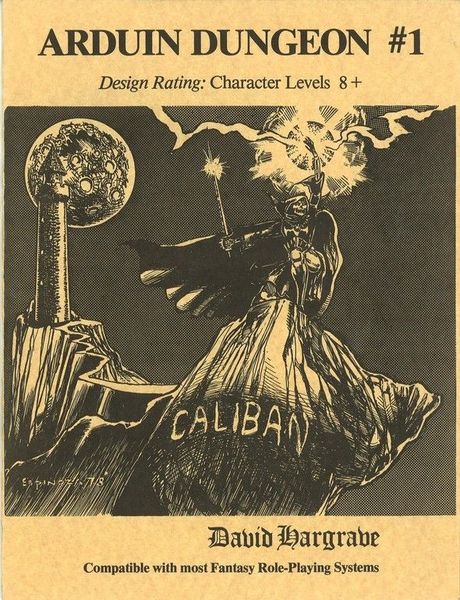
 Working my way back through Hargravian history with Vaults of the Weaver, its interesting to see the way that Caliban the flying Dutchman of dungeons has had on my dungeon design asthetic. What is Caliban and when did it appear; "Caliban (also known as Arduin Dungeon Number One) was a standalone short story and gaming module written in 1979 by David A. Hargrave and published by Grimoire Games. It was based upon Hargrave's gaming system known as Arduin."  Caliban was once a living planar dungeon that challenged the very esssence of Arduin until the gods ripped its evil sentience from it! 

Caliban is far from inactive though because its evil still seeps from it and attracts other monsters with its influence on Arduin. Or at least that's how it is in my head cannon for Arduin. 


So what kicked all of this off?! Reading through the Direbane blog with its introduction to Caliban of all things here. But let me give credit where credit is due; "Unfortunately the entire dungeon, with three more levels, is not presently available (commercially at least, other than $50-$75 used copies), however, posting the entire dungeon will certainly be too much if the copyright holders complain.


What I have done is annotated this portion of the scenario with all the particular monster, spells, and magik items descriptions that one would otherwise need to have the Arduin rulebooks to supply.

My hope is that folks can gain a bit of appreciation for the type of extreme dangers and rewards inherent to an Arduin game. If one focuses on the magic items first, it is like "Holy Toledo!" but I counted about half of the monsters with life level draining abilities. Ouch!"
Note that this blog entry was written in 2018 long before Emperor's Choice came back on the scene in 2021. And Caliban along with other of Dave Hargrave's dungeons appears in the Vault of the Weaver reprint available here. 
Caliban is deadly & still retains its plane traveling abilities so with the right ritual it could appear in in any campaign. There's something very Jack Vance or Michael Moorcock about that little bit of writing on Hargrave's part.  The fact is that Caliban is a high level & nasty dungeon whose influence would in point of fact colour a campaign from the get go. And it might also be supplying monsters to a world in turn. 
Dungeon locations are not static adventure elements & they have to be maintained. And there's got to be a whole evil cult & mechanism in place to do labor & maintence on these locations. And Caliban is no exception. Power attracts power & the evil aura of Caliban is going to go a long way towards hooking a sizable evil cult or create one. Are there still portions of Caliban that are living and can the dungeon itself generate its own monsters able to maintain the coheision of the living organs of the dungeon?! 
And what about the gods themselves of your campaign have they written of Caliban as nothing more then a forgotten relic of a time of war?!  
There are far more questions that I have with Caliban then answers & this I believe is one of the main strengths of the dungeon & adventure location that drags my imagination back again & again. 

Sunday, May 23, 2021

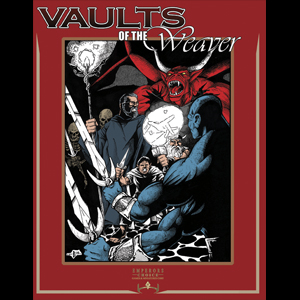
OSR Commentary On Dave Hargrave's Vaults of the Weaver (2006) From Emperor's Choice Games

 
Today we want to talk about the influence of Dave Hargrave's modules & the Vaults of the Weaver module collection from Emperor's Choice Games. The reason is that the collection hasn't been released.. yet from Emperor's Choice  in PDF. But what's in the collection that makes it interesting?! Here let's take a quick look from the Rpg Geek site ; "
Arduin Module Collection of previously published Arduin Dungeons and some never before published Dungeons.

Arduin fans this is it! "Vaults of the Weaver" delivers six modules designed and written by David Hargrave in one book.

Contains reprints of these items:

And also includes these previously unpublished dungeons:

The Dungeon and Overland maps have been re-drawn and cleaned up--the same maps, just better looking." 


So its been one of those weeks when the weekend hits its good to get together with friends. One of my friends is a phyisist & we talked. And talked. The fact is that he's a big fan of  Dave Hargrave's Arduin book & Science Fantasy in general. So over the last day or so we were talking over a couple of beers about the Nexus Gates. There are still one or two titles that Emperor's Choice has yet  to release in official PDF for Vaults of the Weaver. 

Now this collection of adventures highlighs several things about Mr.Hargrave. These are killer adventures & dungeons in many senses of the word. But once again Mr. Hargrave was way ahead of the curve. And in some ways too far ahead. These are high level & quite lethal affairs. Ages befor Dungeon Crawl Classics was even a thought Dave Hargrave was creating these. Being the 'dream weaver'. Dave Hargrave wove these adventures into the coheisive mythology at his own table. From all accounts that we've read. David A. Hargrave was a damn good dungeon master in the California style of Dungeons & Dragons in the Seventies. At his own table he wasn't a 'wild & crazy' DM per say. Sure there were a lot of fantastic elements. 
When we come down to it?! By all accounts Hargrave was way ahead of the curve when it came to his adventure design. No this isn't nosolgia talking here. Living dungeons, alien hives adventure locations, magic artifacts capable of ruining lives, & much more all capable of challenging the gods are a part of Vaults of the Weaver. 
The worth of a collection of adventures is its contents vs utility. 
The contents of Vault of the Weaver is interesting to say the least. The contents of the book are:

- Caliban
- Howling Tower
- Citadel of Thunder
- Death Heart

- and a couple of more books thanks to Paul Mosher:

- Hive Home
- Heart of Darkness

Also included is the Tomb of D'Haera

This collection get's a huge nine on Rpg Geek's site & that says volumes to me as a dungeon master. DM Paul was discussing with me the fact that given the size of the  Arduin campaign setting there's some other factors to cosider from  Vaults of the Weaver

  1. These are mega dungeon & adventure locations from this collection & taken together their influence speaks volumes for the campaign setting. 
  2. The magic artifacts themselves would have entire countries going to war over them. And this is exactly the sort of thing that the evil powers behind some of the locations of Arduin want. Power attracts power is an old axiom of Arduin. 
  3. These adventure locations & dungeons have influence far beyond the bounds of Arduin. The Nexus gates can & do carry the evil of these places into places such as the Wilderlands of High Fantasy. 
  4. These adventures have far reaching implications for a campaign set in motion. They represent major places of confluence & political points of  Arduin diplomacy. 
  5. He who controls the lands around the dungeon controls a major Arduin resource. The power of a place of myth & legend extends far beyond the Nexus gates. 
  6. These dungeons & adventure locations have huge cultural significance to the peoples of Arduin. So there's far more boiling below the surface here. 

Buttom line that we hope in the near future we see a release of Dave Hargrave's Vaults of the Weaver (2006) From Emperor's Choice  Games in book  form  folks. More Arduin goodness coming up. 

Note that in 2022 there's a brand new edition of Dave Hargrave's Vaults of the Weaver Available Here.

Friday, May 21, 2021

Mail Call - Arduin Rpg & Deodanth Blood Feuds

 So there's been a huge amount back & forth on social media about Emperor's Choice Games putting Arduin rpg titles back up on Drivethrurpg  As for myself some combing through Amazon's seller's listings got me three original books for a reasonable price. 


This is very important for two reasons besides the obvious. Which is that Arduin has some very deep roots in causing all kinds of havoc for my player's PC's over the years. And the fact that Dave Hargrave continues to cast a long shadow over my gaming. 


The 'Soul Claw' deodanth clan has had a blood feud in my campaigns with various PC groups connected with any number of patrons. The most recent has been the 'clean up crew' of my Cha'alt/Godbound  games. The OSR version of the Deodanth's that we've used going back ages is from the Underworld cleaning service blog here. 


Deodaths are chaos incarnate in all of its most bloodiest form. They may or may not have been created to murder gods but that's the use we've put them too for ages now. On Arduin they are simply another race of travelers whose blundered into the Nexus gates. Part & parcel of Dave Hargrave's genius was his ability to sift through the grains of his imagination to create reams of old school goodness that you could add or subtract. Mr. Hargrave's eidos was to at least give these pearls of his a try & he was good at what he did. My crew & myself don't have a tenth of  his talent. He was taken far too early from us. 
But now the deodanths are back on the radar for our campaigns & they are out for blood!