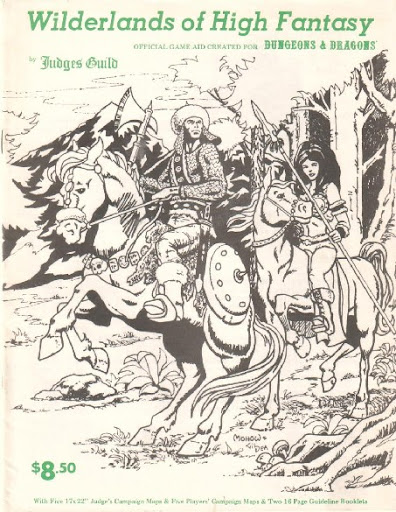
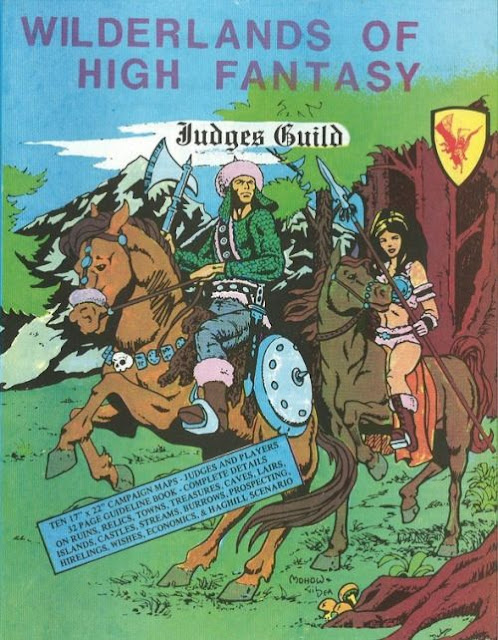
Showing posts with label ''The Wilderlands of High Fantasy'. Show all posts

Thursday, December 22, 2022

Back to the Wilderlands of High Fantasy - Hacking the Wilderlands With Castles & Crusades - Spies of Light Elf By Bryan Hinnen

 ""The Spies of Lightelf is the second booklet in our series of works titled "The Wilderness Project". Each booklet covers an area of wilderness in the Lands of the City States in great detail: any villages in the area have various establishments and prominent NPCs listed, history and way of life of the people briefly described, and a list of interesting events and encounters for passing adventurers....

This particular booklet contains maps of twenty-two five-mile hexes in the area of the Wood of the Gnomes, including the Gnomes' village of Lightelf and the village of Palewood, inhabited by Grey Elves." 

So we're going to pick back up from yesterday's blog post here & dive head long into the Wood of the Gnomes, including the Gnomes' village of Lightelf and the village of Palewood, inhabited by Grey Elves. Spies of Light Elf By Bryan Hinnen isn't so much of a module as it is an adventure tool kit to detail the area around the village of Lightelf itself. 


The Gnome village of Lightelf & the Gnomewoods in  our own City State of the Invincible Overlord's campaign was a strong hold of Fae elemental magic. Magicks that came from the Grey Elves. And our own campaign info on the Grey Elves came from the two sources the Advanced Dungeons & Dtagons first edition Monster Manual II & the Greyhawk rpg setting. According to the Greyhawk Wiki entry on Grey Elves; "Grey elves built the old elven cities which now stand abandoned or were given up to other races as they moved through. They are more given to intellect than other elves, but physically weaker. They practice the oldest elven arts, but hide from the eyes of younger, shorter lived races in their isolated settlements. Once inhabiting mountains, many Grey elves have now settled in meadows and forests.They are thinner than high elves, and have either silver hair and amber eyes or pale golden hair and violet eyes. The latter sort are generally called faeries[1]. They wear complex gowns and flowing robes, favouring clothes the colour of pure driven snow, the noon day sun, silver and gold, with accessories of polished leather, and contrasting colours and jewels. Their cloaks are often deep blue or purple. For battle grey elves favour plate or chainmail, with winged helmets""
So the gnomes move into the lands of the Gnome Woods & take over the old Grey Elven works. They find the Elven elemental magical knowledge & practice it. For Castles & Crusades this comes from the 
Castles & Crusades Adventurers Spellbook

'
'

The magi of the City State fear these elemental magics for a multiplicity of reasons. They enable the Gnome wood to be a 'free area' & there is still the unknown Grey Elves lurking at the edges of the wildness. A part of the Wilderlands but yet not a part of it!? This has lead to massive speculation that they may have their own reasons for passing their magicks onto the Gnomes. 
The Gnomes themselves are escapees from the Fae courta. So the gnomes' pass their knowledge onto the local Neolithic & Bronze age style people's magus or shamans to give the human tribes a fighting chance. The wilderness is rife with monsters just look at Spies of Light Elf's encounter tables. 
Make no mistake Spies of Light Elf continues the Wilderlands tradition of vast tracks of unexplored wilderness that adventurers can & will get themselves into trouble. There's 25 miles of wilderness surrounding the villages & wilds of Gnome Woods and it's right in the description; "' For Castles & Crusades using Spies of Light Elf requires the Castles & Crusades Monster & Treasure book as a must 


The real conflict within Spies of Light Elf By Bryan Hinnen is two fold. One is the Gnomes & Grey Elves vs the humans or the humans vs the wilderness. The latter being the real conflict as the Gnome Woods present actual Non human areas for the PC's to adventure within & perhaps come into 
conflict within. But this isn't  the only area where adventurerers can get into big trouble 

Wednesday, December 21, 2022

Back to the Wilderlands of High Fantasy - Hacking the Wilderlands With Castles & Crusades - Mines of Custalcon By Bryan Hinnen

 "A booklet with full-color cover includes Mini-dungeon, Histories, Descriptions, NPCs, Maps, and Tables for two villages and 476 square miles of wilderness.  The first of a new "Wilderness Series" of playing aids that maps in great detail the Judges Guild's City State wilderness area, using the Campaign Hexagon System.  Twenty-two five-mile hexes, covering over 476 square miles of wilderness, are mapped out, as are the two villages in this area, Byrny and Trollslore. Keyed shops, inns and taverns, as well as histories and ways of life of these villages are provided.  Wilderness encounter tables and a three-level mini-dungeon in the ancient mines of a lost civilization beneath Trollslore are also included"

Mines of Custalcon is really dependant on two villages in this area, Byrny and Trollslore which are kinda almost but not quite blank canvases for the DM.  Byrny & Trollslore as well as the environs are really islands within the wilderness of the Wilderlands series by Judges Guild. 


 Mines of Custalcon By Bryan Hinnen is prime for a Neolithic group of peoples who established the villages of  Byrny and Trollslore. Trollslore itself is rife to become a base of lost peoples with deep connections to the Fae. And the whole area is perfectly suited to transition from Neolithic into Bronze  age civilizations echoing ancient  Great Britian according to Wiki; "Recent tooth enamel isotope research on bodies found in early Bronze Age graves around Stonehenge indicates that at least some of the migrants came from the area of modern Switzerland. Another example site is Must Farm, near Whittlesey, which has recently been host to the most complete Bronze Age wheel ever to be found. The Beaker culture displayed different behaviors from the earlier Neolithic people, and cultural change was significant. Integration is thought to have been peaceful, as many of the early henge sites were seemingly adopted by the newcomers. The rich Wessex culture developed in southern Britain at this time. Additionally, the climate was deteriorating; where once the weather was warm and dry it became much wetter as the Bronze Age continued, forcing the population away from easily defended sites in the hills and into the fertile valleys. Large livestock farms developed in the lowlands and appear to have contributed to economic growth and inspired increasing forest clearances. "
This gradual transition takes the wilderness from cleared land back into the deep wilderness of the Wilderland. This could help to explain the reestablishment of the monsters back into the 476 square miles of wilderness & the reason for the mini dungeon of the Mines of Custalcon.
The Roman style technology within the area is the exception & not the rule around the 
Mines of Custalcon. The City State of The Invincible Overlord's military forces have a vested interest within the Trollslore region. The real power of the area is the Fae & the close ties with the  two villages in this area, Byrny &  Trollslore. 
These powers concentrate some of thier power within the witches of the regions including the hags who are a part of the backbone of 
'Witches of Court Marshes'. 
This plugs directly into the themes & wants of the Castles & Crusades Codex Celtarum 2nd Edition By Brian Young.


So we have Neolithic, Bronze, & Iron age style cultures interacting through the lens of the Wilderlands around Byrny and Trollslore. Castles & Crusades DM's would have to put in a lot of work with Mines of Custalcon By Bryan Hinnen. But this module's adventure  could easily become a part of a Wilderlands C&C campaign. We'll expand upon this coming! 


Back to the Wilderlands of High Fantasy - Hacking the Wilderlands Wi'th Castles & Crusades Through The 'Witches of Court Marshes' By Bryan Hinnen From Judges Guild - Updated

  "The fifth book in the "Wilderness Series", danger awaits on All Hallow's Eve, Witches of the world are gathering en masse, the peasants of the area are going to leave, unless you can stop the wicked Black Mass.  26-pages of maps detail the area around the Witches Court Marshes and the village of Grita Heath.  Complete description of the Witch character class.  Many witch NPCs are detailed.  Three level lair of Mordridda Dungeon under the Marshes contains fabulous wealth and dangerous adventure."


So last night after work we finally got together with our friends at our favorite 'watering hole' which isn't known to the other local animals. We're going over campaign adventure options  for the Wilderlands of High Fantasy that we've been planning. And this one uses the Castles & Crusades options that James Mishler & co did over the years. Someone brought up the Wilderness series from Judge's Guild: 
The Wilderness Series
Mines of Custalcon
Spies of Lightelf
Pirates of Hagrost
Shield Maidens of Sea Rune
Witches Court Marshes

Everything here begins with 'Mines of Custalcon'
 which has its own internal Wilderlands history, mini dungeon, etc. which sorta of interconnects to the others in the series. Well comeback to 'The Mines of Custalcon' soon because of its important part that it plays out in 'The Wilderness series'. 


Now personally we've never been involved with 'Witches of Court Marshes'. But knowing its place in 'The Wilderness series' of adventures things have motivated me to grab it from my friend's thumb drive. Now interesting enough  'Witches of Court Marshes' isn't simply an adventure but a Wilderlands mini 
campaign sourcebook unto itself.  But we digress here, this is a massive Wilderlands campaign arch that came out in '82 & was written by Bryan Hinnen. This isn't a joke here. This module details out  the village of Grita Heath & the dungeons three level lair of Mordridda Dungeon under the Marshes. These dungeon works are no joke. The witches detailed here are nasty business. These witches  are right in line to the hags of Advanced Dungeons & Dragons.  In fact the whole module reeks of Celtic influences right down the core of it. This isn't a bad thing at all. 


Black Annis from AD&D Monster Manual II 

Given how this played up a bit in some of the Wilderlands modules we can assume that there's a whole cloth feel to this source book/adventure that we didn't get from some of the other Wilderlands books. And there's a very good reason for this according to a blurb that we found on Rpgnet's entry on 'Witches Court Marshes';"An eighty page sourcebook detailing the wilderness west of the City-State of the Invincible Overlord and the witchy inhabitants who make it worth a visit. As one of Judges Guild's later supplements, not approved for D&D, it uses their "Universal Fantasy" stats system to describe the area's resident monsters & humans, as well as a long description of the witch character class, including new spells. There are 26 hex-mapped pages of wilderness and a three-level dungeoncrawl"

This doesn't take away from the actual usefulness of the 'Witches of Court Marshes' at all. In fact if we were looking for a breakdown of  peusdo Celtic fortifications for the humans of the Wilderlands. A number of human race's settlements might look like the oppida. An oppida is 
 
a large fortified Iron Age settlement that makes an excellent example for the Wilderlands of High Fantasy. These fortifications are perfect for the surroundings of the the Witches Court Marshes. 


 Kenny Arne Lang Antonsen - artwork of 

Celtic Oppidum Central Europe 1st century B.C.


These fortifications are perfect adventure set pieces because they allow the DM to tap into real world history to give that little inch of campaign promise to the players as seen in the  oppida wiki entry;"Oppidum is a Latin word meaning the main settlement in any administrative area of ancient Rome, and applied more generally in Latin to smaller urban settlements than cities, equating to "town" in English (bearing in mind that ancient "cities" could be very small by modern standards). The word is derived from the earlier Latin ob-pedum, "enclosed space", possibly from the Proto-Indo-European *pedóm-, "occupied space" or "footprint".

In his Commentarii de Bello GallicoJulius Caesar described the larger Celtic Iron Age settlements he encountered in Gaul during the Gallic Wars in 58 to 52 BC as oppida. Although he did not explicitly define what features qualified a settlement to be called an oppidum, the main requirements emerge.[1]

They were important economic sites, places where goods were produced, stored and traded, and sometimes Roman merchants had settled and the Roman legions could obtain supplies. They were also political centres, the seat of authorities who made decisions that affected large numbers of people, such as the appointment of Vercingetorix as head of the Gallic revolt in 52 BC". 

This plugs directly into the themes & wants of the Castles & Crusades Codex Celtarum 2nd Edition By Brian Young. The mythology of the 'Witches of Court Marshes' would have to be altered quite a bit but it could easily fit into the back bone of the themes of the Codex Celtarum 2nd Edition 
The Iron Age settlements would have to have deeper ties to the Fae then previously mentioned to get the full use out of 
 the Castles & Crusades Codex Celtarum 2nd Edition By Brian Young.


The problem comes about when combining too much of these things into a flowing campaign. The fact is that one adventure element at a time should be used. The 'Witches of Court Marshes' By Bryan Hinnen is that lens first that needs to be looked at by the dungeon master. Everything else will fall into place. The 'Witches of Court Marshes' By Bryan Hinnen is a huge campaign arch & the events of the module will have lasting effects within a campaign. The module could consolidate the power of the witch's coven within this area of the Wilderlands if the PC's fail. The 'Witches of Court Marshes' By Bryan Hinnen is a classic & still works quite effectively as a campaign motivator module.

Tuesday, October 12, 2021

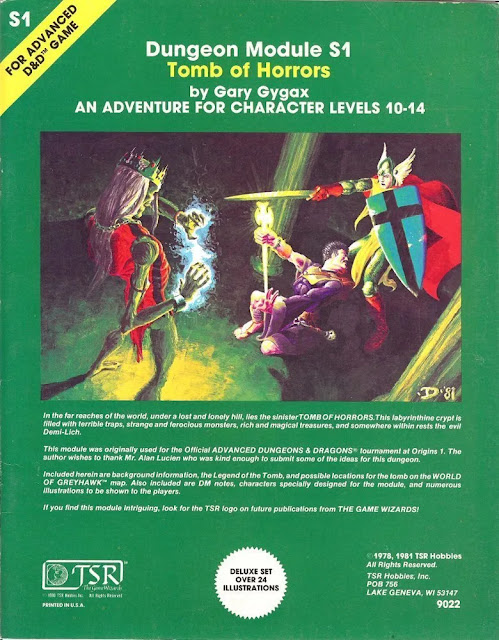
Clark Ashton Smith, The Wilderlands of High Fantasy, & S1 Gary Gygax's Tomb of Horrors As Old School Campaign

 A few days ago I posted about 'Judges Guild 'Wilderlands of High Fantasy' & Gary Gygax's B2 'Keep on the Borderlands' As Old School Campaign' on the blog. And over the last couple of day this blog entry has me thinking about 'The Arduin Grimoire'. For those of you who don't know of my love of these books let me assure you that they have coloured my campaigns for decades. 


Last night I went back into 'Into The Cities'.dot.com webpress blog and came across the following little nugget; "There’s another version of the Wilderlands over here. Scott Driver’s version is heavily influenced by Clark Ashton Smith.

Check this out:

“The City State of the Invincible Overlord is an ancient, decadent metropolis surrounded by howling wilderness and ruled by a grim tyrant. Its precincts are prowled by grasping merchants, ruthless slavers, cunning thieves, hollow-eyed whores, and the ululating thralls of weird cults. Beneath its cobbled streets and reeking sewers lies a sprawling labyrinth teeming with foul creatures and brimming with forgotten treasures and forbidden lore." 
So Clark Ashton Smith, The Wilderlands of Hight Fantasy & more?!  You can find Scott Driver's Wilderlands on the Wayback machine here!  Driver goes on with the following; "A pronounced fondness is evinced for fungi, vermiforms, slimes, pods, cephalopods, gastropods, mutants, human-animal amalgams, dark cults, body horror, unspeakable tentacular booglies, anachronisms, purple prose, and gamer humor." 


The idea of B2 Keep on the Borderlands adventure locations surrounded by a mix of Robert E. Howard & Clark Ashton Smith inspired wilderness has very deadly implications. What about the village of Hommlet being a forgotten piece of these border fortresses along the edges of  'The City state of the Invincible Overlord'. If this is the case then perhaps S1 'The Tomb of Horrors' by Gary Gygax might also find a place within such a wilderness expanse. Now let's think about this for a moment, we've got a Clark Aston Smith inspired Wilderlands. The tomb dungeon & its occupant could be left alone by the Invincible Overlord to kill off any up & coming adventurer rivals. 


If we go with these CAS's influences  then S1 Tomb of Horror makes a certain amount of sense. The idea of a gallows humor dungeon & tomb with its lich king testing adventurers out in the wild wastelands & wilderness makes a lot of sense. Steve Wach of Red Pub Games also has a free set of maps available here for S1 Tomb of Horror 

Meanwhile the idea of a CAS inspired Wilderlands goes a long way towards roping in some of the ideas of the Arduin Grimoire. The alien influences, the nexus gates, forgotten technologies, etc. all point to an Arduin inspired connection. 

Saturday, October 9, 2021

Judges Guild 'Wilderlands of High Fantasy' & Gary Gygax's B2 'Keep on the Borderlands' As Old School Campaign

We're going to be returning to the Wilderlands of High Fantasy & there's the fact that I've wanted to revisit some of the adventure events from last year's B2 Keep on the Borderlands by Gary Gygax. Now we didn't necessarily place the keep in a definitive hex per say. 


But over at the Piazza forums  there's  thread called 'Keep on The Borderlands in the Wilderlands' by  ZardokhasSpoken  which goes into the following; " I placed them in CSIO hex 4623. This hex just seemed to me an ideal fit for this iconic module. The only change necessary was the inclusion of the keep, which made sense being Skandian, to "help and protect" the Gnomes of Lightelf. So much political intrigue at this location, with the spies of Lightelf sowing the seeds of Gnomish revolt, the shield maidens seeking to recapture Sea Rune, the bandits from B2 (hirelings of the Overlord to harass the Skandians?), and the elves of Palewood trying to stay neutral."  This makes things very interesting as the make up of the Wilderlands shifts yet again! 


ZardokhasSpoken  also released some free maps for the Keep & environs within the  Wilderlands to provide the DM with some lift to integrate the whole affair into their personal campaigns. 
The B2 Keep on the Borderlands & Wilderland  Maps are available right here

Thursday, March 25, 2021

OSR Sword & Sorcery Commentary - CM2: "Death's Ride" (1984), by Garry Spiegle

"A King's Commission leads to danger!

All communication with the barony of Twolakes Vale has ceased. King Ericall, worried about the security of his border and angered at the loss of tax revenues, has commissioned you, a delegation of powerful adventurers, to investigate. This is not a petty problem to by solved by the armies of local nobility. Indeed, the king's forces are desperately needed elsewhere. Twolakes Vale is, after all, only a small barony on the far frontier of Ericall's domain.


"And yet? The cloud is there, its nature and cause unknown. None have returned for the barony for weeks. Furthermore, the cloud is spreading, and vague reports of unrest and mysterious disappearances are starting to trickle in from nearby baronies.


Can you discover the secret of Two Lakes Vale?"


 So over the past couple of days the module CM2 Death's Ride has come up again at the table top level because of the Astonishing Swordsmen & Sorcerers of Hyperborea rpg Bundle of Holding &  campaign from a couple of years ago. A bit of background & history on CM2: "Death's Ride" (1984), by Garry Spiegle, the module was the second Companion-level adventure for Basic D&D  & was released in 1984


 CM2 is  one of those modules that has several things going on at once & its one that over the years has graced my table several times. Looking over the module again, we can't honestly say that we'd run it as is in Hyperborea at this time.  Now you'd need a setting that's Sword & Sorcery but has the necromatic backstory too it. That's the easy part I'd set  CM2 Death's Ride within Clark Ashton Smith's  Zothique as a possible back story for the wizard's nercomatic heritage. 


DM Steve's version of Zothique based on Rodney Mathews fantastic artwork.
Used without permission no breech of trademark or copyright is intended.

But with CM2 Death's Ride needs to be set within a world that can support both the Sword & Sorcery elements & the High Fantasy elements without loosing the Companion-level adventure elements  for Basic D&D. Fortunately we've got all of those elements within the Wilderlands of High Fantasy setting! 


What about the Sphere of Death?! This strange overlap plane of entroptic energies & source of undeath?! Now I've said before that Frank Mentzer doesn't get half of the credit he deserves. And when it comes to BECMI this is most certainly the case. Are these planes or sphere?! Why not both?! We've got the death leech an alien creature that certainly seems right in line with the negative energy plane. Hmm The death leech seems like its straight out of Lamentations of the Flame Princess rpg. Hell if you want to Flame Princess the module further add in the Random Estoretic Creature Generator to add some off the wall spice to critters in CM2 as needed. 

Alright so let's say that we want to keep the sphere of  Death & Entropy using it as the shadow of the negative plane along with immortals & the like.But let's keep the OSR vibe going. A strong possibility for CM2  is using the Dark Dungeon Retroclone by Bucky The Black Ball. 

The Twolakes Vale is a Northern land locked barbarian kingdom state within the Wilderlands of High Fantasy. We've got all of the information about the state & we could theoratically use AS&SH system as the engine to drive this. The necromatic elements including the sphere of death are intact. And we've got a setting that not only can support a dragon but the Sword & Sorcery PC classes from AS&SH. 
And then there's the fact that PC's could take over the Twolakes Vale as their own kingdom in the Wilderlands of High Fantasy. All of the required stats are within the module. 


Saturday, November 28, 2020

Chaos Fey & Arthur Machen's Works Within 'The Wilderlands of High Fantasy' Campaign Setting

' We wake sometimes from dreams uttering strange phrases, murmuring incredible things. At the moment of waking, for some ineffable instant of time, the words we speak, or perhaps think we speak, seem to us full of illumination. To every one who speculates at all as to the heights and depths of the soul, there comes at very rare moments—there are not, perhaps, more than half-a-dozen such experiences given to any man's lifetime—the sense of the true world which lies beyond this dark place of images and shadows; a world that is full of light and glory, a world where all our dim desires are interpreted and fulfilled. It is as if we stood among shadows before a black curtain, as if for one moment a fold were caught back and we saw that which we can never utter: but never deny."

The Shining Pyramid (collection) by Arthur Machen


The Foundry Elebor figure found here.

The adventurers stopped & looked at the strange series of henges where they knew there were none mere days ago. The first one heard the dog like things behind them first. Shu- ks they called em & it was the last thought they had before the hound like beasts tore into the party. 

Sidney Paget's illustration of The Hound of the Baskervilles. The story was inspired by a legend of ghostly black dogs in Dartmoor.

Up on the hill was a wild figure of a man like shape that snapped a whip that snapped with what seemed the fires of Hell itself. 

In the wilderness of the 
 Wilderlands of High Fantasy campaign man holds no sway at all. Even the demi races of Advanced Dungeons & Dragons tread lightly. The ancient sons & daughters of the Nephiliam still hold sway here. They are caught between the ancient threshold of dream & reality for this is their sway.  Now going through my own Machen literature & reference books there's quite a bit of a case to be made for the rude,primitive,  & highly dangerous servants of the Chaos Fey. These things are quite literally able to slip in between realities to take their alternative time & space contiuum onto the Wilderlands. This blog entry picks right up right after this one! 


Even regular Fey give these things a wide bearth, their altars are stained with the blood man. These left overs from another era & time are able to use rust spells, cloud kill fogs, & ancient curses to kill with little regard for hearth, home, & humanity. They feed on anyone they choose with impunity & rule the local residents through a combination of implied fear, outright might, & damnation. Fairy tales & legends are the masks that the locals put on the 'kindly ones' & speak of them in hushed tones given to gods, heroes, & myths. The truth is much darker. 


These pagan god hold overs breed with the local population producing twisted off spring that often carry out their parent's wishes among the residents that they rule. 
These can also be bred into several of the evil humanoid races found within Advanced Dungeons & Dragons first edition monster manual. 


After the events of 
Mines of Custalcon are over then its the perfect time to spring upon the players the other gods that have stakes within the area. The ancient 'gods' that are Hell bent on taking over but this isn't their only conquest within the Wilderlands. 


Machen leaves lots of hints, possiblities, & survivals on the table with his stories. My ancient Elven hold overs are the inheritors of a banished race of ancient proto god things that want what's thiers back! They will do anything to regain it as we shall see. 


Friday, November 27, 2020

Chaos Fey, The Wildness series of Judges Guild Adventures, & Arthur Machen's Works Within 'The Wilderlands of High Fantasy' Campaign Setting

' Nurse put me down on the soft moss under a tree, and she said: "She can't get to the pond now." So they left me there, and I sat quite still and watched, and out of the water and out of the wood came two wonderful white people, and they began to play and dance and sing. They were a kind of creamy white like the old ivory figure in the drawing-room; one was a beautiful lady with kind dark eyes, and a grave face, and long black hair, and she smiled such a strange sad smile at the other, who laughed and came to her. They played together, and danced round and round the pool, and they sang a song till I fell asleep. Nurse woke me up when she came back, and she was looking something like the lady had looked, so I told her all about it, and asked her why she looked like that. At first she cried, and then she looked very frightened, and turned quite pale. She put me down on the grass and stared at me, and I could see she was shaking all over. Then she said I had been dreaming, but I knew I hadn't. "
The White People (Machen) by Arthur Machen
The Green Book


The Foundry Lilith figure 

The Wildness series of Judges Guild  adventures is the perfect  Wilderlands of High Fantasy campaign series of adventures to modify into a fantastic jump point for a Celtic Sword & Sorcery campaign. The Wilderness series is as follows  :

The Wilderness Series
Mines of Custalcon
Spies of Lightelf
Pirates of Hagrost
Shield Maidens of Sea Rune
Witches Court Marshes


There are several races of god/Elves in my game campaigns that let's simply call them very nasty & evil. These things align themselves with far more Sword & Sorcery & mythology then they do with the regular garden variety of original  Dungeons & Dragons  or Advanced Dungeons & Dragons first edition's depictions of  Elves. In fact the Elves of AD&D first edition are known huldra ("hidden being") in Scandinavian languages these life force  are a food staple for these Pagan  gods. 


These pagan gods are almost but not quite demonic harkening back to the time of the post Biblical flood. These entities are most likely a member  Nephilim family stretching back millions of years. They pass themselves off as 'gods' gaining food from the spiritual aspects of human scarafice & worse. I found a good version of these beings in The Foundry's Revenant Elves army. 


These things are perfect powers to be behind the affairs of Witches Court Marshes. Their favors are going to be fickle at the best of times & solidly nasty later on. The Witches are powers within their own right with all kinds of adventure or campaign possibilities. 


This version of the 'Wilderlands of High Fantasy' draws very deeply from the Castles & Crusades material James & Jody Mishler Games had out a couple of years ago. 
But this time it seems that with Arthur Machen's influence upon me once again. There are far more Machenian survivals out among the misty stones & ruins of the wilderness of the Wilderlands. A world before the world so to speak  & the original Elves Dungeons & Dragons owe more to Appendix N writers & less to Machen's vision; "
A pioneering work of the fantasy genre was The King of Elfland's Daughter, a 1924 novel by Lord Dunsany. The Elves of Middle-earth played a central role in Tolkien's legendarium, notably The Hobbit and The Lord of the Rings; this legendarium was enormously influential on subsequent fantasy writing. Tolkien's writing had such influence that in the 1960s and afterwards, elves speaking an elvish language similar to those in Tolkien's novels became staple non-human characters in high fantasy works and in fantasy role-playing games. Tolkien also appears to be the first author to have introduced the notion that elves are immortal.[citation needed] Post-Tolkien fantasy elves (which feature not only in novels but also in role-playing games such as Dungeons & Dragons) are often portrayed as being wiser and more beautiful than humans, with sharper senses and perceptions as well. They are said to be gifted in magic, mentally sharp and lovers of nature, art, and song. They are often skilled archers. A hallmark of many fantasy elves is their pointed ears"

Dungeons & Dragons Elves have their own taboos that they do not speak of & like the American Indians simply leave the area when these ancient & nameless things are spoken abo


Älvalek, "Elf Play" by August Malmström (1866)

These ancient god Elven like things often use not traditional sources of military action but disease like curses & spreading maladies of occult origin. When h
ard pressed they will construct very alien & archaic constructions such as the Teratic Tome's Obsidian Giants. These monsterosities are capable of going toe to toe with mecha & even giant kin as well as kind. The Obsidan Giants are constructed  things or war machine that  are fueled by regular Elven slaves that have been captured. And married to these foul creations. 


The question is out in the middle of the unknown & savage Wilderland of High Fantasy are there artifacts & structures such as Arthur Machen's Shining Pyramide!?! Not only do I think so but many of the original Judge's Guilds Wilderlands of High Fantasy adventures bare this out. 


These are ancient Pagan gods that are far more arrogant, alien, & utterly inhuman in their take torward humanity & even their own supposed kin. Dwarves, Elves,etc. all of the demi human races of Dungeons & Dragons are their prey. They come from a time when the hills ran red with their sacrifices, & altar stones ran wild with their revelries!