Showing posts with label Odin. Show all posts

Saturday, October 1, 2022

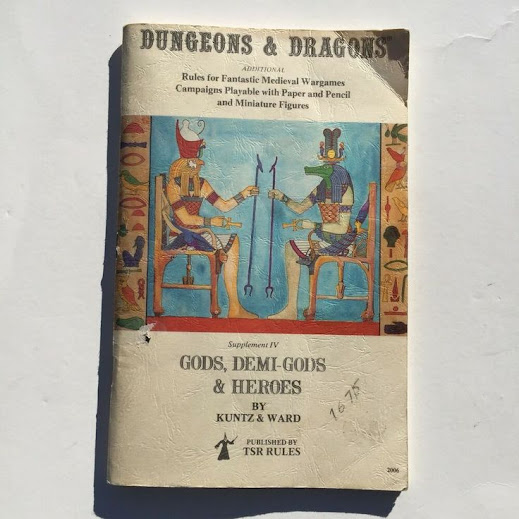
The Norse God of Law From Adventurer, Conqeuror, King Rpg - Thoughts on Kuntz & Ward's Original Dungeons & Dragons's Gods, Demi Gods, & Heroes - Updated

 When it comes to Kuntz & Ward's "Supplement IV" Gods, Demi-Gods and Heroes the Norse mythology certainly gets the lion share of coverage in the book. But why does this make things interesting for an Adventurer,Conqueror, King rpg? This blog entry will pick up from this blog entry here. 


We know that Odin in Kuntz & Ward's "Supplement IV" Gods, Demi-Gods and Heroes is gearing up for war. But what god is he going to turn to when it comes such a war against chaos?! That god isn't Thor who get's the royal treatment in the additional material in  'Supplement IV' instead its Tyr whose an aboslute beast; "Tyr: Armor Class: 2 Magic Spell Ability: None Move: 12" Fighter Ability: 19th Level Hit Points: 250 Psionic Ability: Class 6 This one-armed God of War was overshadowed by Thor muchly and had very little to do with Norse Mythology. Tyr though is the only God capable of approaching the Fenris wolf with any success. He inspires a berserker type fighting (similar to Odin, but with only 50% effectiveness) in his followers rage. His dwelling place is not mentioned nor are his sons. He does occupy a seat amongst the twelve at Asgard and it is assumed that he dwells there most of the time."  Why would Odin turn to Tyr?! Because Tyr is actually the Germanic & Norse god of war & Law! This aspect of the god has Greco Roman connections; "These deities are generally understood by scholars to refer to *Wōđanaz (known widely today as Odin), *Þunraz (known today widely as Thor), and *Tīwaz, respectively. The identity of the "Isis" of the Suebi remains a topics of debate among scholars.[18] Later in Germania, Tacitus also mentions a deity referred to as regnator omnium deus venerated by the Semnones in a grove of fetters, a sacred grove. Some scholars propose that this deity is in fact *Tīwaz.[19]

votive altar has been discovered during excavations at Housesteads Roman Fort at Hadrian's Wall in England that had been erected at the behest of Frisian legionaries. The altar dates from the 3rd century CE and bears the Latin inscription Deo Marti Thingso Et Duabus Alaisiagis Bede Et Fimmilene. In this instance, the epithet Thingsus is a Latin rendering of Proto-Germanic theonym *Þingsaz. This deity is generally interpreted by scholars to refer to Týr. The goddesses referred to as Beda and Fimmilene are otherwise unknown, but their names may refer to Old Frisian legal terms.[20]

In the sixth century, the Roman historian Jordanes writes in his De origine actibusque Getarum that the Goths, an east Germanic people, saw the same "Mars" as an ancestral figure:

Moreover so highly were the Getae praised that Mars, whom the fables of poets call the god of war, was reputed to have been born among them. Hence Vergil says:
"Father Gradivus rules the Getic fields"


Týr equated with Mars in an 18th-century manuscript (ÍB 299 4to)


While Thor gets all of the press Tyr has many connections with Law & is going to be the natural enemy of giant kind & many of the Chaotic humanoid races. And his actions prove this especially his mention within 

the  Sigrdrífumál; " the valkyrie Sigrdrífa imparts in the hero Sigurd knowledge of various runic charms. One charm invokes the god Týr:

'You must know victory-runes
if you want to know victory. Carve them
into your sword's hilt, on the blade guards
and the blades, invoking Tyr's name twice.'
Jeramy Dodds translation[23]

In Lokasenna, the gods hold a feast. Loki bursts in and engages in flyting, a contest of insults, with the gods. The prose introduction to the poem mentions that "Tyr was in attendance, even though he had only one hand because the wolf Fenrir had recently ripped off the other while the wolf was being bound."[24] Loki exchanges insults with each of the gods. After Loki insults the god FreyrTýr comes to Freyr's defense. Loki says that "you can't be the right hand of justice among the people" because his right hand was torn off by Fenrir, elsewhere described as Loki's child. Týr says that although he misses his hand, Loki misses Fenrir, who is now bound and will remain so until the events of Ragnarök.
When it comes to Law Odin is going to have a shaky relationship at
best but Tyr is going to be his right hand man literally; "

The Prose Edda sections Gylfaginning and Skáldskaparmál reference Týr several times. The god is introduced in part 25 of the Gylfaginning section of the book:

High said: 'There is also an As called Tyr. He is the bravest and most valiant, and he has great power over victory in battles. It is good for men of action to pray to him. There is a saying that a man is ty-valiant who surpasses other men and does not hesitate. He was so clever that a man who is clever is said to be ty-wise. It is one proof of his bravery that the Æsir were luring Fenriswolf so as to get the fetter Gleipnir on him, he did not trust them that they would let him go until they placed Tyr's hand in the wolf's mouth as a pledge. And when the Æsir refused to let him go then he bit off the hand at the place that is now called the wolf-joint [wrist], and he is one-handed and he is not considered a promoter of settlements between people.
A. Faulkes translations (notes are by Faulkes)

[26] This tale receives further treatment in section 34 of Gylfaginning ("The Æsir brought up the wolf at home, and it was only Tyr who had the courage to approach the wolf and give it food.").[27] Later still in Gylfaginning, High discusses Týr's foreseen death during the events of Ragnarök:

Then will also have got free the dog Garm, which is bound in front of Gnipahellir. This is the most evil creature. He will have a battle with Tyr and they will each be the death of each other." 
A. Faulkes translation
Tyr is literally straddling the bows of Chaos of the Norse gods & the high points of Law. He's the god with elements in both camps. He will have scouted out & taken down giants within Jötunheimr behind enemy lines. 
PC's in our games over the years who were involved with Tyr did so with some darksides to their relationships with the god. From 
'The OSR Grimoire' Blog comes this little tid bit; "Paul Karlsson Johnstone discusses berserkers in his excellent article "Origins of the Norse Pantheon" in The Dragon #29 (September, 1979)" And its this dark beserker aspect that can get the PC's killed and while they fill the ranks of Odin's army of the dead & Valhalla. Our party was often left with out our best fighters & thieves. 
Another aspect of Tyr is the fact that the god is a master psionic & this could be how he deals with the powers of Chaos in very unexpected ways. Able to read minds, implant suggestions, and create opportunities for his worshipers. 
How does this relate to the  Adventurer, Conqeuror, King rpg?! Think about where Tyr sits within the patheons of the Norse. A god of war, Law, and justice is going to on the front lines of a war between Law & Chaos. Because giant warlords crossing from Jötunheimr into Midgard is a real possibility with vast armies of humanoids & smaller giant kind such as ogres & the like. This is the time when kingdoms can be won in battle but warriors should remember the fact there is a ton of crossover material potential here. Crossover potential with both Conan's Hyboria supplemental material & Elric's supplemental material within Gods, Demigods, & Heroes. In the flickering candle light of when the oceans drank Atlantis & the rise of the Norse gods,Crom has his hands full with the Celtic gods & mythology.  These competing gods are going to war among themselves as well as the forces of Chaos. There's plenty of room for the players to get caught up in such affairs. See Michael Moorcock's mythos for the type of disasters that can happen when dealing in the affairs of the gods. 

Saturday, December 18, 2021

The Norse God of Law From Adventurer, Conqeuror, King Rpg - Thoughts on Kuntz & Ward's Original Dungeons & Dragons's Gods, Demi Gods, & Heroes

 When it comes to Kuntz & Ward's "Supplement IV" Gods, Demi-Gods and Heroes the Norse mythology certainly gets the lion share of coverage in the book. But why does this make things interesting for an Adventurer,Conqueror, King rpg? This blog entry will pick up from this blog entry here. 


We know that Odin in Kuntz & Ward's "Supplement IV" Gods, Demi-Gods and Heroes is gearing up for war. But what god is he going to turn to when it comes such a war against chaos?! That god isn't Thor who get's the royal treatment in the additional material in  'Supplement IV' instead its Tyr whose an aboslute beast; "Tyr: Armor Class: 2 Magic Spell Ability: None Move: 12" Fighter Ability: 19th Level Hit Points: 250 Psionic Ability: Class 6 This one-armed God of War was overshadowed by Thor muchly and had very little to do with Norse Mythology. Tyr though is the only God capable of approaching the Fenris wolf with any success. He inspires a berserker type fighting (similar to Odin, but with only 50% effectiveness) in his followers rage. His dwelling place is not mentioned nor are his sons. He does occupy a seat amongst the twelve at Asgard and it is assumed that he dwells there most of the time."  Why would Odin turn to Tyr?! Because Tyr is actually the Germanic & Norse god of war & Law! This aspect of the god has Greco Roman connections; "These deities are generally understood by scholars to refer to *Wōđanaz (known widely today as Odin), *Þunraz (known today widely as Thor), and *Tīwaz, respectively. The identity of the "Isis" of the Suebi remains a topics of debate among scholars.[18] Later in Germania, Tacitus also mentions a deity referred to as regnator omnium deus venerated by the Semnones in a grove of fetters, a sacred grove. Some scholars propose that this deity is in fact *Tīwaz.[19]

votive altar has been discovered during excavations at Housesteads Roman Fort at Hadrian's Wall in England that had been erected at the behest of Frisian legionaries. The altar dates from the 3rd century CE and bears the Latin inscription Deo Marti Thingso Et Duabus Alaisiagis Bede Et Fimmilene. In this instance, the epithet Thingsus is a Latin rendering of Proto-Germanic theonym *Þingsaz. This deity is generally interpreted by scholars to refer to Týr. The goddesses referred to as Beda and Fimmilene are otherwise unknown, but their names may refer to Old Frisian legal terms.[20]

In the sixth century, the Roman historian Jordanes writes in his De origine actibusque Getarum that the Goths, an east Germanic people, saw the same "Mars" as an ancestral figure:

Moreover so highly were the Getae praised that Mars, whom the fables of poets call the god of war, was reputed to have been born among them. Hence Vergil says:
"Father Gradivus rules the Getic fields"


Týr equated with Mars in an 18th-century manuscript (ÍB 299 4to)


While Thor gets all of the press Tyr has many connections with Law & is going to be the natural enemy of giant kind & many of the Chaotic humanoid races. And his actions prove this especially his mention within 

the  Sigrdrífumál; " the valkyrie Sigrdrífa imparts in the hero Sigurd knowledge of various runic charms. One charm invokes the god Týr:

'You must know victory-runes
if you want to know victory. Carve them
into your sword's hilt, on the blade guards
and the blades, invoking Tyr's name twice.'
Jeramy Dodds translation[23]

In Lokasenna, the gods hold a feast. Loki bursts in and engages in flyting, a contest of insults, with the gods. The prose introduction to the poem mentions that "Tyr was in attendance, even though he had only one hand because the wolf Fenrir had recently ripped off the other while the wolf was being bound."[24] Loki exchanges insults with each of the gods. After Loki insults the god FreyrTýr comes to Freyr's defense. Loki says that "you can't be the right hand of justice among the people" because his right hand was torn off by Fenrir, elsewhere described as Loki's child. Týr says that although he misses his hand, Loki misses Fenrir, who is now bound and will remain so until the events of Ragnarök.
When it comes to Law Odin is going to have a shaky relationship at best but Tyr is going to be his right hand man literally; "

The Prose Edda sections Gylfaginning and Skáldskaparmál reference Týr several times. The god is introduced in part 25 of the Gylfaginning section of the book:

High said: 'There is also an As called Tyr. He is the bravest and most valiant, and he has great power over victory in battles. It is good for men of action to pray to him. There is a saying that a man is ty-valiant who surpasses other men and does not hesitate. He was so clever that a man who is clever is said to be ty-wise. It is one proof of his bravery that the Æsir were luring Fenriswolf so as to get the fetter Gleipnir on him, he did not trust them that they would let him go until they placed Tyr's hand in the wolf's mouth as a pledge. And when the Æsir refused to let him go then he bit off the hand at the place that is now called the wolf-joint [wrist], and he is one-handed and he is not considered a promoter of settlements between people.
A. Faulkes translations (notes are by Faulkes)

[26] This tale receives further treatment in section 34 of Gylfaginning ("The Æsir brought up the wolf at home, and it was only Tyr who had the courage to approach the wolf and give it food.").[27] Later still in Gylfaginning, High discusses Týr's foreseen death during the events of Ragnarök:

Then will also have got free the dog Garm, which is bound in front of Gnipahellir. This is the most evil creature. He will have a battle with Tyr and they will each be the death of each other." 
A. Faulkes translation
Tyr is literally straddling the bows of Chaos of the Norse gods & the high points of Law. He's the god with elements in both camps. He will have scouted out & taken down giants within Jötunheimr behind enemy lines. 
PC's in our games over the years who were involved with Tyr did so with some darksides to their relationships with the god. From 
'The OSR Grimoire' Blog comes this little tid bit; "Paul Karlsson Johnstone discusses berserkers in his excellent article "Origins of the Norse Pantheon" in The Dragon #29 (September, 1979)" And its this dark beserker aspect that can get the PC's killed and while they fill the ranks of Odin's army of the dead & Valhalla. Our party was often left with out our best fighters & thieves. 
Another aspect of Tyr is the fact that the god is a master psionic & this could be how he deals with the powers of Chaos in very unexpected ways. Able to read minds, implant suggestions, and create opportunities for his worshipers. 
How does this relate to the  Adventurer, Conqeuror, King rpg?! Think about where Tyr sits within the patheons of the Norse. A god of war, Law, and justice is going to on the front lines of a war between Law & Chaos. Because giant warlords crossing from Jötunheimr into Midgard is a real possibility with vast armies of humanoids & smaller giant kind such as ogres & the like. This is the time when kingdoms can be won in battle but warriors should remember the fact there is a ton of crossover material potential here. Crossover potential with both Conan's Hyboria supplemental material & Elric's supplemental material within Gods, Demigods, & Heroes. In the flickering candle light of when the oceans drank Atlantis & the rise of the Norse gods,Crom has his hands full with the Celtic gods & mythology.  These competing gods are going to war among themselves as well as the forces of Chaos. There's plenty of room for the players to get caught up in such affairs. See Michael Moorcock's mythos for the type of disasters that can happen when dealing in the affairs of the gods. 

Tuesday, November 16, 2021

Odin & The Forces of Law - Thoughts on Kuntz & Ward's Original Dungeons & Dragons's Gods, Demi Gods, & Heroes

 When it comes to original Dungeons & Dragons then I've still got a soft spot for Kuntz & Ward's "Supplement IV" Gods, Demi-Gods and Heroes. And there's minor things that have jumped out after reading it last night. 


Looking over the Norse deities reveals something very interesting & that is that Odin seems absolutely resigned to war. All of his artifacts are geared towards absolutely geared to war including his stats. Everything divine is dived towards war because of the wargaming aspect of original Dungeons & Dragons. Back to Odin for a moment whose loins are girt for war; "Odin: Armor Class: 2 Magic Spell Ability: (See below) Move: 12* Fighter Ability: 18th Level Hit Points: 300 Psionic Ability: Class 1 Odin is supreme among this class of Gods and has many special abilities or innate powers because of his standing. Among them are: 1. The ability to shape change into any animal (normal sized) or to become dragon or humanoid in appearance. 2. Being also the God of full understanding and knowledge. Odin knows of all intentions for or against him and can weed out truths by use of natural E.S.P. and telepathy powers. Range of both powers is 240". 3. He may use any or all spells of magical and clerical nature. Clerical spells, though, conform mainly to Law, and Odin may not use any Raise Dead spells. 4. Odin inspires berserker rage in all of those whom he desires near him. Persons within a 20' radius gain 4 levels fighting capability for as many full turns as their level, (i.e., A second level fighter would become a sixth level for two turns) The Odin Eye: Those persons of the 9th level or below that view an enraged Odin squarely in his one remaining eye are automatically paralyzed. Those of the 12th level or below are confused for 18 full turns and those from 13th level to 25th level, including 1st - 6th level Demons are merely transfixed physically for 9 full turns. Count 1-4 possibilities of someone viewing Odin when confronted by him. Odin needs not hold his gaze to effect a person."
"Odin's Weaponry 
Gungnir is Odin's spear (+5). This spear, when used in battle, always points to the strongest member of the opposition. Furthermore, all adversaries within a 20' radius of it when Odin holds it aloft are stricken with fear (as a fear symbol). Those that Odin allows to touch Gungnir (usually before a battle) will be blessed with a double effect bless spell for the duration of the battle or adventure. All enemies that dare touch Gungnir fare much for the worst since this spear is treated as an artifact as outlined in D & D, volume # 2. Odin's Bow: Treat as a +3 composite recurve as far as range and additional accuracy is considered. This weapon fires a total of 10! +3 arrows each turn that never miss their mark! Odin's Rune Wand: This wand is golden with etched Nordic Runes of Power upon and around its surface. Every time this wand is used the particular Rune that represents the power being used will shine. The wand's many powers are: 1. Acts as a Rod of Rulership (see "Greyhawk") 2. Summons the Elements. (1-4 Elementals of the All Fathers' choice) 3. Conjure or Dispel Demon. (See "Eldritch Wizardry" for listed Demons- He may summon or dispel a demon once a month. 4. Emanates a continual Anti-Magic Spell. Odins' magic can work through this 'shell.' 5. Stores 12 spells of Odin's choice. 6. Drains 6 energy levels or 100 points for every melee round it is held by any other God than Odin. 7. Causes instantaneous death to any mortal or non-god that handles it. 8. It is an artifact and as such it can not be detected by detect magic spells etc. Corselet of Mail: +5 Helm: +5 " 

"Ring, Draupnir: Although not a weapon this artifact produces a similar ring (golden) of 10,000- 60,000 gold piece value every night. Odin often gives these away to his faithful servants, the Einheriar, or those others that please him. Odin also keeps in his possession two ravens (names — Hugin & Munin), two wolves (Freke & Gere) and a horse (Sleipner). Hugin and Munin (thought and memory) are constantly bringing the All-Father news of the outside world. Treat these Ravens as normal birds for attack though they are very intelligent and are rarely forced to do any fighting due to their cleverness. Treat Freke and Gere as Werebears for attack/defensive abilities adding the capability of the Hell-hounds sensing. Sleipner is Odin's personal eight-legged steed. This horse is truly the most marvelous "item" in that it flies (24" a turn), may cross water at a full gallop and perform in all other respects as a Paladins horse. Also, it may teleport itself and its "burden" once per day at the rider's command. Only Odin may mount Sleipner though there is a very good chance that the horse (which is very intelligent) would save some Lawful or deserving person or creature in need of help by transporting them. Those actually gaining the favor of the All-Father may be advanced a level, gain monetary or magical rewards, strength, wisdom points etc., or get the ultimate reward and pleasure of battling at Odin's side at Ragnarok! A treasure unparalleled! Lastly, Odin's halls and lodgings are numerous, among them Valhalla; Odin's council hall — (as it is all of the other God's hall) is Gladsheim and finally Odin's palace Valaskialf where is located Hlidskialf, his magical "All Seeing" throne. (Treat as an unlimited duration crystal ball with clairvoyance.)" 

So what can we learn looking at Odin, his armor, weaponry, & regalia? Quite a bit, it seems likely to me that Odin & his fellow gods have been fighting a guerilla war with the forces of Chaos. The warm ups & brush fire wars  leading up to Ragnarök. And leading the charge is the Jotunn the age old agents of evil & chaos. The  the jötnar are literally one or two steps above the usual humanoid armies  of regular D&D. 


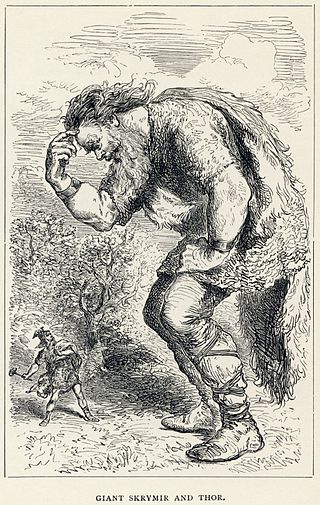
Giant Skrymir and Thor
by Louis Huard.

 Over the years there are number of magic items that have shown up in our various D&D games from Jötunheimr. And is it any wonder that Odin has girt himself & his gods for war because of the forces of Jötunheimr? This brings up the fact that Jötunheimr is a land far closer to Chaos & the very forces of the creation of the multiverse. And this is made clear by Gods, Demigods, & Heroes's take on the giants of  Jötunheimr; "The Giants: As a general rule, giants are among the most magically gifted beings in all Norse mythology. Fire and Frost giants have the ability to change shape, polymorph objects, control weather to a certain extent, use illusions (count 10% as solely illusionists) and use fire and cold respectively. Another interesting characteristic is that these giants are not stupid as legend often informs us that they are. Also, some of them equal the gods for beauty. Listed among the other giants that reside in Jotunheim (Giantland) are Storm giants. Rock giants and Stone giants, though these groups are not as banded together as the Fire or Frost giants are. Giants have class H treasures. If not detailed, giants take 100 Points of Damage and their armor class is 3."
And from 'The OSR Grimoire' Blog comes this little tid bit; "Paul Karlsson Johnstone discusses berserkers in his excellent article "Origins of the Norse Pantheon" in The Dragon #29 (September, 1979)" 

How does this relate to Adventurer, Conqueror, King Rpg and the forces of Chaos?! Well its a bit of a game changer really. Because giant warlords crossing from Jötunheimr into Midgard is a real possibility with vast armies of humanoids & smaller giant kind such as ogres & the like. And its this possibility that would put Odin on the side of Law for the moment. 


Odin's alliance with Law is going to be a shaky one at best & at worst an antagonistic affair with betrayal & double dealing within such a compact. OD&D's Odin is more then likely to seek out mortals aka adventurers to gain a hand over the forces of Law. This means in Adventurer, Conqueror, King rpg terms that's kingdoms & lands might be in the offering. But it also means murder & conquest Odin is after all a god of war & magic. 

This has crossover potential with both Conan's Hyboria supplemental material & Elric's supplemental material within Gods, Demigods, & Heroes. Odin & his gods are the new gods within Conan's sphere representing the newer gods crawling out of Crom's shadow. There is much adventure potential between the old guard of the gods & the newer upstarts in the form of the Norse pantheon. Not to mention the giant  survivors of the sinking of Atlantis. 
Odin & his Norse gods represent the essence of the 'other gods' of legend flicking just out of the candle fire of the Celtic mythologies featured in Corum & Elric's tales by Michael Moorcock. Odin's pact with Law is likely to cause strife & problems between theses forces. Something that the adventurers are likely to get caught in the middle of. 

Sunday, March 8, 2020

Odin A God Of A Different Battle Field - A Different Twist On A Classic Norse God For Your Old School Campaigns

"They came down out of the star-spaces unto this Earth, so that They might deal a grim and heavy judgement upon their former servants; and They went to and fro upon the Earth, terrible in Their wrath, like unto mighty Towers of Flame that walked like Men. Yea and verily was it writ of old, Terrible be the Elder Gods in Their wrath in the Hour of Their coming-hence."

Lin Carter 
 "The Horror in the Gallery" (1976)

We sort of get a set up on the Elder Gods in the Lovecraft circle mythos cycle but very few details. There was a war of incredible scale in which the Great Old Ones were killed, yet through out the eons are still continuing to die & are still dreaming.
According to the H.P. Lovecraft wiki;"The Elder Gods are said to be the former lords of the Great Old Ones. While some have specific appearances, like Nodens, most or them are described as "terrific Towers of Flame". In the Zanthu Tablets, titular Zanthu enrages the Elder Gods when he manages to break one of Ythogtha's chains, thus being able to see them when they descend to Earth. (EXP: "The Thing in the Pit")
They are said to rule in the star Glyu-Vho (Betelgeuse), from which they watch the Earth eternally. (AWDThe Lurker at the Threshold)"
The Elder gods have been given the lovely relationship toward humanity but personally I think its nothing more then a white wash & propaganda treatment by modern writers after the era of Lin Carter; 
"In post-Lovecraft stories, the Elder Gods oppose the likes of Cthulhu and his ilk. Derleth attempted to retroactively group the benevolent deity Nodens in this category (who acts as deus ex machina for the protagonists in both The Dream-Quest of Unknown Kadath and "The Strange High House in the Mist"). With regards to the nature of the Great Old Ones, Joseph S. Pulver mentions in his Nightmare's Disciple (2006) a series of original Elder Gods, though lacking of any description about their true form. The story introduces entities as AdaeduAlithlai-TyyDveahtehsEyroixOvytonvUrthuvnXislanyx and Xuthyos-Sihb’Bz'. Others have a cult title as Othkkartho (Sire of the Four Titans of Balance and Order), which is said to be Nodens's son, and Zehirete, who is The Pure and Holy Womb of LightSk'tai and Eppirfon are both siblings. Eppirfon was originally Cthulhu's second bride who bore him a son, T'ith, now dead, murdered by Cthulhu himself."

Known Elder Gods in the Mythos[edit]

The following is another Elder God with no description: Walter C. DeBill, Jr.'s Paighon, an extra-galactic entity which now dwells in Earth's core, said to be inimical to the Outer God Ngyr-Korath and his servitor 'Ymnar.

Bast[edit]

Bast (Goddess of Cats or Pasht) appears as a female human with a cat's head.

Hypnos[edit]

An ambiguous deity regarded as an Elder God. First appeared in Lovecraft's short story Hypnos

Kthanid[edit]

creation of Brian Lumley, Kthanid looks the same as Cthulhu except for eye colour.

Oryx[edit]

Oryx was introduced without name in August Derleth's "The Lair of the Star-Spawn" (1932). The name Oryx is given in Call of Cthulhu RPG supplement "The Creature Companion" (The Bright Flame) manifests as a giant pillar of blinding white and purple flames. Although its expression is bright and blinding, no one feels its heat. No one can look at Oryx more than a few seconds; after the first glance, the eyes of anyone who looks become sore and watery.

Oztalun[edit]

Oztalun (Golden and Shimmering One) is an Elder God introduced by James Ambuehl. It is symbolized by a seven-pointed star symbol, which is his own Seal.

Nodens[edit]

Nodens ("Lord of the Great Abyss") appears as a human male riding a huge seashell pulled by legendary beasts. In CthulhuTech supplements, Nodens is said to be the avatar of the Forgotten One Savty'ya.

Shavalyoth[edit]

Shavalyoth (Shadowy and Shapeless One) is an Elder God introduced by James Ambuehl, supposed to be dark and formless.

Ulthar[edit]

Ulthar (or Uldar and also Ultharathotep[92]) is a deity sent to Earth to hold vigil over the Great Old Ones.

Vorvadoss[edit]

Vorvadoss* (The Flaming OneLord of the Universal SpacesThe Troubler of the SandsWho Waiteth in the Outer Dark) appears as a cloaked, hooded being, enveloped in green flames, with fiery eyes. He is described as a son of both the Elder God Nodens and the Great Old One Lythalia and has a twin brother, Yaggdytha.[31]

Yad-Thaddag[edit]

Another Brian Lumley deity. Has the same appearance as Yog-Sothoth, except its spheres are of a different color and its nature is purely benevolent.

Yaggdytha[edit]

Yaggdytha ("The Incandescent One") is twin brother of Vorvadoss, manifesting as a great, amorphous, incandescent ball of cyan living energy, spreading itself into a web of giant talons of light."
But I have a completely different theory for my own campaigns. The fact is that the more I dig into Robert E.Howard's Mythos contributions the more I'm convinced that some of the conventional Pagan gods of mankind are among their ranks. This is especially true of the Lovecraft circle fans I know locally.Robert E. Howard's story The Cairn on the Headland" by Robert E. Howard goes into what I think goes into the last incarnation of a rather nasty aspect of Odin; ""We of North Europe had gods and demons before which the pallid mythologies of the South fade to childishness. At a time when your ancestors were lolling on silken cushions among the crumbling marble pillars of a decaying civilization, my ancestors were building their own civilization in hardships and gigantic battles against foes human and inhuman.
"Here on this very plain the Dark Ages came to an end and the light of a new era dawned on the world of hate and anarchy. Here, as even you know, in the year 1014, Brian Boru and his Dalcassian ax wielders broke the power of the heathen Norsemen forever--those grim anarchistic plunderers who had held back the progress of civilization for centuries.
"It was more than a struggle between Gael and Dane for the crown of Ireland. It was a war between the White Christ and Odin, between Christian and pagan. It was the last stand of the heathen--of the people of the old, grim ways. For three hundred years the world had writhed beneath the heel of the Viking, and here on Clontarf that scourge was lifted forever.
"Then, as now, the importance of that battle was underestimated by polite Latin and Latinized writers and historians. The polished sophisticates of the civilized cities of the South were not interested in the battles of barbarians in the remote northwestern corner of the world--a place and peoples of whose very names they were only vaguely aware. They only knew that suddenly the terrible raids of the sea kings ceased to sweep along their coasts, and in another century the wild age of plunder and slaughter had almost been forgotten--all because a rude, half-civilized people who scantily covered their nakedness with wolf hides rose up against the conquerors.
"Here was Ragnarok, the fall of the Gods! Here in very truth Odin fell, for his religion was given its death blow. He was last of all the heathen gods to stand before Christianity, and it looked for a time as if his children might prevail and plunge the world back into darkness and savagery. Before Clontarf, legends say, he often appeared on earth to his worshipers, dimly seen in the smoke of the sacrifices where naked human victims died screaming, or riding the wind-torn clouds, his wild locks flying in the gale, or, appareled like a Norse warrior, dealing thunderous blows in the forefront of nameless battles. But after Clontarf he was seen no more; his worshipers called on him in vain with wild chants and grim sacrifices. They lost faith in him, who had failed them in their wildest hour; his altars crumbled, his priests turned grey and died, and men turned to his conqueror, the White Christ. The reign of blood and iron was forgotten; the age of the red-handed sea kings passed. The rising sun, slowly, dimly, lighted the night of the Dark Ages, and men forgot Odin, who came no more on earth." 


Odin, in his guise as a wanderer, by Georg von Rosen (1886)

Odin is one of the original gods of a completely different order then the later Norse gods;
"The earliest records of the Germanic peoples were recorded by the Romans, and in these works Odin is frequently referred to—via a process known as interpretatio romana (where characteristics perceived to be similar by Romans result in identification of a non-Roman god as a Roman deity)—as the Roman god Mercury. The first clear example of this occurs in the Roman historian Tacitus's late 1st-century work Germania, where, writing about the religion of the Suebi (a confederation of Germanic peoples), he comments that "among the gods Mercury is the one they principally worship. They regard it as a religious duty to offer to him, on fixed days, human as well as other sacrificial victims. Hercules and Mars they appease by animal offerings of the permitted kind" and adds that a portion of the Suebi also venerate "Isis". In this instance, Tacitus refers to the god Odin as "Mercury", Thor as "Hercules", and Týr as "Mars", and the identity of the "Isis" of the Suebi has been debated.[8]
Anthony Birley noted that Odin's apparent identification with Mercury has little to do with Mercury's classical role of being messenger of the gods, but appears to be due to Mercury's role of psychopomp.[8] Other contemporary evidence may also have led to the equation of Odin with Mercury; Odin, like Mercury, may have at this time already been pictured with a staff and hat, may have been considered a trader god, and the two may have been seen as parallel in their roles as wandering deities. But their rankings in their respective religious spheres may have been very different.[9] Also, Tacitus's "among the gods Mercury is the one they principally worship" is an exact quote from Julius Caesar's Commentarii de Bello Gallico (1st century BCE) in which Caesar is referring to the Gauls and not the Germanic peoples. Regarding the Germanic peoples, Caesar states: "[T]hey consider the gods only the ones that they can see, the Sun, Fire and the Moon", which scholars reject as clearly mistaken, regardless of what may have led to the statement.[8]
Although the English kingdoms were converted as a result of Christianization of the Germanic peoples by the 7th century, Odin is frequently listed as a founding figure among the Old English royalty.[10] He is also either directly or indirectly mentioned a few times in the surviving Old English poetic corpus, including the Nine Herbs Charm and likely also the Old English rune poem. Odin may also be referenced in the riddle Solomon and Saturn. In the Nine Herbs Charm, Odin is said to have slain a wyrm (serpent, European dragon) by way of nine "glory twigs". Preserved from an 11th-century manuscript, the poem is, according to Bill Griffiths, "one of the most enigmatic of Old English texts". The section that mentions Odin is as follows:
+ wyrm com snican, toslat he nan,
ða genam woden VIIII wuldortanas,
sloh ða þa næddran þæt heo on VIIII tofleah
Þær gaændade æppel and attor
þæt heo næfre ne wolde on hus bugan.[11]
A serpent came crawling (but) it destroyed no one
when Woden took nine twigs of glory,
(and) then struck the adder so that it flew into nine (pieces).
There archived apple and poison
that it never would re-enter the house.[11]
—Bill Griffiths translation
The emendation of nan to 'man' has been proposed. The next stanza comments on the creation of the herbs chervil and fennel while hanging in heaven by the 'wise lord' (witig drihten) and before sending them down among mankind. Regarding this, Griffith comments that "In a Christian context 'hanging in heaven' would refer to the crucifixion; but (remembering that Woden was mentioned a few lines previously) there is also a parallel, perhaps a better one, with Odin, as his crucifixion was associated with learning."[11] The Old English gnomic poem Maxims I also mentions Odin by name in the (alliterative) phrase Woden worhte weos, ('Woden made idols'), in which he is contrasted with and denounced against the Christian God."


Odin: Armor Class: 2 Magic Spell Ability: (See below) Move: 12* Fighter Ability: 18th Level Hit Points: 300 Psionic Ability: Class 1 Odin is supreme among this class of Gods and has many special abilities or innate powers because of his standing. Among them are: 1. The ability to shape change into any animal (normal sized) or to become dragon or humanoid in appearance. 2. Being also the God of full understanding and knowledge. Odin knows of all intentions for or against him and can weed out truths by use of natural E.S.P. and telepathy powers. Range of both powers is 240". 3. He may use any or all spells of magical and clerical nature. Clerical spells, though, conform mainly to Law, and Odin may not use any Raise Dead spells. 4. Odin inspires berserker rage in all of those whom he desires near him. Persons within a 20' radius gain 4 levels fighting capability for as many full turns as their level, (i.e., A second level fighter would become a sixth level for two turns)


In the far future of Astonishing Swordsmen & Sorcerers of Hyperborea  Odin & the gods take the battlefield of Ragnarok. But these are not your traditional gods for if Odin is an Elder God. Then what are the other Pagan gods of Hyperborea? A number of AS&SH dungeon masters have been using the so called powerful & utterly alien  transmundane race as candidates for various Pagan & heathen gods; 
"The transmundane are members of a powerful and enigmatic race whose place of origin is unknown, but which certainly lies beyond Hyperborea. A transmundane looks much like a six- to seven-foottall handsome man or woman, typically clad in the dress and hairstyle of classical Greece and bearing an Hellenic name such as Hypnos or Kressida. The flesh, clothing, and hair of these beings are shades of gold and silver, making the transmundane look not unlike animated statues, or perhaps cunning automata; appearances notwithstanding, they do seem to be living creatures. Their voices are high and melodious, and they are surrounded by a pleasing scent of exotic blossoms, but their personalities are most haughty and imperious. "

Odin sacrificing himself upon Yggdrasil as depicted by Lorenz Frølich, 1895
If Odin & the other Norse pantheon gods died in the events of Ragnarok. Then does it stand to reason that in some quarters of Hyperborea that the  
powerful & utterly alien  transmundane race passes themselves of as the Norse pantheon?! The utterly alien  transmundane race is virtually immortal. And there is reason to believe they have connections to the Elder Gods. These beings are incredibly alien, extremely long lived, & have had interaction with mankind for eons. The can & have in the past masqueraded as gods when & where it suited their agendas. Agendas that don't always have the best intentions of mankind within  their machinations.
So what does 'Odin' then intend for mankind on the shores of alien Hyperborea?


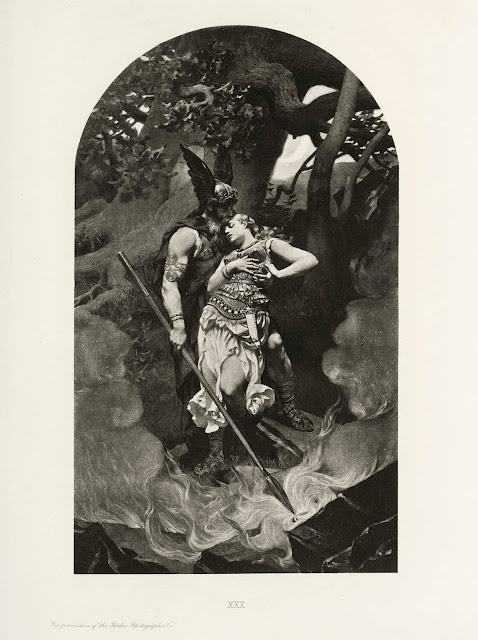
Wotan takes leave of Brunhild (1892) by Konrad Dielitz

Make no mistake then the famous couplet by H.P. Lovecraft did not simply apply to the Great Old Ones. It was a indeed a very far reaching bit occult dross that touched many aspects of the Mythos.

“That is not dead which can eternal lie,
And with strange aeons even death may die.”


― Howard Phillips Lovecraft, The Nameless City