Showing posts with label Wizards. Show all posts

Friday, June 12, 2026

The villainous Gemini from Thundarr the Barbarian For Sword of Cepheus 2nd Edition

 Bringing the 80s Saturday-morning post-apocalyptic swagger of Thundarr the Barbarian into the gritty, OSR-style mechanics of Sword of Cepheus 2nd Edition is an awesome cross-genre mix.


Gemini is the ultimate Thundarr antagonist: an evil, ancient-tech-wielding cyborg sorcerer with a literal split-personality. His head rotates 180° beneath his visor to switch between a short-tempered, aggressive tactical persona and a cold, calculating, diplomatic side.

Here is how you can stat and run Gemini as a major planetary warlord or cosmic threat using the Sword of Cepheus system.

Gemini — Cyber-Sorcerer Warlord


Gemini functions beautifully as a high-tier Sorcerer boss who balances brutal raw physical power with high-tech Sorcery (which, in a Thundarr setting, is a mix of genuine magic and hyper-advanced pre-collapse tech).

Attributes & Basic Stats

  • STR: 11 (+1)

  • DEX: 9 (+0)

  • END: 13 (+2)

  • INT: 10 (+0)

  • EDU: 9 (+0)

  • SOC: 12 (+2) — Warlord/Sorcerer-King status

  • Stamina: 25

  • Lifeblood: 13

  • Armor: 8 (Heavy Cybernetic Powered Frame / Visor)

Skills

  • Sorcery-4

  • Combat (Unarmed)-2

  • Leadership-2

  • Tactics-2

  • Deception-2

  • Vehicles (Grav/Flying)-1

Dual-Persona Mechanics (The Two Faces)

Gemini’s most famous feature is his rotating head. In Sword of Cepheus, this acts as a unique tactical shift. At the start of any round, Gemini can spend a minor action to rotate his head, immediately switching his active combat profile.

Face ModeTactical Effects

Aggressive Face


(Furious & Short-tempered)

Gemini gains +2 to all Melee Damage rolls and becomes immune to morale checks or psychological manipulation. However, he suffers a -1 penalty to Sorcery checks as anger clouds his focus.

Calm Face


(Diplomatic & Cold)

Gemini gains +1 to all Sorcery checks and +2 to Deception/Leadership tasks. He prefers to let his minions fight while he channels devastating energy attacks or plots a strategic escape.

Special Powers & Cyber-Sorcery

Because Sword of Cepheus models magic through distinct spells, Gemini's cartoon abilities translate directly into potent Sorcery effects. He uses INT as his casting characteristic.

  • Beam-Eyes (Energy Blast): Gemini can fire destructive red laser beams from his eyes.

    • Mechanic: Range 30m, Damage 3d6, uses Sorcery skill to attack.

  • Immobilization Beam: A crimson tractor-like beam that freezes targets in place.

    • Mechanic: Target must succeed on an END check (Difficulty: 10) or be paralyzed for 1d6 rounds. Gemini must maintain concentration to keep them pinned.

  • Sorcerous Barrier: A blazing wall of blue magical flame.

    • Mechanic: Creates a physical barrier blocking movement and ranged attacks. Anyone attempting to cross takes 2d6 energy damage.

  • Flight (Thundercloud): Gemini can manifest a dark cloud to hover and fly at speeds up to 60 km/h.

Arsenal & Forces

Gemini rarely fights alone. He rules from a high-tech fortress on stilts in the swamps near the ruins of "Manhat" (New York), commanding an army of mutants and robots.

  • The Groundlings: Rat-like mutant underlings. Give them Combat (Slug Throwers)-1 or Combat (Melee)-1, and equip them with scavenged pre-collapse motorcycles and Beam-Clubs (treat as maces with an extra +1d6 energy damage).

  • Robotic Knights: Gemini's elite mechanical shock troops. They have Armor 6, Stamina 15, are immune to mind-altering magic, and carry metallic energy weapons or pilot pre-collapse attack helicopters.

GM Running Tip: Play up the cartoon villainy! Gemini is arrogant, cruel, and cannot tolerate failure from his Groundlings. If a player manages to damage or Jam his helmet visor, a Hard (-2) Athletics or Combat check can force his head to lock halfway between rotations—leaving him completely disoriented and unable to use his face abilities for 1d3 rounds!

Here are the full Sword of Cepheus 2nd Edition NPC stat blocks for Gemini's Robotic Knights and his rat-like mutant underlings, The Groundlings.

Both are designed to scale smoothly inside a classic Thundarr-inspired science-fantasy sandbox.

1. Robotic Knights (Elite Shock Troops)

These mechanical enforcers are the backbone of Gemini's heavy terror operations. They look like towering, blank-faced medieval knights forged from polished chrome and black polymer, completely silent until they strike.

Unlike the bumbling Groundlings, the Robotic Knights are cold, relentless, and tactically precise.

Attributes & Basic Stats

  • STR: 12 (+2)

  • DEX: 8 (+0)

  • END: 12 (+2)

  • INT: 8 (+0) (Advanced Combat Logic AI)

  • EDU: 0 (-3)

  • SOC: 0 (-3)

  • Stamina: 16

  • Lifeblood: 12

  • Armor: 6 (Integrated Heavy Plasteel Chassis)

Skills

  • Combat (Energy Weapons)-2

  • Combat (Heavy Blades)-1

  • Athletics-1

  • Recon-1

Traits & Abilities

  • Construct: Robotic Knights are entirely mechanical. They are completely immune to poison, disease, suffocation, vacuum, and mind-altering magic or illusions. They cannot heal naturally and must be repaired using the Repair skill.

  • Internal Targeting: When using built-in or synced energy weapons, they ignore the first -1 penalty from range or concealment.

Equipment & Attacks

  • Heavy Laser Rifle: Range 150m, Damage 4d6, Magazine: Internal power pack (20 shots).

  • Vibro-Broadsword: Damage 3d6+2 (ignores 2 points of physical armor).

  • Built-in Comms: Linked directly to Gemini's fortress mainframe.

2. The Groundlings (Mutant Foot Soldiers)

The Groundlings are craven, rat-faced beastmen who worship Gemini out of sheer terror. They are numerous, loud, poorly disciplined, and survive entirely on scavenged pre-collapse scrap.

They are best used in large packs to overwhelm the party's frontline or ambush them on motorized skiffs.

Attributes & Basic Stats

  • STR: 8 (+0)

  • DEX: 10 (+0)

  • END: 9 (+0)

  • INT: 6 (-1)

  • EDU: 4 (-1)

  • SOC: 2 (-2)

  • Stamina: 8

  • Lifeblood: 9

  • Armor: 2 (Scavenged tire-tread leather and scrap metal plates)

Skills

  • Combat (Slug Throwers)-1

  • Combat (Unarmed)-1

  • Survival-1

  • Stealth-1

  • Vehicles (Grav/Ground)-1

Traits & Abilities

  • Pack Tactics: Groundlings are cowards alone but vicious in numbers. They gain a +1 bonus to hit in melee for every other Groundling adjacent to their target (maximum +3).

  • Craven Morale: If their pack drops to half its original numbers, or if a Robotic Knight supervisor is destroyed, the remaining Groundlings must pass an Average (+0) END or INT check or immediately flee, surrender, or scatter into the ruins.

Equipment & Attacks

  • Scavenged Autopistol: Range 25m, Damage 2d6+2.

  • Spiked Club / Scrap Cleaver: Damage 2d6.

  • Scavenged Junk-Cycle: Rough terrain motorcycle used for desert or ruin patrols.

Encounter Design Tip: A standard Gemini strike team consists of one Robotic Knight acting as a cold, unyielding commander over a squad of 4–6 Groundlings. The Knight will ruthlessly coordinate the fire of the Groundlings, using them as a meat-shield while keeping its heavy laser rifle trained on the party's heavy hitters or sorcerers. 

Wednesday, March 22, 2023

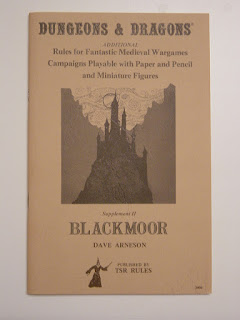
Original Dungeons & Dragons Blackmoor, Gamma World First Edition & the Temple of the Frog

Yesterday was an extremely busy day but there was time enough to look deeper into 1975's Blackmoor supplement. While product designation TSR 2004 is usually known for temple of the Frog. Actually original Dungeons & Dragon Blackmoor actually has several other uses. 
Deep within Blackmoor according to the wiki entry is an entire section on underwater adventures;"The supplement introduced rules for underwater adventures, such as rules and guidelines for swimming, equipment weight restrictions when fighting underwater, and the effects of underwater combat on weapons and spells. Blackmoor also includes numerous new water-dwelling monsters and equipment useful for underwater adventures. A number of these underwater monsters and magic items were the creations of Steve Marsh
And while this does complement Blackmoor's Temple of the Frog it also comes in incredibly handy for those who want to run first edition Gamma World's GW1 Legion of Gold's underwater adventure section on the Legion itself. 

Blackmoor also hits the high notes for Gamma World first edition by providing the rules framework for further underworld adventures. This is a fact that has not been lost upon me. 


Speaking with my players yesterday there was talk about the fact that Temple of the Frog itself could be switched over to Gamma Terra & no one would be the wiser. The Froggies, the advanced technologies, and more are all reflective of the dangers present within the radioactive wasteslands of Gamma World. And what about an NPC assassin straight out of the bowels of Blackmoor that could well be a Red Death operative or agent. Stepthen The Rock could easily be slipped into Gamma Terra and few if anyone would be the wiser that the Temple of the Frog fits easily into the wastelands of Gamma World. 

Thursday, March 16, 2023

The Dungeon As Battle Front Within Original Dungeons & Dragons

 It's one of those mornings where the original Dungeons & Dragons books find thier way into my hands once again. And the pages feel as crisp as they did when we played our first game of original Dungeons & Dragons. Monsters & Treasures is one of those books that really hits home for me as a DM. 


Why?! Because it Monsters & Treasures does two things. One it intoduces so many iconic D&D monsters to the fore of the dungeon & two it brings home the importance of the treasures in original Dungeons & Dragons. Gnolls, Orcs, Goblins all come into the light of the party of adventurers purview. And Tim Waddell in his review of OD&D from Space Gamer issue #2 hits the nail on the head from the Original Dungeons & Dragons wiki entry:"Tim Waddell reviewed the original Dungeons & Dragons in The Space Gamer #2.[7] Waddell commented that "The most stimulating part of the game is the fact that anything can happen. Nothing is impossible."[7] Andy Pudewa also reviewed the original Dungeons & Dragons in The Space Gamer #2.[8] Pudewa said that "As a game, D&D is a fantastical outlet for the imagination. It has the quality of being infinitely flexible, and with it comes the reality of impossibility. [...] There are drawbacks to the game however; as there are in any game. D&D cannot even begin to get interesting in less than 20 hours playing time. Hundreds of hours of work must be done ahead of time by the referee, and it takes a fairly long time to prepare on the part of the players."
And Monsters & Treasures goes hand in hand with the Swords & Spells supplement. And it's really Chainmail second edition. Don't believe me? Check out 
Clark Timmins Rpg Geek's article 'A Wargame Disguised as an Rpg" here.  And the article makes
an excellent point about original Dungeons & Dragons Swords & Spells supplement:"
What does any of this have to do with roleplaying? Not much. There are some ties back to Dungeons & Dragons, but some are cosmetic - and most are because Dungeons & Dragons itself ties back to Chainmail. No need to explain what kobolds, lizard men, or gnolls are - that's been covered in the previous little booklets. Here, though, we learn that kobolds can only group in Unorganized, Mass, or Column Mass formations. While dwarves can form into Line or Echeloned Line they can't form into Column. And we have a spell list that's suspiciously similar to the Dungeons & Dragons list - only the Dungeons & Dragons effects are here replaced by (similar) mass unit combat effects. The same with saving throws - the same types of throws are reproduced, but with different values to accommodate scale miniatures."

Further the article goes into armor class's wargaming OD&D roots;"What's really interesting is how much of Dungeons & Dragons (Original Edition) "matches" these miniatures rules because, well, Dungeons & Dragons (Original Edition) came from a previous set of similar miniatures rules. So the terms "movement in inches" and the "area of effect" come literally from using a ruler to measure inches of distance on the tabletop. Armor class is a derived phrase from scale miniature unit stands where each was assigned a class of unit armor. Instead of using Dungeons & Dragons's dice of damage for an attack (a random number that averaged over time) here we actually use the "Average Damage Matrix" to figure the damage delivered from one mass unit (representing usually 10 individuals) to another mass unit. The "Level" of character types or the "Hit Dice" of monster types here are translated into, essentially, training and combat proficiency. "Level 0" means an untrained levy while the mid levels/hit dice (2 - abt. 6) represent trained combatants in like ranks." 
There's a consistancy to Original Dungeons & Dragon's shift into it's wargaming roots & mode. A consistancy that has been lost on many folks. And this further ties into the modular nature of "Underworld & Wilderness Adventures" Because original Dungeons & Dragons could shift the wargaming nature into the dungeon itself. Original Dungeons & Dragons literally did have the means & end to have the battles taking place within the mega dungeon itself as another front for the wargmer/OD&D dungeon master. 
And this ties back into a blog post I wrote about the fighter class in original Dungeons & Dragons back in Feb of 2019 here. 

Monday, February 11, 2019

Blood Soaked Fields - Fighters, Wizards, & The Path of Tears In Old School Campaigns

Fighters are not simply meat & violence shields in dungeons. I can't stress this enough. Fighters given the whole range of  original Dungeons & Dragons options have a wide variety of roles within the grand game. When Greyhawk was published for original Dungeons & Dragons it changed well everything!


Doing a bit of research last night on the Rpgeek site last night I came across this entry which really crystalized the importance of Greyhawk for me; "In 1974, Dungeons & Dragons (oD&D) was first printed. It came with three booklets: "Men & Magic", "Monsters & Treasure" and "The Underworld and Wilderness Adventures". The combat rules were based on the miniatures game Chainmail (which you needed to play), but an optional set of combat rules were given which more people ended up playing. Alignment was Lawful, Neutral or Chaotic. There were three classes "Fighting Man", "Cleric" and "Magic-User", and four races: "Human", "Dwarf", "Elf" and "Halfling". The rules for elves - who could be both Fighters and Magic-Users - were terribly unclear.


For 1975-8, five supplements were released for oD&D. The most important of those, Supplement I: Greyhawk, changed the game around a lot. Ability Scores became a lot more important, damage and hit dice became diverse, and it added a lot of other material (like the Thief character class)."

This changed everything at the table top level for original Dungeons & Dragons especially fighters who were supposed to portray the grand heroes of myth, legend, & literature.


Flash forward to the publication of The Dragon magazine issue #2 ; ARTICLES: Monkish Combat in the Arena of Promotion (D&D); Gnome Cache, ch. 2 (fiction); Gen Con IX Update; Hints for D&D Judges - Part 3: The Dungeons; Shadow of a Demon (Niall fiction) by Gardner F. Fox; Feathered Serpent (Quetzalcoatl); Creature Features - The Remorhaz; D&D Character Class - The Alchemist; D&D Option - Weapon Damage; more.
August 1976 ... 31 pages
Notice the article D&D option - Weapon Damage, this article brings the fighter into the world of heroes. By heroes I mean those broke & down out individuals who could become heroes if they were given the opportunity. After a while on the path of the stoic warrior they become something much more.


Information & article break down from 'The Dragon magazine from Wayne's Books. 


These aren't simply your run of the mill adventurers these are men & women whose minds & bodies have been forged in the fires of war of the most unusual & dangerous types. This thread on Rpg net bares this out with all of the options being used for the fighter PC class ;
"Fighters were always immune to Fear, etc. starting at 4th level, we always used multi-attack options and/or granted scaling damage, always granted morale bonuses to associated men-at-arms, etc. A high level fighter would always generate morale checks for a bunch of lower level monsters/NPCs, though I tended to grant it more organically than just starting it at 8th level.

The only one I don't recall was explicitly granting the detection of invisibility at higher level. OTOH, we always accepted that a fighter at that level has superhuman sense in general."


Excellent uses of these abilities can be found in a myriad of sources but an excellent example of exactly the sort of abilities possessed by the fighter can be found in The Master Mind of Mars by Edgar Rice Burroughs


Free download of 

Amazing Stories Annual v01n01 (1927) available here 


Once Ulysses Paxton is on Barsoom then the mad scientist wizard uses him as a body guard, assistant, & full on confident in all of his super science endeavours. In fact whist all of his is going on Paxton is assembling his own party from the stores of bodies within the  elderly mad scientist Ras Thavas's ranks. Everything about how the fighter goes about is calculated & his expertly handled. In fact this is where Paxton begins to split his class with levels in the mad scientist/ wizard class; 
'Days ran into weeks, weeks into months, as day by day I labored at the side of Ras Thavas, and more and more the old surgeon took me into his confidence, more and more he imparted to me the secrets of his skill and his profession.
Gradually he permitted me to perform more and more important functions in the actual practice of his vast laboratory. I started transferring limbs from one subject to another, then internal organs of the digestive tract. Then he entrusted to me a complete operation upon a paying client I removed the kidneys from a rich old man, replacing them with healthy ones from a young subject The following day I gave a stunted child new thyroid glands. A week later I transferred two hearts and then, at last, came the great day for me--unassisted, with Ras Thavas standing silently beside me, I took the brain of an old man and transplanted it within the cranium of a youth.'
Paxton has many of the finer qualities of the fighter. He knows how to plan, use the resources at his disposal, can carry out a complex plan, & still fight his way out of a situation. Fighters are both the knives & shields of adventuring parties capable of setting up a defense in a dungeon or hunting down in the depths of the lowest ruins. Indeed the treasures & relics of a dungeon seem to call to fighters & yet seek to destroy them. The treasure of the dragon in Beowulf a solid example of this. 

Fighters are literally able to make or break a party of adventurers. When coupled with other party members if the player's party balance is correct then we a very successful campaign. A great example of an Original Dungeons & Dragons fighter who has made it to epic levels from mythology is Beowulf. All of the instincts & abilities are there in the character. 

"Now he belched forth flaming fire."
An illustration of Beowulf fighting the dragon that appears at the end of the epic poem.
  • Marshall, Henrietta Elizabeth (

Sunday, February 10, 2019

Thieves, Treasures, Relics, & The Prices of Power In Old School Campaigns

Let's talk about thieves in original Dungeons & Dragons & why their so damn important. No its not the dreaded back stab ability but that is a key point to the character class. Thieves were introduced in the original Dungeons & Dragons supplement Greyhawk back in 1975.


Now according to the 'Rogue' entry on Wiki (by the way I hate the term rogue) the thief class came about from the following; 'D&D fan Gary Switzer shared the idea for a thief class with Gary Gygax over the phone;[4] development was done in Switzer's roleplaying group, primarily by D. Daniel Wagner, one of the writers of the Manual of Aurania, the first non-TSR D&D supplement.[5] The thief class was introduced in the original 1975 Greyhawk supplement. They had 4-sided hit diceunder the new combat system introduced in that supplement'.
That's just charming but if we look at the creative origins according to this same entry we find some very Appendix 'N' details; '
The abilities of the thief class were drawn from various archetypes from history and myth, but clear debts from modern fantasy literature can be traced to characters such as J.R.R. Tolkien's Bilbo Baggins, Fritz Leiber's The Gray Mouser, and Jack Vance's Cugel the Clever.[2]

In his article "Jack Vance and the D&D Game", Gary Gygax stresses the influence that Vance's Cugel and also Zelazny's Shadowjack had on the thief class.' Yeah that figures but I'm not one to simply stick with the usual word of mouth D&D historical dogma. Thieves are far more useful & desperation motivates the life of an adventurer. This includes the search for coin & the ability to live for more then three or four days at a time. Given Ernie Gygax's fascination nay obsession with Jack Vance I'd say that there's more then a little bit of Jack Vance's Shadow Jack in the mix of our D&D thieves. But given my Sword & Sorcery obsession I turn back to two very interesting sources. Source one is Clark Ashton Smith's "The Tale of Satampra Zeiros" part of his Hyperborea cycle. Now this story is important for two reasons. Reason one is the fact that we've got a band of cut throat thieves closing in one what they think is the relics of an abandoned temple complex. This temple is far from abandoned. The second aspect of this story that's important is what they plan on doing with any relics they come across.


An amazing piece of artwork by SANTIAGO CARUSO that illustrates the scene from the classic story of Clark Ashton Smith's story "The Tale of Satampra Zeiros".


Not only does this story have the classic dungeon crawl aspects but it also illustrates quite nicely the supply & demand chain that thieves & wizards have. The path of power is one that demands the services of all kinds of player classes. But it also up points the unexpected circumstances that thieves travel in all of the time.  This is the over lap that thieves & wizards have. The low level boots on the ground gritty aspect of the underworld life of the adventurer.  The shear circumstances of survival & guts that it takes to be a thief in the world of Dungeons & Dragons. 
Robert Howard's Conan illustrates this really well in his story. 'The Phoenix in The Sword'. In this story written by written by American author Robert E. Howard, and first published in Weird Tales magazine, in December, 1932. We get the gist of the thief in glorious Sword & Sorcery stereo; Over shadowy spires and gleaming towers lay the ghostly darkness and silence that runs before dawn. Into a dim alley, one of a veritable labyrinth of mysterious winding ways, four masked figures came hurriedly from a door which a dusky hand furtively opened. They spoke not but went swiftly into the gloom, cloaks wrapped closely about them; as silently as the ghosts of murdered men they disappeared in the darkness. Behind them a sardonic countenance was framed in the partly opened door; a pair of evil eyes glittered malevolently in the gloom.
"Go into the night, creatures of the night," a voice mocked. "Oh, fools, your doom hounds your heels like a blind dog, and you know it not."
The speaker closed the door and bolted it, then turned and went up the corridor, candle in hand. He was a somber giant, whose dusky skin revealed his Stygian blood. He came into an inner chamber, where a tall, lean man in worn velvet lounged like a great lazy cat on a silken couch, sipping wine from a huge golden goblet.
"Well, Ascalante," said the Stygian, setting down the candle, "your dupes have slunk into the streets like rats from their burrows. You work with strange tools."
"Tools?" replied Ascalante. "Why, they consider me that. For months now, ever since the Rebel Four summoned me from the southern desert, I have been living in the very heart of my enemies, hiding by day in this obscure house, skulking through dark alleys and darker corridors at night. And I have accomplished what those rebellious nobles could not. Working through them, and through other agents, many of whom have never seen my face, I have honeycombed the empire with sedition and unrest. In short I, working in the shadows, have paved the downfall of the king who sits throned in the sun. By Mitra, I was a statesman before I was an outlaw."
"And these dupes who deem themselves your masters?"
"They will continue to think that I serve them, until our present task is completed. Who are they to match wits with Ascalante? Volmana, the dwarfish count of Karaban; Gromel, the giant commander of the Black Legion; Dion, the fat baron of Attalus; Rinaldo, the hare-brained minstrel. I am the force which has welded together the steel in each, and by the clay in each, I will crush them when the time comes. But that lies in the future; tonight the king dies."

Its this classic Conan the treasure supply chain that seems fueled by both desperate circumstances & that powerful need for both gold & bill paying . So the motive for Conan's drive is to merely lead to a path where the power follows the gold. Thieves however are the perfect foils for during adventures for wizards. The wizard's thirst for relics & hunger for forbidden knowledge drives the party of adventurers ever onward. 


Frank Frazetta's Conan is one of the more iconic & endearing portraits of the warrior & thief that is the barbarian king.

Its this quest for gold & glory that drives these games of blood & dust ever onward. The fact that in 2019 we're still talking about it is a testament to the hold that the power of these pop culture myths have on us as players. Thieves guilds in Dungeons & Dragons owe Jack Vance's Dying Earth series big time. The fact that they exist suggests no demands that dungeon masters pay attention to the fundamentals of the concept of the thieves guild. They are intricately & elegantly connected with the path of power of wizards or what we as players refer to as the PC classes's level.
Thieves are found throughout fantasy literature & their almost always connected with wizards in one way or another. Why?! Because wizards are clients to thieves for many of the books, illicit spell components, pieces of knowledge, relics, & even the occasional monster. 


Cassim in the cave by Maxfield Parrish (1909)

Take for example the legend of Ali Baba ; ' Ali Baba (Arabicعلي بابا‎ ʿAlī Bābā ) is a character from the folk tale Ali Baba and the Forty Thieves (علي بابا والأربعون لصا). This story is included in many versions of the One Thousand and One Nights, which it was added to in the 18th century by Antoine Galland, who heard the story from a Syrian storyteller, Hanna Diyab. It is one of the most familiar of the "Arabian Nights" tales, and has been widely retold and performed in many media, especially for children, where the more violent aspects of the story are often suppressed."I'm not talking about the kids version here. So throw out the Alladin & Disneyfied drek here.Ali Baba itself from  One Thousand and One Nights, has many of the classic elements of Dungeons & Dragons. This includes the thieves using magic, the thieves cant language including secret symbols & words along with the title character better himself through some very clever trickery worth of any D&D thief. Hell the character of Morgiana, the slave girl could be a bard & sword dancer PC straight out of the  Adventurer, Conqueror, King rpg. 


Our Christmas box, Griffith, Farran, Okeden & Welsh (Publisher), 1891
So what does all of this have to do with wizards? Well everything really. Because looking at the treasure from Ali Baba from  One Thousand and One Nights, we get a clear understanding that the thieves took over an ancient magic site that was left in the area. This site was probably left by some ancient Pre Flood or first ice age race.  Thieves are opportunists & they'll use what is at hand. This is something that we see Conan's thieves & cut throats do as well there is a derth of these sites that have been passed from father to son; 
'"Know, oh prince, that between the years when the oceans drank Atlantis and the gleaming cities, and the years of the rise of the Sons of Aryas, there was an Age undreamed of, when shining kingdoms lay spread across the world like blue mantles beneath the stars — Nemedia, Ophir, Brythunia, Hyperborea, Zamora with its dark-haired women and towers of spider-haunted mystery, Zingara with its chivalry, Koth that bordered on the pastoral lands of Shem, Stygia with its shadow-guarded tombs, Hyrkania whose riders wore steel and silk and gold. But the proudest kingdom of the world was Aquilonia, reigning supreme in the dreaming west. Hither came Conan, the Cimmerian, black-haired, sullen-eyed, sword in hand, a thief, a reaver, a slayer, with gigantic melancholies and gigantic mirth, to tread the jeweled thrones of the Earth under his sandalled feet."
— The Nemedian Chronicles'

by Robert Ervin Howard

Thieves guilds can also be family businesses & again this is something that we see in a wide variety of both Appendix N sources & even older ones. Treasures & relics seem to have an aura of power & tragedy about them. This is evident at the fate of the guild of the forty thieves & several of Conan's poor cohorts over the stories. But many of these remains of a by gone age pass on & into the hands of wizards. Wizards often seem to collect many different treasures from bygone days. Many of these relics are dangerous often handed over to wizards for safe keeping. In modern terms Dr. Strange had many relics of power that turned on him later in the series as the writers often used them to convey the supernatural dangers that Strange faced. Many a time was it that I wondered how some of those items had come into his possession.


Wizards seem to be prime motivating force for adventurers into dungeons but their not the only ones. As we shall see next time. 


Dusk on the sea; the fading twilight shifts'
The night wind bears the ocean's whisper dim—
Wind, on your bosom many a phantom drifts—
A silver star climbs up the blue world rim.
Wind, make the green leaves dance above me here
And idly swing my silken hammock—so;
Now, on that glimmering molten silver mere
Send the long ripples wavering to and fro.
And let your moon-white tresses touch my face
And let me know your slim-armed, cool embrace
While to my dreamy soul you whisper low.

Dream—aye, I've dreamed since last night left her tower
And now again she comes on star-soled feet.
Welcome, old friend; here in this rose-gemmed bower
I've drowsed away your Sultan's golden heat.
Here in my hammock, Time I've dreamed away
For I have but to stretch a hand out, lo,
I'm treading langurous shores of Yesterday,
Moon-silvered deserts or the star-weird snow;
I float o'er seas where ships are purple shells,
I hear the tinkle of the camel bells
That waft down Cairo's streets when dawn winds blow.

South Seas! I watch when dusky twilight comes
Making vague gods of ancient, sea-set trees.
The world path beckons—loud the mystic drums—
Here at my hand the magic golden keys
That fit the doors of Romance, Wonder, strange
Dim gossamer adventures; seas and stars.
Why, I have roamed the far Moon Mountain range
When sunset minted gold in shimmering bars.
All eager eyed I've sailed from ports of Spain
And watched the flashing topaz of the Main
When dawn was flinging witch fire on the spars.

I am content in dreams to roam my fill
The vagrant, drifting sport of wind and tide,
Slave of the greater freedom, venture's thrill;
Here every magic ship on which I ride.
Gold, green, blue, red, a priceless treasure trove,
More wealth than ever pirate dared to dream.
My hammock swings—about the world I rove.
The sunset's dusk, the dawning's glide and gleam,
Moon-dappled leaves are murmuring in the wind
Which whispers tales. Lo, Tyre is just behind,
Through seas of dawn I sail, Romance abeam.
Adventurer  (1926)