Showing posts with label G1 Steading of the Hill Giant Chief. Show all posts

Friday, July 21, 2023

OSR Commentary - Lands of the Jotunn & G1 Steading of the Hill Giant Chief By Gary Gygax (1978)

 " Giants have been raiding the lands of men in large bands, with giants of different sorts in these marauding groups. Death and destruction have been laid heavily upon every place these monsters have visited. A party of the bravest and most powerful adventurers has been assembled and given the charge to punish the miscreant giants"


I've been thinking heavily about G1 Steading of the Hill Giant Chief  By Gary Gygax (1978) & looking into how this style of tourament module could be used in a Pulp style game & before you head off give me a chance. Since these are a part of the classic Against the Giants series of modules by Gary Gygax let's get a little insight;"Against the Giants is an adventure module written by Gary Gygax and published by TSR in 1981 for the Dungeons & Dragons fantasy role-playing game." G1 Steading of the Hill Giant Chief  By Gary Gygax  takes place within Jotunn in Greyhawk & if that location was rifted into the modern world then events get very horrific & dangerous. Now I was reading through Dungeon of Sighs review of G1-3 Against the Giants from 2017. I was struck by the following; "he Hill Giant steading is a balance between two common stock communities - the barbarian ‘meadhall’ and the cannibal ‘hillbilly’ clan compound.  One can easily push it in either direction, depending on how one sees Hill Giants.  Certainly the Hill Giant of the 5th edition (and perhaps the Monster Manual) is driven by gluttony and seems like something out of “The Hills Have Eyes” more than a Fomorian of Celtic myth.  This second idea, Hill Giants as oversized classical celtic with monstrous table manners is closer to the 1978 G1.  Giants cover everything in furs and love decorative jewelry, living in a hall as an extended clan, the warrior elite lording over their captives and servants.  The little art in G1 straddles these two conceptions as well, with giants clad in furs, or sometimes dressed in 19th century looking prairie dresses and depending on one’s campaign going in either direction could be very fun. " 

Now let's say that lands of the Jotunn plannarly merged with modern day England & that's when the real trouble starts. In Norse mythology this place is literally the land of giants, trolls, and other Dungeons & Dragons humanoids. For some reason H.G. Wells Food of the Gods stuck with me here & the idea that the Hill Giants might be feeding some of the locals on their own food or Eitr. Yeah this is right outta of the Bob Something Godbound/Scion: Titanspawns play book. The hill giants have been turning the locals into cannon fodder, slaves,etc.
Now this isn't the first time I've thought about doing this & for a Godbound/Dungeons & Dragons campaign this isn't a bad way to go. Scientists who are studying the food of the gods or Ambrosia are extremely dangerous circumstances. The food of the gods comes from Greco/Roman mythology; "Ambrosia is very closely related to the gods' other form of sustenance, nectar. The two terms may not have originally been distinguished;[6] though in Homer's poems nectar is usually the drink and ambrosia the food of the gods; it was with ambrosia Hera "cleansed all defilement from her lovely flesh",[7] and with ambrosia Athena prepared Penelope in her sleep,[8] so that when she appeared for the final time before her suitors, the effects of years had been stripped away, and they were inflamed with passion at the sight of her. On the other hand, in Alcman,[9] nectar is the food, and in Sappho[10] and Anaxandrides, ambrosia is the drink.[11] A character in Aristophanes' Knights says, "I dreamed the goddess poured ambrosia over your head—out of a ladle." Both descriptions could be correct, as ambrosia could be a liquid considered a food (such as honey).

The consumption of ambrosia was typically reserved for divine beings. Upon his assumption into immortality on Olympus, Heracles is given ambrosia by Athena, while the hero Tydeus is denied the same thing when the goddess discovers him eating human brains. In one version of the myth of Tantalus, part of Tantalus' crime is that after tasting ambrosia himself, he attempts to steal some away to give to other mortals.[12] Those who consume ambrosia typically had not blood in their veins, but ichor the blood of immortals.[13]
Both nectar and ambrosia are fragrant, and may be used as perfume: in the Odyssey Menelaus and his men are disguised as seals in untanned seal skins, "...and the deadly smell of the seal skins vexed us sore; but the goddess saved us; she brought ambrosia and put it under our nostrils."[14] Homer speaks of ambrosial raiment, ambrosial locks of hair, even the gods' ambrosial sandals."

So let's say that the hill giants are using the local youth for part of an army of muscle & cult recruitment. Surely there couldn't be someone among them whose got the brains to organize hill giants into such a back handed group of muscle & dominance right? Well enter Geoffrey of Monmouth's Historia Regum Britanniae ("The History of The Kings of Britain", 12th century), & Gogmagog. "He was a giant inhabitant of Albion, thrown off a cliff during a wrestling match with Corineus (a companion of Brutus of Troy). Gogmagog was the last of the Giants found by Brutus and his men inhabiting the land of Albion."


Its no accident that I mentioned that G1 Steading of the Hill Giant Chief  By Gary Gygax (1978) might be transported to a modern England this goes back to Gogmagog (also Goemagot, Goemagog, GoĆ«magot and Gogmagoc); "Gogmagog ("Goemagot", "Goemagog") in the legend of the founding of Britain as written by Geoffrey of Monmouth in Historia Regum Britanniae (1136). Gogmagog was a giant of Albion who was slain by Corineus, a member of the invading Trojan colonizers headed by Brutus. Corineus was subsequently granted a piece of land that was named "Cornwall" eponymously after him.
The Historia details the encounter as follows: Gogmagog, accompanied by twenty fellow giants, attacked the Trojan settlement and caused great slaughter. The Trojans rallied back and killed all giants, except for "one detestable monster named Gogmagog, in stature twelve cubits, and of such prodigious strength that at one shake he pulled up an oak as if it had been a hazel wand". He is captured so that Corineus can wrestle with him. The giant breaks three of Corineus's ribs, which so enrages him that he picks up the giant and carries him on his shoulders to the top of a high rock, from which he throws the giant down into the sea. The place where he fell was known as "Gogmagog's Leap" to posterity."

So why would 
 Gogmagog return with hordes of hill giants & the like to modern England? To track down his modern day descendants & use them in an army of the Apocalypse to destroy modern society; "The Lord Mayor's account of Gogmagog says that the Roman Emperor Diocletian had thirty-three wicked daughters. He found thirty-three husbands for them to curb their wicked ways; they chafed at this, and under the leadership of the eldest sister, Alba, they murdered their husbands. For this crime they were set adrift at sea; they washed ashore on a windswept island, which they named "Albion"—after Alba. Here they coupled with demons and gave birth to a race of giants, whose descendants included Gog and Magog" 

There's always been a mix here of gods & giants going back to Norse mythology
 the primary example here being Loki.
 But there are many others & to take this back to Dark Albion if 
 G1 Steading of the Hill Giant Chief  By Gary Gygax (1978) & placed it within Dark  Albion or Lion & Dragon  with our additions the effects could be devestating. Ambroisa being used as a sacrement for a cult of the hill giants on the local populace would have incredibly dangerous effects. The supplicant's strength gains  +4 & perhaps a +2 on dexterity.But their intelligence & wisdom go down by -2 points after two weeks of being on the Ambroisia. The cult's members become creatures of chaos before too long gaining unsightly & unnatural muscles. Originally these monsters were used as shock troops by the Elves in ages past & now these monsters have returned!


Hill giants have always been creatures of chaos within my mind anyway. Dangerous in the exgtreme, prone to violence, quick tempered, & representive of a different order then humanity entirely. 
And this gets into the fact that all of the above could potentially be used with a Troll Lords Mythos dark Europe. Let me explain, while may seem a bit convoluted and far fetched the forces of chaos could in point of fact be returning from Fairy and planning a full scale invasion of Europe! 
And the Mythos line of books from Troll Lord Games supports this! The Fey could easy taint the wells of surrounding  towns and other locations such as the Borderlands. And again here's where I'd pull quite a bit Adventurer, Conqueror, King's take on the forces of Chaos! 


Tuesday, November 8, 2022

OSR Commentary On G1 Steading of the Hill Giant Chief By Gary Gygax For Advanced Dungeons & Dragons First Edition

 "Giants have been raiding the lands of men in large bands, with giants of different sorts in these marauding groups. Death and destruction have been laid heavily upon every place these monsters have visited. A party of the bravest and most powerful adventurers has been assembled and given the charge to punish the miscreant giants." 

When it comes to iconic Advanced Dungeons & Dragons first edition G1 Steading of the Hill Giant Chief By Gary Gygax  comes to my mind. And there's a reason for this, the module is perfect for bringing the PC's into a Sword & Sorcery campaign. G1 Steading of the Hill Giant Chief By Gary Gygax  has the feel of a first part of a mythological campaign with Sword & Sorcery shade to it. 


The inspiration for this blog post is actually this blog entry from 2010 from Delta's D&D Hotspot blog here. And one of his observations brings home why I pull out G1 from time to time; "In the past I assumed that everyone who's played D&D for any amount time will be intimately familiar with every detail of the classic modules, but I was thrilled to realize a few years back that that wasn't the case. To players just a few years younger than myself, the adventures are novel, so I get an opportunity to DM them all over again." This is one of the reasons why the classic AD&D modules still have impact today. And we can even bring this into Mystara quite easily using the Vaults of Pandius article "Setting module G1-2-3/Against the Giants in the Northern Reaches" By  Demos Sachlas using the following; I'm back with another look at a classic AD&D 1e module - this time, the iconic G1-2-3. I'm actually in the middle of running this right now (my players have made it all the way to G3 - you can check out our campaign journal over on Dragonsfoot here) so I've been contemplating where these adventures might work best on Mystara.

The G series, by Gygax himself, kicked off the practice of publishing tournament scenarios as modules. In this case, the adventures debuted at the Origins tournament in 1978, recounted in Dragon #19 (October 1978). The original setting seemed generic (these were the first modules ever published by TSR), but later established to be Greyhawk when the Folio came out (1980). The series in general and G1 in particular was inspired by "The Roaring Trumpet" by Fletcher Pratt and L. Sprague deCamp (and is recommended reading for anyone running these).

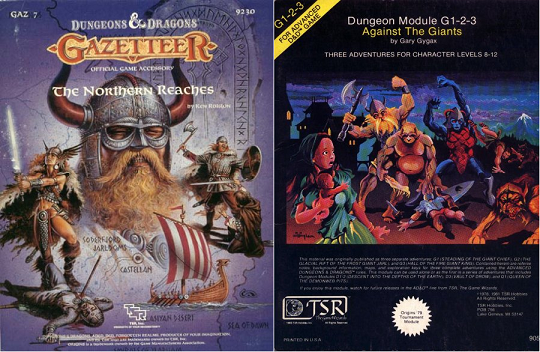
With its strong nordic connection, the Northern Reaches are a natural setting for these modules in Mystara ." And this makes it perfect for Gazetteer Northern Reaches! 


This brings into sharp contrast the fact that the PC's may be Vikings dealing with the machinations of the giant races. These could even be left over from the affairs of Ragnorok easily! Ward & Kuntz's classic AD&D first edition  Dieties & Demigods has the entire cast of gods that can easily influence your game campaigns. 


G1 has the advantage of being not only a tourament module but the first of a series to bring in the PC's into the fold of a world changing module by introducing the Drow into the mix of your campaign. These rare manipulators may have far more influence then at first it seems. And this can translate into running G1 with really old school OD&D rules once again we turn to Delta's blog here; "Although published for AD&D, I ran this using OD&D rules (with my usual house rules; see OED sidebar to the right). The past few years I ran sessions of S1 using AD&D itself (much of it being dependent on AD&D clerical spells like find traps and true seeing and commune that I felt obliged in that way). Due to the nature of this adventure, I felt totally comfortable running G1 with OD&D rules and deleting clerics (albeit giving the party a few jugs of healing potion), as usual. I'm more-or-less done with AD&D, and my tuned OD&D feels so "right" in play (finally!) that I really don't have the appetite to run anything else. I translated hit points by just subtracting a monster's Hit Dice (i.e., translating d8's to d6's on average), or else just rolling everything on the fly (more comments on that further down)."

Not only have we got the reduction going on but the re balancing of encounters and such. What this means is that G1 could theoritcially be run with your favorite OSR rpg  system if you as the DM are willing to put in the time. If we go back in time to Feb. 12 2019 then we've got Jason Vey's Grey Elf Age of Conan here on the blog. This makes G1 easily to convert over into  OD&D Sword & Sorcery style games. 


G1 closes in on the Robert E.Howard's The Frost Giant's Daughter turf with the giants growing far more restless because of the machinations of the Drow. 

Tuesday, November 24, 2020

Raids, Ruins, & Hersey In The Countryside - G1 Steading of the Hill Giant Chief (1e) By Gary Gygax & The Hundred Years War

 So what happens when the giants during The Hundred Year War start to stir in the Welsh terrorities?! The players have already gone through the N1 Against the Reptile Cult & that's been put down. Now reports of giants have begun to get reports that giants are raiding the countryside. 


Now here's the thing, a prisoner has escaped back to the authorities, & she reports a pagan hersey involved as well. She seen Ysbaddaden Bencawr; "Ysbaddaden, Chief of Giants, among them.


Illustration by John D. Batten (1892)

Whose Ysbaddaden?  Ysbaddaden Bencawr is  the chief antagonist of the early Arthurian tale How Culhwch won Olwen. And very dangerous as well as cunning;"Ysbaddaden Bencawr; "Ysbaddaden, Chief of Giants," is the primary antagonist of the Welsh romance Culhwch ac Olwen.[1] A vicious giant residing in a nigh unreachable castle, he is the father of Olwen and uncle of Goreu fab Custennin.

Culhwch's father, King Cilydd son of Celyddon, loses his wife Goleuddydd after a difficult childbirth. When Cilydd remarries, the young Culhwch rejects his stepmother's attempt to pair him with his new stepsister. Offended, the new queen puts a curse on him so that he can marry no one besides the beautiful Olwen, daughter of the giant Ysbaddaden. Though he has never seen her, Culhwch becomes infatuated with her, but his father warns him that he will never find her without the aid of his famous cousin Arthur. The young man immediately sets off to seek his kinsman. He finds him at his court in Celliwig in Cornwall and asks for support and assistance.

Arthur agrees to help, and sends six warriors to join Culhwch in his search for Olwen. They travel onwards until they come across the "fairest of the castles of the world", and meet Ysbaddaden's shepherd brother, Custennin. They learn that the castle belongs to Ysbaddaden, that he stripped Custennin of his lands and murdered the shepherd's twenty-three children out of cruelty. Custennin set up a meeting between Culhwch and Olwen, and the maiden agrees to lead Culhwch and his companions to Ysbadadden's castle. The warrior Cai pledges to protect the twenty-fourth son, Goreu, with his life." 

Make no mistake this turns 'G1 The Steading of the Hill Giant Chief ' by Gary Gygax into a full on inquistor's campaign starter module involving Dark Albion's Cults of Chaos . The PC's are going to be acting as the Black Prince's agents in the Welsh countryside. 

Edward The Black Prince is a major NPC influence here & isn't to be taken lightly. The PC's are going to report directly too him through mystical means. The major NPC villain here is going to acting through intermediatary NPC's so the chief in Gary Gygax's Steading is a vassel or chieftain of Ysbaddaden Bencawr
The PC's are dealing with the fall out of Arthur and Gwalchmai fab Gwyar efforts & this propels things ahead at break neck speed. The PC's are going to be up to their necks in this one. 


Culhwch at Ysbaddaden's court. An illustration by E. Wallcousins in Celtic Myth & Legend, Charles Squire, 1920 "Horses shall I have, and chivalry; and my Lord and kinsman Arthur will obtain for me all these things. And I shall gain thy daughter, and thou shalt lose thy life." "Go forward...and when thou hast compassed all these marvels, thou shalt have my daughter for thy wife."

The Drow are going to be mentioned & they have an entirely different agenda & its not a good one. "
Temple found under the steading is explicitly stated to be dedicated to the Elder Eye, which by 4th edition was synonymous with Tharizdun." And this might tie in with Norkers being a part of the mercenary armies of the Drow and  'The Forgotten Temple of Tharizdun' by Gary Gygax. 


The PC's are being manipulated from all sides here & they are going to be dealing with some very heavy duty foes. Extra player characters are going to need to be on stand by. Basically this is simply going to turn into yet another front in the Hundred Years war. The Drow are following an age old pattern set out by their Elven god ancestors to manipulate the humans. They don't bank on humanity's ability to cope with the mythological at this point. 

We'll get into the tie in with 

RPGPundit Presents: The Old School Companion 1 coming up! 


Wednesday, September 25, 2019

OSR Commentary - Lands of the Jotunn & G1 Steading of the Hill Giant Chief By Gary Gygax (1978)

" Giants have been raiding the lands of men in large bands, with giants of different sorts in these marauding groups. Death and destruction have been laid heavily upon every place these monsters have visited. A party of the bravest and most powerful adventurers has been assembled and given the charge to punish the miscreant giants"


I've been thinking heavily about G1 
Steading of the Hill Giant Chief  By Gary Gygax (1978) & looking into how this style of tourament module could be used in a Pulp style game & before you head off give me a chance. Since these are a part of the classic Against the Giants series of modules by Gary Gygax let's get a little insight;"Against the Giants is an adventure module written by Gary Gygax and published by TSR in 1981 for the Dungeons & Dragons fantasy role-playing game." G1 Steading of the Hill Giant Chief  By Gary Gygax  takes place within Jotunn in Greyhawk & if that location was rifted into the modern world then events get very horrific & dangerous. Now I was reading through Dungeon of Sighs review of G1-3 Against the Giants from 2017. I was struck by the following; "he Hill Giant steading is a balance between two common stock communities - the barbarian ‘meadhall’ and the cannibal ‘hillbilly’ clan compound.  One can easily push it in either direction, depending on how one sees Hill Giants.  Certainly the Hill Giant of the 5th edition (and perhaps the Monster Manual) is driven by gluttony and seems like something out of “The Hills Have Eyes” more than a Fomorian of Celtic myth.  This second idea, Hill Giants as oversized classical celtic with monstrous table manners is closer to the 1978 G1.  Giants cover everything in furs and love decorative jewelry, living in a hall as an extended clan, the warrior elite lording over their captives and servants.  The little art in G1 straddles these two conceptions as well, with giants clad in furs, or sometimes dressed in 19th century looking prairie dresses and depending on one’s campaign going in either direction could be very fun. " 

Now let's say that lands of the Jotunn plannarly merged with modern day England & that's when the real trouble starts. In Norse mythology this place is literally the land of giants, trolls, and other Dungeons & Dragons humanoids. For some reason H.G. Wells Food of the Gods stuck with me here & the idea that the Hill Giants might be feeding some of the locals on their own food or Eitr. Yeah this is right outta of the Bob Something Godbound/Scion: Titanspawns play book. The hill giants have been turning the locals into cannon fodder, slaves,etc.
Now this isn't the first time I've thought about doing this & for a Godbound/Dungeons & Dragons campaign this isn't a bad way to go. Scientists who are studying the food of the gods or 
Ambrosia are extremely dangerous circumstances. The food of the gods comes from Greco/Roman mythology; "Ambrosia is very closely related to the gods' other form of sustenance, nectar. The two terms may not have originally been distinguished;[6] though in Homer's poems nectar is usually the drink and ambrosia the food of the gods; it was with ambrosia Hera "cleansed all defilement from her lovely flesh",[7] and with ambrosia Athena prepared Penelope in her sleep,[8] so that when she appeared for the final time before her suitors, the effects of years had been stripped away, and they were inflamed with passion at the sight of her. On the other hand, in Alcman,[9] nectar is the food, and in Sappho[10] and Anaxandrides, ambrosia is the drink.[11] A character in Aristophanes' Knights says, "I dreamed the goddess poured ambrosia over your head—out of a ladle." Both descriptions could be correct, as ambrosia could be a liquid considered a food (such as honey).

The consumption of ambrosia was typically reserved for divine beings. Upon his assumption into immortality on Olympus, Heracles is given ambrosia by Athena, while the hero Tydeus is denied the same thing when the goddess discovers him eating human brains. In one version of the myth of Tantalus, part of Tantalus' crime is that after tasting ambrosia himself, he attempts to steal some away to give to other mortals.[12] Those who consume ambrosia typically had not blood in their veins, but ichor the blood of immortals.[13]
Both nectar and ambrosia are fragrant, and may be used as perfume: in the Odyssey Menelaus and his men are disguised as seals in untanned seal skins, "...and the deadly smell of the seal skins vexed us sore; but the goddess saved us; she brought ambrosia and put it under our nostrils."[14] Homer speaks of ambrosial raiment, ambrosial locks of hair, even the gods' ambrosial sandals."

So let's say that the hill giants are using the local youth for part of an army of muscle & cult recruitment. Surely there couldn't be someone among them whose got the brains to organize hill giants into such a back handed group of muscle & dominance right? Well enter Geoffrey of Monmouth's Historia Regum Britanniae ("The History of The Kings of Britain", 12th century), & Gogmagog. "He was a giant inhabitant of Albion, thrown off a cliff during a wrestling match with Corineus (a companion of Brutus of Troy). Gogmagog was the last of the Giants found by Brutus and his men inhabiting the land of Albion."


Its no accident that I mentioned that G1 Steading of the Hill Giant Chief  By Gary Gygax (1978) might be transported to a modern England this goes back to Gogmagog (also Goemagot, Goemagog, GoĆ«magot and Gogmagoc); "Gogmagog ("Goemagot", "Goemagog") in the legend of the founding of Britain as written by Geoffrey of Monmouth in Historia Regum Britanniae (1136). Gogmagog was a giant of Albion who was slain by Corineus, a member of the invading Trojan colonizers headed by Brutus. Corineus was subsequently granted a piece of land that was named "Cornwall" eponymously after him.
The Historia details the encounter as follows: Gogmagog, accompanied by twenty fellow giants, attacked the Trojan settlement and caused great slaughter. The Trojans rallied back and killed all giants, except for "one detestable monster named Gogmagog, in stature twelve cubits, and of such prodigious strength that at one shake he pulled up an oak as if it had been a hazel wand". He is captured so that Corineus can wrestle with him. The giant breaks three of Corineus's ribs, which so enrages him that he picks up the giant and carries him on his shoulders to the top of a high rock, from which he throws the giant down into the sea. The place where he fell was known as "Gogmagog's Leap" to posterity."

So why would 
 Gogmagog return with hordes of hill giants & the like to modern England? To track down his modern day descendants & use them in an army of the Apocalypse to destroy modern society; "The Lord Mayor's account of Gogmagog says that the Roman Emperor Diocletian had thirty-three wicked daughters. He found thirty-three husbands for them to curb their wicked ways; they chafed at this, and under the leadership of the eldest sister, Alba, they murdered their husbands. For this crime they were set adrift at sea; they washed ashore on a windswept island, which they named "Albion"—after Alba. Here they coupled with demons and gave birth to a race of giants, whose descendants included Gog and Magog" 

There's always been a mix here of gods & giants going back to Norse mythology the primary
example here being Loki. But there are many others & to take this back to Dark Albion if 
 G1 Steading of the Hill Giant Chief  By Gary Gygax (1978) & placed it within Dark  Albion or Lion & Dragon  with our additions the effects could be devestating. Ambroisa being used as a sacrement for a cult of the hill giants on the local populace would have incredibly dangerous effects. The supplicant's strength gains  +4 & perhaps a +2 on dexterity.But their intelligence & wisdom go down by -2 points after two weeks of being on the Ambroisia. The cult's members become creatures of chaos before too long gaining unsightly & unnatural muscles. Originally these monsters were used as shock troops by the Elves in ages past & now these monsters have returned!

Hill giants have always been creatures of chaos within my mind anyway. Dangerous in the exgtreme, prone to violence, quick tempered, & representive of a different order then humanity entirely. 

Friday, May 17, 2019

An Arthurian Take On G1-3 Against the Giants (1e) By Gary Gygax As Old School Campaign

"Giants have been raiding the lands of men in large bands, with giants of different sorts in these marauding groups. Death and destruction have been laid heavily upon every place these monsters have visited. A party of the bravest and most powerful adventurers has been assembled and given the charge to punish the miscreant giants. "


Its been a busy last two days & its been very interesting to say the least. But I've been doing a lot of thinking about the Against the Giants series of modules &  the Descent Into The Depths of the Earth.  The campaign  adventure overarching  plot  is outlined in the wiki entry;
"The D-series itself is part of a larger overall campaign of adventures set in the World of Greyhawk campaign setting. The overall campaign begins with the three modules in the Against the Giants series, continues through the D-series, and concludes with module Q1 Queen of the Demonweb Pits. The latter segments of the campaign, including the D-series and module Q1, are set in a vast network of caverns and tunnels called the Underdark."


I've been doing a lot of thinking about how to incorporate this whole series into an Arthurian style OSR campaign. The entry point for such a campaign would be Welsh mythology specifically;"
Culhwch and Olwen (WelshCulhwch ac Olwen) is a Welsh tale that survives in only two manuscripts about a hero connected with Arthur and his warriors: a complete version in the Red Book of Hergest, ca. 1400, and a fragmented version in the White Book of Rhydderch, ca. 1325. " When you start looking at the overall manipulation by the Drow it reminds me of the Fey court's meddling in many of the Arthurian tales;


"Culhwch's father, King Cilydd son of Celyddon, loses his wife Goleuddydd after a difficult childbirth. When he remarries, the young Culhwch rejects his stepmother's attempt to pair him with his new stepsister. Offended, the new queen puts a curse on him so that he can marry no one besides the beautiful Olwen, daughter of the giant Ysbaddaden Pencawr. Though he has never seen her, Culhwch becomes infatuated with her, but his father warns him that he will never find her without the aid of his famous cousin Arthur. The young man immediately sets off to seek his kinsman. He finds him at his court in Celliwig in Cornwall; this is one of the earliest instances in literature or oral tradition of Arthur's court being assigned a specific location and a valuable source of comparison with the court of Camelot or Caerleon as depicted in later Welsh, English and continental Arthurian legends."


"Culhwch at Ysbaddaden's court. An illustration by E. Wallcousins in Celtic Myth & Legend, Charles Squire, 1920 "Horses shall I have, and chivalry; and my Lord and kinsman Arthur will obtain for me all these things. And I shall gain thy daughter, and thou shalt lose thy life." "Go forward...and when thou hast compassed all these marvels, thou shalt have my daughter for thy wife.""
"Arthur agrees to help, and sends six of his finest warriors (CaiBedwyrGwalchmeiGwrhyr Gwalstawd IeithoeddMenw son of Tairgwaedd and Cynddylig Gyfarwydd) to join Culhwch in his search for Olwen. The group meets some relatives of Culhwch's that know Olwen and agree to arrange a meeting. Olwen is receptive to Culhwch's attraction, but she cannot marry him unless her father agrees, and he, unable to survive past his daughter's wedding, will not consent until Culhwch completes a series of about forty impossible-sounding tasks. The completion of only a few of these tasks is recorded and the giant is killed, leaving Olwen free to marry her lover." Seems pretty straight forward right?! Arthurian court gets involved with the Welsh giant courts & all is put right.. Or is it? What happens if the events of say G1-2 are actually the result of 
Culhwch's father, King Cilydd son of Celyddon, being played by the Dark Elves of the Underworld? Think about it?! A king loses his wife & is now emotionally vulnerable to manipulations of evil Fey?? 
Make no mistake that Arthur sending in his finest warriors is a tactically sound move especially 
CaiBedwyrGwalchmeiGwrhyr Gwalstawd IeithoeddMenw son of Tairgwaedd and Cynddylig Gyfarwydd. Freeing of  Mabon ap Modron from his watery prison has more then a few consequences for Ysbaddaden Bencawr; "Ysbaddaden, Chief of Giants,".


Why? Because the Drow are after all out war between the humans & the Fey races. A war of ultimate extinction & Arthur's warriors are the ultimate stabilizing force except for family & marriage as peace time contract.  Ysbaddaden Bencawr
; "Ysbaddaden, Chief of Giants is a magic using giant of no small standing. He's a high level enchanter & warrior of renowned among the giants. In fact I've seen his preserved head used as a relic in certain campaigns. the preserved head is able to summon a planar door to his castle in Fairyland.
This is only the start of this Arthurian commentary & I've got some thoughts about expanding & what the far reaching consequences of such a campaign might be.