A blog about sewing machine repairs,but mainly my hobbies which include old school role playing games, science fiction,films, horror, and general geekery. Sit down and stay a spell.
Showing posts with label Hostile Work Environment. Show all posts
Showing posts with label Hostile Work Environment. Show all posts
Bringing Fel (Fenrir) from Campfire Cooking in Another World with My Absurd Skill into The Primal Order (TPO) requires translating his overwhelming "cheat-level" power into the language of Primal Base, Divine Rank, and Essence. This entry picks up from OSR Commentary - Can Castles & Crusades rpg be played with The Primal Order Rpg?!
In TPO terms, Fel isn't just a high-level monster; he is a Primal Entity—specifically a Lesser or Intermediate Deity of the Wild and Gluttony (by association).
Fel: The Legendary Fenrir
Divine Rank: 3 (Lesser Deity)
Primary Sphere: Predation & Wind
Secondary Sphere: Culinary Appreciation (Acquired via Mukohda)
Stat
Value
Notes
Primal Base
450
Reflects his status as a legendary beast.
Essence Pool
12,000
Massively inflated by the "blessings" of Ninrir.
Movement
300' (Ground) / 600' (Air)
Wind-walking allows for extreme mobility.
Armor Class
-12 (Equivalent)
Divine hide + Wind Barrier.
Primal Skills & Abilities
1. Absolute Wind Mastery (Sphere: Wind)
Fel can manipulate air currents with Primal authority. This functions as a Primal Blast that deals massive physical and cutting damage.
Cost: 100 Essence per 10d10 damage.
Effect: Can create localized tornadoes or vacuum blades that bypass non-primal invulnerability.
2. The Blessing of Ninrir (Divine Favor)
Because Fel is the chosen familiar of the Goddess of Wind, he acts as a Proxy.
Effect: Fel can draw up to 1,000 Essence directly from Ninrir’s pool once per day, provided he has recently "sacrificed" high-quality otherworldly sweets (via Mukohda) to her.
3. Claw of the Fenrir (Primal Strike)
His physical attacks are infused with Primal energy, allowing him to rend the physical form of other deities or planes-walkers.
Cost: 50 Essence per strike.
Effect: Ignores the first 50 points of any mundane or magical damage reduction.
4. Divine Gluttony (Unique Ability)
Fel gains temporary Essence boosts by consuming creatures with high mana or Primal signatures.
Effect: For every 1,000 HP of a "boss-level" creature Fel consumes, he recovers 500 Essence.
Alignment & Disposition
Alignment: Neutral (with a heavy lean toward "Hungry").
Motivation: The pursuit of the ultimate meal and the protection of his "contractor" (the source of said meals).
Weakness: Mentioning a "bath" or a lack of ginger pork can cause a temporary dip in his Divine Morale.
Combat Logistics
In The Primal Order system, Fel functions as a Living Artillery Piece. He rarely engages in complex divine politics, preferring to use Primal Flux to simply overwhelm opponents with raw power. If a player character isn't at least Rank 1, Fel’s "Intimidation Aura" acts as a permanent Fear effect with no saving throw.
Note to GMs: Fel should be treated as an unstoppable force of nature. He doesn't want your kingdom; he just wants your krakens—deep-fried.
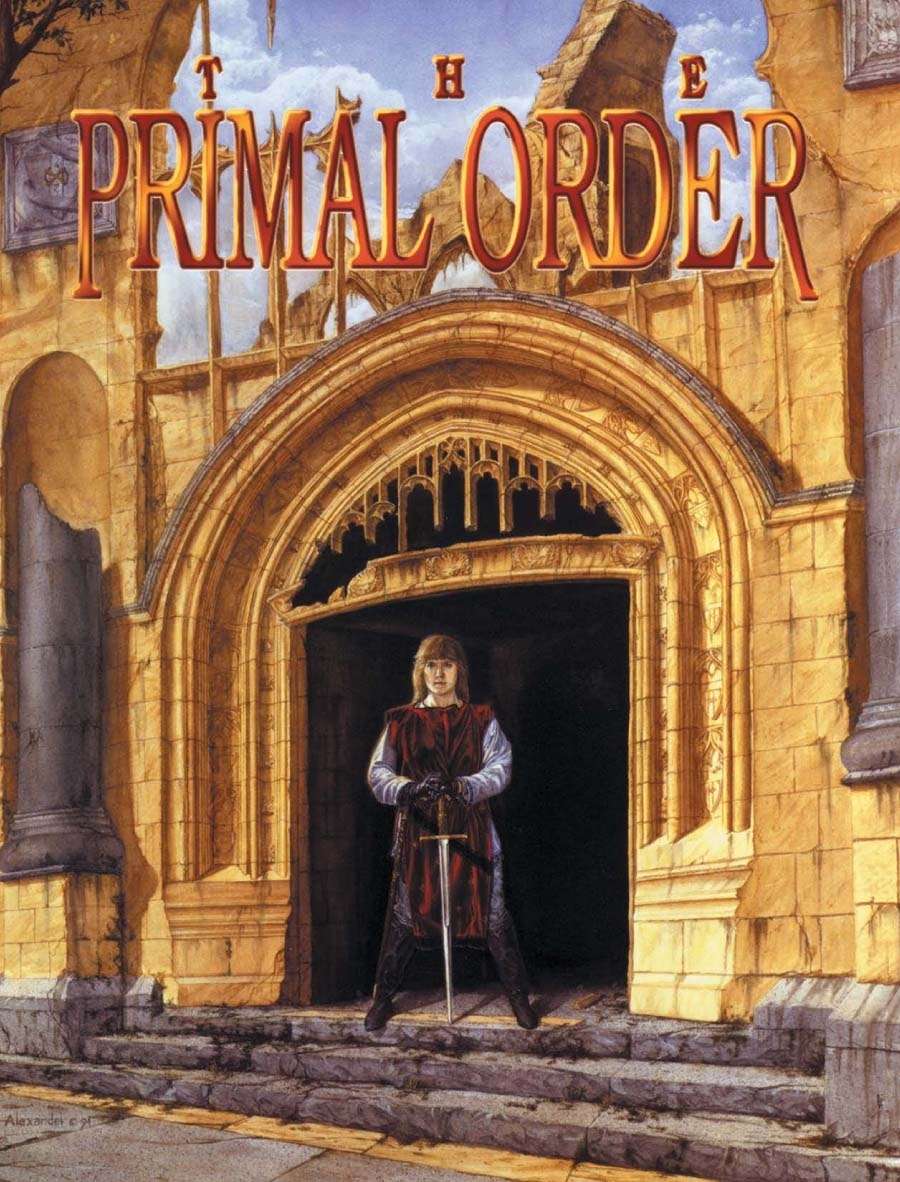
Published in 1992 by Peter Adkison (who later founded Wizards of the Coast), The Primal Order (TPO) is a landmark "capsule" supplement. It wasn't meant to replace your game; it was designed to sit on top of any RPG—whether D&D, GURPS, or Shadowrun—to provide a rigorous, mechanical framework for playing as, or interacting with, actual deities
It is famous for introducing Primal Base, the first system-agnostic "translator" for RPG statistics.
The Core Concept: Primal Energy
Most RPGs treat gods as just high-level monsters with a lot of HP. TPO changes this by introducing Primal, a cosmic energy source that exists "behind" magic and physics.
Primal vs. Mundane: A god doesn't just cast a "Fireball." They use Primal to create a Fireball. Because Primal is a higher-order energy, it automatically pierces mundane defenses.
The Power Gap: If a mortal wizard casts a 100-damage spell at a god, and the god spends just 1 point of Primal to "resist," the spell is completely nullified. This creates a terrifying, logical hierarchy where gods are truly untouchable by mortals unless those mortals also tap into Primal.
Divine Hierarchy
The system classifies deities into stages based on their Primal Base (the amount of energy they can hold and regenerate):
Rank
Scale
Description
Pawns
Mortal+
Heroes or high priests granted a tiny sliver of Primal.
Demigods
Local
Gods of a specific city, forest, or tribe.
Lesser Deities
Regional
Gods of a kingdom or a specific natural phenomenon.
Greater Deities
Global/Planar
Major players who define the laws of a world.
Primal Entities
Cosmic
Beings that represent fundamental constants (Time, Death, Chaos).
Key Mechanics
1. Primal Base (PB)
This is the "currency" of godhood. You spend PB to perform Primal Feats—creating artifacts, answering prayers, or reshaping geography. If you run out of PB, you become "deflated" and vulnerable to being killed by mortals.
2. The Feedback Loop
Gods gain Primal from two main sources:
Worship: The more sentient beings believe in you and follow your tenets, the more Primal you generate.
The Plane: Gods "own" divine realms that generate energy based on how well the realm aligns with the god's alignment/personality.
3. Divine Planes
TPO provides a blueprint for how gods construct their "home turf." In your own plane, you are functionally omnipotent. Invading another god's plane is considered a near-suicide mission because the host can literally change the laws of physics to make your attacks useless.
The "WotC" Connection:The Primal Order was the very first book published by Wizards of the Coast. Ironically, a legal battle with Palladium Books over the "conversion" notes in this book nearly bankrupted the young company before they eventually struck gold with Magic: The Gathering.
Why it Still Matters
Even 30+ years later, TPO is considered the "gold standard" for divine rules. It avoids the "power creep" problem by making gods fundamentally different from mortals, rather than just "mortals with bigger numbers."
If you want to run a campaign where players ascend to godhood, this remains the most intellectually consistent framework ever written for the genre.
Can Castles & Crusades rpg be played with The Primal Order Rpg?!
The Primal Order (TPO) was specifically designed as a "capsystem"—a set of rules intended to be "capped" onto any existing RPG. Because Castles & Crusades (C&C) is built on the SIEGE Engine (which is heavily derived from AD&D and 3rd Edition), the two systems are remarkably compatible.
Since TPO includes official conversion notes for AD&D 2nd Edition and generic d20-style systems, you can integrate it into C&C with very little friction.
How to Blend the Two Systems
The primary mechanic of TPO is Primal Energy (Base and Flux), which acts as a "layer" above your standard game stats. Here is how to handle the integration:
Saving Throws: C&C uses the SIEGE Engine (Attribute-based saves).In TPO, divine effects often bypass normal saves or require a "Primal" defense.
Ruling: If a deity uses Primal Flux to power an ability, treat the Challenge Level (CL) as significantly higher (e.g., +10 or more) unless the defender also has Primal energy.
Armor Class: TPO uses descending AC in its original printing (2nd Edition style). Since C&C uses ascending AC, simply use the standard conversion: $20 - \text{Descending AC} = \text{Ascending AC}$.
The "Primal" vs. "Mortal" Gap: TPO's core philosophy is that "Primal" energy always trumps "Mortal" energy. In C&C terms, a wizard’s Fireball (mortal magic) would be effortlessly snuffed out by a deity spending even 1 point of Primal Flux, regardless of the wizard's level or C&C's high-level spell rules.
Attribute Checks: When a deity uses a Primal-enhanced attribute, treat it as an automatic success against any mortal Challenge Class (CC) unless you want to roll for the degree of success.
Key Considerations for Your Campaign
The Power Scale: TPO is designed for "deity-level" play. If your C&C party is at the typical "sweet spot" (levels 5–9), the introduction of Primal entities will make them feel very small.
Conversion Guides: While there isn't a "Castles & Crusades" chapter in the original TPO book (as C&C didn't exist in 1992), you should follow the AD&D 2nd Edition or WOTC/d20 conversion notes provided in the back of the TPO manual. They map almost 1:1 to C&C.
Recommended Approach
Treat TPO as the "engine" for your world's mythology and high-level planar threats, while using C&C for the moment-to-moment tactical play. If a player eventually "ascends" in your campaign, you would start tracking their Primal Base and Flux on a separate sheet while keeping their C&C class abilities as their "mortal" foundation.
The Primal Order (TPO) was specifically designed as a "capsystem"—a set of rules intended to be "capped" onto any existing RPG. Because Castles & Crusades (C&C) is built on the SIEGE Engine (which is heavily derived from AD&D and 3rd Edition), the two systems are remarkably compatible.
Since TPO includes official conversion notes for AD&D 2nd Edition and generic d20-style systems, you can integrate it into C&C with very little friction.
How to Blend the Two Systems
The primary mechanic of TPO is Primal Energy (Base and Flux), which acts as a "layer" above your standard game stats. Here is how to handle the integration:
Saving Throws: C&C uses the SIEGE Engine (Attribute-based saves).In TPO, divine effects often bypass normal saves or require a "Primal" defense.
Ruling: If a deity uses Primal Flux to power an ability, treat the Challenge Level (CL) as significantly higher (e.g., +10 or more) unless the defender also has Primal energy.
Armor Class: TPO uses descending AC in its original printing (2nd Edition style). Since C&C uses ascending AC, simply use the standard conversion: $20 - \text{Descending AC} = \text{Ascending AC}$.
The "Primal" vs. "Mortal" Gap: TPO's core philosophy is that "Primal" energy always trumps "Mortal" energy. In C&C terms, a wizard’s Fireball (mortal magic) would be effortlessly snuffed out by a deity spending even 1 point of Primal Flux, regardless of the wizard's level or C&C's high-level spell rules.
Attribute Checks: When a deity uses a Primal-enhanced attribute, treat it as an automatic success against any mortal Challenge Class (CC) unless you want to roll for the degree of success.
Key Considerations for Your Campaign
The Power Scale: TPO is designed for "deity-level" play. If your C&C party is at the typical "sweet spot" (levels 5–9), the introduction of Primal entities will make them feel very small.
Conversion Guides: While there isn't a "Castles & Crusades" chapter in the original TPO book (as C&C didn't exist in 1992), you should follow the AD&D 2nd Edition or WOTC/d20 conversion notes provided in the back of the TPO manual. They map almost 1:1 to C&C.
Recommended Approach
Treat TPO as the "engine" for your world's mythology and high-level planar threats, while using C&C for the moment-to-moment tactical play. If a player eventually "ascends" in your campaign, you would start tracking their Primal Base and Flux on a separate sheet while keeping their C&C class abilities as their "mortal" foundation.