A blog about sewing machine repairs,but mainly my hobbies which include old school role playing games, science fiction,films, horror, and general geekery. Sit down and stay a spell.
Showing posts with label AD&D Manual of the Planes. Show all posts
Showing posts with label AD&D Manual of the Planes. Show all posts
The Dwarven gods that appear within Dieties and Demigods might actually predate the Elven gods of our Greyhawk campaign that we've been talking about last time on the blog.
So let's pick it up with the Fall, September is around the corner and already the chill of Autumn is in the air of August. If you've been following our posts we dive back into both classic Advanced Dungeons & Dragons first edition Dieties & Demigods & Castles and Crusades with Castles & Crusades Codex Celtarum 2nd Printing. Last time we spoke about a multiplicity of Greyhawks. And let's assume for a moment using the Great Wheel cosmology that someplace among the Prime material plans that there's a Greyhawk that follows the Celtic mythology put forth within Castles & Crusades Codex Celtarum 2nd Printing. The rebellions & battles of the Celtic gods might actually line up with the Elven gods of Chaos that appeared in Adventurer,Conqueror, King's King's By This Axe. Giving the Dwarves a rather dim view of the Elves while enhancing the human's postion within this world.
This is a world of Celtic tribes and peoples, the Fey have full reign here, and the word of Druids might be law. The Dwarves are actually older then the Fey, the Elves, and most certainly the humans. The abandoned Dwarven city dimensional gates of Stains upon the Green lead into Dark Wizard's #4 Vault of the Dwarven King.
And the Fey would not be happy at all with the release of a Chaos elemental Earth elemental in the hands of the Dark Fairy, Elves, and others forces of Chaos.This world of Greyhawk may be far more raw, primative, and highly dangerous. Perhaps this version of Greyhawk might even be pre Iron Age. The PC's gate into a very different Dwarven city from Stains on the Green. The Dwarven halls are full, the city is fully staffed, and even the Dwarven gods walk the fields of battle.
This version of Greyhawk is within the grip of the time of legendsClangeddin Silverbeard walks upon the field of battle himself. The Dwarven race here is in thier prime. Even here Chaos rears it's head and the races of humanoids are on the uptick. If the party is captured and questioned by the Dwarves they are going to have to do some fancy foot work and talking to escape.
Clangeddin Silverbeard, the Father of Battle, as depicted in Dragon #58 (1982).
This is a Greyhawk that reeks of legends & lore in the full of itself. Castle Greyhawk may still stand or have fallen to the forces of Chaos long ago. Something is amiss and off even as the PC's are beguiled by the forces of the Fey. But why?! Tales of the Outer Planes may contain the answers as the PC's try to deal with thier position within the Dwarven fortress city. Jeff Grub's Manual of the Outer Planes might be of some use when moving into another alternative Prime Material plane. And then there's the facts that the Castles & Crusades Codex Celtarum 2nd Printing may contain alternative forces of Evil that the players will not be expecting. My advice for the forces of Chaos is to use the Random Esoteric Creature Generator for Classic Fantasy Role-Playing Games and Their Modern Simulacra. The monsters will be the stuff of nightmares quite literally.
One of the reasons why Kuntz and Ward's Dieties & Demigods is useful is because of the fact that the gods and mythologies protrayed in this Advanced Dungeons & Dragons first edition book sorta conform to our world. When I say sorta of some of the entries are not quite in line with the 'real world' mythology. And we're gonn pick it right up from here on the blog. And this is just fine. Why?! Because it conforms to TSR classic era Greyhawk.
What do you mean fine?! Well this is because classic first edition Dieties & Demigods plugged into classic era Greyhawk and according to the Forgotten Realms wiki;"Deities & Demigods was the first print appearance of various fictional non-human deities, such as Corellon, Moradin, Gruumsh, and others, many of which have become standard features of Dungeons & Dragons and its derivatives. These deities were the creation of James Ward." And all of these non human dieties end up referenced in the original Greyhawk box set. So Dieties and Demigods ties in with Greyhawk exceedly strongly.
Remember Dieties & Demigods introduced the 'Great Wheel' concept into Advanced Dungeons & Dragons first edition. Even further back it came into focus in Dragon issue#8 with a commentary by Gary Gygax. 'The Great Wheel' model of the planes includes multiple Oearths as a matter of course. And so we have a multiplicity of Oreaths out there in the various Prime Material universes. So this means that there are multiple Greyhawks that are still in the multiverse. And to tie this in with Our Stains Upon the Green campaign.
The Dwarves know of this multiplicity of planar material reflections through thier divinities. And so took full advantage of this fact within the lead from Stains upon the Green's abandoned Dwarven city straight into Dark Wizard's #4 Vault of the Dwarven King.
If we build on Adventurer,Conqueror, King's By This Axe. The Dwarves know of this multiplicity of planar material reflections through thier divinities. And so took full advantage of this fact something that we see within Adventurer,Conqueror, King's By This Axe with Dieties & Demigods then the Dwarves place becomes clearer.
"Cyclopedia of Gods and Heroes from Myth and Legend
Provides the Dungeon Master with gods, heroes and monsters from myth, fiction and legend for use in rounding out an Advanced D&D campaign. Within this book are seventeen pantheons of divinities, each profusely illustrated. Also included are new material on clerics' conduct and their relationships with their deities, information on character mortality and immortality, and more!"
Dieties & Demigods 1st edition ( yes the edition with the Cthulhu Mythos, the Elric, & Lieber Mythos) within remains a favorite. And what kicked this off is Thomas Denmark's review of the Kuntz & Ward's Dieties & Demigods. The publication history &information from the Dieties & Demigods wiki entry contains several interesting things;" TSR published the first version ofDeities & Demigodsin 1980 as a 144-page hardcover for the first editionAdvanced Dungeons & Dragonsrules.[2]This edition, byJames M. WardandRobert J. Kuntz, served to update the material they had earlier included in 1976's Supplement IV:Gods, Demi-Gods & Heroesfor the original D&D ruleset.[3]The book presents the game statistics and background information for gods and legendary heroes and creatures taken from various mythologies.[4]The original edition included 12 pantheons of gods taken from both myth and folklore, as well as gods for various nonhuman races, and four groups taken from fictional works: theArthurian heroes, theNehwon mythosfrom Fritz Leiber, the Melnibonéan mythos from Michael Moorcock, and theCthulhu Mythosfrom H. P. Lovecraft.[2]These statistics are presented in a fashion similar to that of theMonster Manual, and illustrations accompany the statistics, as well as a short description that details what circumstances might cause the god to personally appear and what actions the god might take in such an instance, and what responsibilities and penchants that god may have.[3]The book also details themythoiof these religions, as well as what behaviors are expected of clerics, and describes the knownplanes of existenceand how characters may find themselves in the afterlife .[3]Interior illustrations were submitted byJeff Dee, Eymoth (Kenneth Rahman),Jennell Jaquays,[a]Dave S. LaForce, Jeff Lanners,Erol Otus,Darlene Pekul,Jim Roslof,David C. Sutherland III, andD.A. Trampier.[5]
The original Deities & Demigods includes a 9-page chart for clerics, as well as an entire chapter about the various planes of existence.["
Now I'm not going over any of the controversy that surrounds the Dieties & Demigods book. You can read about that on the Dieties & Demigods wiki entry here. What no one really talks about in thier various reviews, commentaries, etc. is the nine page clerical chart & Great Wheel Cosmology section within the Dieties and Demigods Gods book. Sure you'll see Amazon reviews like Patrick Payne's from October 2007; "This is a good addition to any 1st Edition AD&D library, particularly any one that is going to be set on a fantasy Earth. The book presents a number of well-known real mythoi (even if they are somewhat changed from their historical underpinnings for ease of gameplay -- but Schick and Kuntz do provide an extensive bibliography for the source material) including lesser-known pantheons such as the Native American and Finnish gods. There is even a section for King Arthur and his Knights of the Round Table (following Mallory's Morte d'Arthur, and not the post-Roman noble he probably was, but that's just a nitpick). Monsters and other heroes conected with the deities are also included.
But the most legendary point of the book is, of course, official AD&D stats for Cthulhu and others in the Lovecraft mythos -- and they are bruisers.
Don't let the deities' stat blocks fool you into thinking the gods are there like other monsters -- for the purpose of "kill it and take its stuff." These gods are GODS -- they have stats only to be used "if absolutely necessary." Any of these deities could reasonably be expected to kill a PC of almost any level within a round or two (and some, like Cthulhu, could even make short work of some of the toughest critters from the Monster Manual such as Demogorgon or Orcus). Use them sparingly as direct combat opponents (although sending Cthulhu [400 HP, 30 attacks (you read that right) of a damage level I don't recall, but obscenely high] against a "full of itself, 'let's rip the moustache off the king and raid his treasury'" party might just knock some sense into them <evil laugh>), instead trying to use them as either patrons or prime movers -- The PCs probably would never face Loki or Izumo, but might be fighting fire giants or Ogre Magi/Oni that the gods are directing.
One thing -- make sure to look carefully at the product description. If you want just any copy, any edition of this book (or the identical-but-for-a-different-cover-and-title Legends and Lore) are extremely serviciable. But if you're a collector, or are looking to use the 1st Edition stats for the Cthulhu or Melinebone (sp?) mythoi, be sure the product description states that it is the first edition -- after that (and perhaps a second printing), TSR decided to take the stats out rather than have to give a "thank you" credit to Chaosium. However, some later printings have the "thank you" note without the stats (they hadn't gotten around to changing the plates) -- therefore get the first printing and you're assured of Lovecraftian goodness."
Sure there's a ton of great information there but what the reviewer isn't telling you and what makes Kuntz & Ward's Dieties & Demigods the fourth core AD&D first edition book is that nine page chart for clerics. Why? Because it gives all of the information about whom the cleric's god is opposition too, what is required of the cleric, and more. Its the combination of the chart and the stat blocks of the gods that makes Dieties & Demigods an invaluable book. In point of fact Dieties and Demigods 1st edition is invaluable for Advanced Dungeons & Dragons clerics. Because it continues the material from Kuntz & Ward's Gods, Demigods, and Heroes from original Dungeons & Dragons.
Comparing and contrasting the two supplements is day and night. The Advanced Dungeons & Dragons version expands on the entries of Gods. Demi Gods, and Heroes. This isn't to say that it's superior but simply that it's a different edition of the same material spun & edited for a different edition. But if your PC's somehow
do end up on a god's home plane, boy are they going to be in trouble. And for the 'Great Wheel Cosmology' Dieties & Demigods collected all of the information about the planes and then spun it with the gods. And this is also the first appearance of the Demi Human & Humanoid races which were James Ward's creation according to the Forgotten Realms Dieties & Demigods Wiki entry; "Deities & Demigodswas the first print appearance of various fictional non-human deities, such asCorellon,Moradin,Gruumsh, and others, many of which have become standard features ofDungeons & Dragonsand its derivatives. These deities were the creation ofJames Ward.
The original edition covered 12 pantheons of gods from myth and folklore, plus gods for various nonhumans, and four fictional groups: the Arthurian heroes, Fritz Leiber's Nehwon mythos, Michael Moorcock's Melnibonéan mythos, and H. P. Lovecraft's Cthulhu Mythos. These statistics are presented in a fashion similar to that of the Monster Manual, and the statistics are accompanied by illustrations, as well as a short descriptive piece that details under what circumstances the god will appear, what the god might do if he does appear, and what his responsibilities and penchants may be. The book also details the mythoi of these religions, as well as how their clerics should behave, and describes the known planes of existence and how the afterlife applies to characters." For the Delving Deeper rpg, OSRIC, or even Castles & Crusades - Dieties & Demigods remains incredibly useful especially for putting a complete different spin on clerics for these games. Dieties and Demigods is almost but not quite completely unknown to the fifth edition player. There are are vast differences between the cosmology of Jeff Grubb's Manual of the Planes & Dieties & Demigods in the placement of the gods and planes. This is something that the DM is going to have to work at resolving themselves. For Castles & Crusades this means possibly either using or ignoring C&C dieties cosmology & mythology or using Dieties & Demigods cosmology as thier campaign setting's. The Manual of the Planes & OP1: Tales of the Outer Planes" (1988) comepletely messes with the cosmology further indicating some huge planar conflict that may have upset the balance of the multiverse or planes. The DM has to decide this from here.
"...from Arcadia to Pandemonium, from the plane of elemental Fire to the Astral plane, vast new worlds of adventure are now open to players."
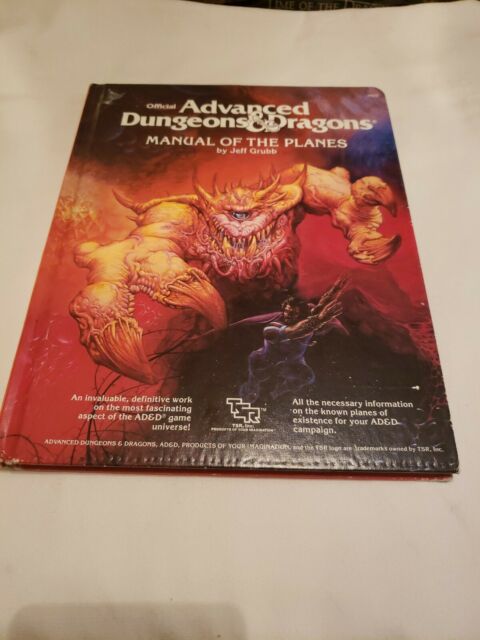
A vital source book for players and DMs of all levels of experience, the Manual of the Planes details the manifold worlds of the known planes of existence. This book describes the inhabitants, rulers, and environments of these worlds, as well as rules for movement, survival, combat, and spell use in these alien surroundings. A different style of AD&D adventures awaits!
The Manul of the Planes By Jeff Grubb remains one of my all time favorite of the orange spine Advanced Dungeons & Dragons books. The Manual of the Planes follows in the footsteps of Roger E. Moore's Plane Dragon magazine articles. And the Manual exclusively follows; "The Great Wheel of Planes first appeared in The Dragon #8 (July 1977). It was refined in the Player's Handbook (1978) and Deities & Demigods (1980)." And then allows the adventurers to adventure onto the very planes where only high level adventurers once tread. The Manual of the Planes have everything from the effects of magic and planes, the effects on equipment, gravity, reality, and more all within the atmosphere of the Advanced Dungeons & Dragons first edition According to the Wiki entry on 'The Manual of the Planes' here we get a bit of everything; "The book also details how to survive in the planes, and how combat and magic differ under each plane's special conditions. The Ethereal Plane, The Inner Planes—including the Plane of Elemental Air, the Plane of Elemental Fire, the Plane of Elemental Earth, and the Plane of Elemental Water, the Para-Elemental Planes (Smoke, Magma, Ooze, and Ice), the Energy Planes (Positive
Now it goes without saying that The Manual of the Planes could easily be moved into the field of the OSR especially for a retroclone such as OSRIC. That it wouldn't be hard to use 'The Manual of The Planes' with most of the major OSR retroclones. At the vary least 'The Manual of the Planes' is easily usable with "OP1: Tales of the Outer Planes" (1988). This is one of the pivotal old school Eighties planar adventure anthologies that brought the things talked about within The Manual of the Planes onto the table top!
"OP1: Tales of the Outer Planes" (1988) brings everything that was used in the 'Manual of the Planes' home into the adventures putting the PC's into the middle of the action at every level of play. According to the Forgotten Realms wiki entry here's what we got:
How to Use Tales of the Outer Planes
Prime: A Simple Deed, Well Rewarded
Ethereal: Castle at the Edge of Time
Air: The Brewing Storm
Water: The Voyage of the Nereid
Fire: Through the Fire
Earth: The Missing Kristal
Astral Into the Astral Plane
Seven Heavens: An Element of Chaos
Olympus: A Friendly Wager
The Abyss: The Sea of Screams
Nine Hells: To Hell and Back
Lairs
We got a little bit of everything from the simple to the Abyss and back again in one very handy adventure anthology. Enough to keep a party of adventurers going for years! The Manual of the Planes & OP1: Tales of the Outer Planes" (1988) is perfect for use with another set of OSR rules and that's Castles & Crusades rpg. This is exactly the sort of gaming adventuring solution that Castles & Crusades were designed for. The DM wants to bring his or her adventurers onto the planes but wants a modern OSR style of play.
Dragons ruled Cha'alt ages ago, the last couple of weeks Cha'alt has been on my mind again. And it goes back to the fact that the party of Godbound have been disrupting events on Cha'alt. And the Lovecraftian Elven tribesmen have been on the PC's case. This of course is part of my on going Cha'alt/Godbound campaign.
The various Lovecraftian Elven worshipers are being drawn from Adventurer, Conqueror, King's Secrets of the Nethercity by Alexander Marcus & Newton Grant. These elves were originally worshippers of the ancient dragons but these have been corrupted by the demonic desert worms. And these worms have among their cult's ranks the following:the Elven Cultist, Elven Hierophant, Elven Warlord, and Elven Wizard.
Part of this campaign's NPCs are going to be drawn from Venger's July 2018 entry here. And this brings up the PC's saving an ancient dragon priest. And this is going to happen below the streets of the city of A'agrybah.
The ancient rivalry of worm cults vs dragon cults results in the facts that players may see full on warfare with lots of forces being called in from the planes that appear in Jeff Grubb's Manual of the Planes for the Advanced Dungeons & Dragons. This gives Cha'alt an almost but not quite Moorcock Stormbringer feel to it. The dragons are not going to stand for this & call in the PC's as Godbound to help resolve these issues.
The PC's may have to speak with the gods of Cha'alt to help resolve this ancient & dangerous rivalry. This is where Goblinoid Games Realms of Crawling Chaosis a Cthulhu sent resource. Because it includes lots of artifacts,technologies, etc. that can all be created through the book's random charts.
Cha'alt has a ton of weird Elves that can be used as stand ins for the NPC Lovecraftian worm cult.
The dungeon that we're going to be using is going be two or three randomly created ancient temple complexes.