A blog about sewing machine repairs,but mainly my hobbies which include old school role playing games, science fiction,films, horror, and general geekery. Sit down and stay a spell.
Showing posts with label Inner Earth Sword & Sorcery Campaign Castles & Crusades (C&C). Show all posts
Showing posts with label Inner Earth Sword & Sorcery Campaign Castles & Crusades (C&C). Show all posts
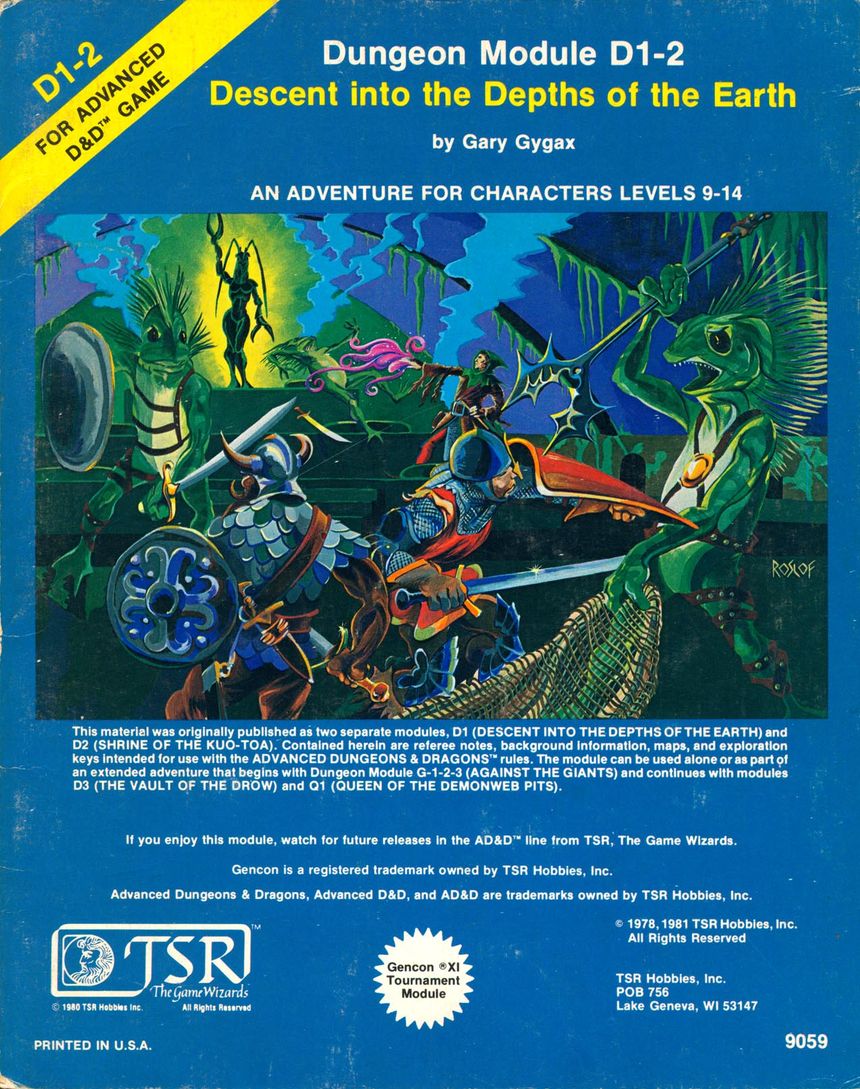
1. The "D" Series: Descent into the Depths of the Earth (1e)
This is the foundational text for subterranean adventuring. Comprising D1-D2: Descent into the Depths of the Earth and D3: Vault of the Drow, this series by Gary Gygax introduced the concept of the Underdark as a vast, interconnected ecosystem.
The Vibe: A massive "hex-crawl" through the crust of the earth.
Key Feature: It moves from monster-infested tunnels to the alien city of Erelhei-Cinlu, proving that the world below is just as civilized (and corrupt) as the world above.
2. Night Below: An Underdark Campaign (2e)
Often considered the ultimate boxed set for subterranean play, this campaign takes characters from 1st level all the way to 14th. It starts as a mystery on the surface but eventually leads to a grand tactical war in the deep.
The Vibe: A slow-burn descent into a global conspiracy.
Key Feature: The "Great Shallows" and the "City of the Glass Pool" offer a massive sandbox where players must navigate the politics of Aboleths, Mind Flayers, and Derro.
3. B4: The Lost City (B/X)
While it starts as a pyramid crawl, The Lost City is the perfect entry point for a hollow-earth campaign. Players find a buried civilization beneath the desert sands that has retreated into a drug-fueled, masked existence.
The Vibe: Weird fantasy and decadent, ancient cultures.
Key Feature: The module is designed to be expanded by the DM, providing a blueprint for a subterranean lake and warring factions that can sustain months of play.
4. Mystara: Hollow World Boxed Set (BECMI)
If you want a true "Inner Earth" (where the world is literally hollow with a sun at the center), this is the definitive setting. It functions as a cultural "preserve" for the world's gods, housing dinosaurs and civilizations that went extinct on the surface.
The Vibe: Pulp adventure in the vein of Journey to the Center of the Earth.
Key Feature: Unique mechanics for "World Shields" and a sun that never sets, creating a surreal environment where time feels irrelevant.
5. I6: Ravenloft II: The House on Gryphon Hill (1e)
While often overlooked in favor of its predecessor, this module contains the "Moors of the Dark," which delves into the idea of a dream-like, subterranean nightmare. It’s excellent for GMs who want their Inner Earth to feel psychologically oppressive.
Comparison of Classic Subterranean Styles
Module
Mechanical Focus
Atmosphere
D1-D3 (Descent)
Logistics & Tactical Combat
Alien and Hostile
Night Below
Sandbox & Faction War
Epic and Overwhelming
B4 (Lost City)
Roleplay & Exploration
Decadent and Strange
Hollow World
Survival & Discovery
Primeval and Grand
Modern Supplements for a Classic Feel
For those running these classics today, adding a supplement like Veins of the Earth can heighten the tension. It introduces "Lume" (light as currency) and three-dimensional mapping, which makes the descent feel physically taxing and claustrophobic. If your campaign reaches the "divine" level where players are shaping these subterranean civilizations, systems like Godbound or The Primal Order provide the high-tier mechanics necessary to manage godly influence in the deep.
Here is the breakdown of how to run this Mesoamerican-themed "death trap" dungeon using the C&C ruleset.
1. The Core Challenge: The Siege Engine
The biggest shift from 1E to C&C is moving from "percentage chances" and "fixed saves" to Attribute Checks.
Traps & Hazards: Tamoachan is infamous for its environmental puzzles. In C&C, almost every interaction should be a Challenge Base (CB) check.
Example: If a 1E description says "1-in-6 chance to notice the pressure plate," use a Wisdom Check (CL 5-7).
Saving Throws: Convert 1E saves directly to C&C Prime/Non-Prime checks.
Poison/Gas: Constitution.
Dodge/Pit Traps: Dexterity.
Ancient Curses/Mental Stress: Charisma or Wisdom.
2. The Poison Gas Mechanic
The most iconic (and controversial) part of C1 is the amber-colored poison gas in the lower levels that slowly kills the party.
The Original Rule: 1d6 damage every 10 minutes (1 turn) with no save.
C&C Adjustment: This can be brutal for C&C’s flatter HP curves.
The "Gritty" Approach: Keep it as-is to maintain the tournament "ticking clock" feel.
The "Siege" Approach: Allow a Constitution Check (CL 5) every 30 minutes. Success means the character takes no damage; failure results in 1d6 damage and a -1 penalty to all physical checks due to coughing and nausea.
3. Monster Conversions
Most monsters in C1 have direct equivalents in the C&C Monsters & Treasure book.
C1 Monster
C&C Equivalent
Note
Giant Crayfish
Giant Crayfish
Keep the "crushing" grapple mechanics.
Gibbering Mouther
Gibbering Mouther
Use a Charisma Save to avoid the confusion effect.
Nereid
Nereid / Water Nymph
Be careful with the "kiss of death"—it's a high-CL Con save.
Giant Slug
Giant Slug
Acid spit should target AC or require a Dex check to dodge.
The Vampire (Lozakan)
Vampire
In C&C, vampires are high HD. Scale the HD to match the party level (approx. 7-8 HD).
4. Specific Mechanics to Watch
The "Tournament" Scoring
If you aren't running this as a competition, ignore the scoring system. However, the pre-generated characters are very well-balanced for the module's lethality. If your players are bringing their own characters, ensure they are at least Level 5–7.
Ancient Olman Lore
C&C emphasizes a "Classic Fantasy" feel. The Mayan/Aztec flavor of the Olman people provides a great opportunity for Intelligence (Legend Lore) or Wisdom (Religion) checks to decipher the murals, which often give clues on how to bypass traps.
Knocking/Breaking Doors
Many doors in Tamoachan are stone or heavy bronze. Use Strength Checks (CL depends on the door's weight) rather than the standard "Open Doors" d6 roll from 1E.
CK Tip: Tamoachan is a "thinking player's" dungeon. Reward clever use of the environment. If a player uses a Strength (Athletics) check to wedge a stone block into a trap reset mechanism, give them a +4 bonus or automatic success to encourage that OSR-style play.
Integrating The Hidden Shrine of Tamoachan into an Inner Earth (Hollow Earth) sandbox campaign is a brilliant move. It shifts the dungeon from a "forgotten ruin" to a "gateway" or a "border fortress" between the surface and the subterranean world.
Here is how to adapt the module for a Hollow Earth C&C sandbox:
1. The Narrative Hook: The Descent
In a standard game, the players fall into the shrine. In an Inner Earth campaign, the shrine shouldn't just be a dead end; it should be a Vertical Transit Point.
The "Bottom" is the Top: Consider flipping the progression. The players might enter through a "sun-hole" in the jungle floor and realize that as they descend, the air pressure changes, the gas thins, and they emerge not into a basement, but onto a cliffside overlooking the Inner World.
The Olman as Gatekeepers: In your sandbox, the Olman civilization might not be extinct. They could be a thriving (or decadent) empire living on the "inner shell," and this shrine is their primary customs house or a forbidden seal preventing "outer" Surface-Dwellers from entering.
2. Environmental Adjustments
Running this in a "Dying Earth" or "Hollow Earth" context allows you to play with the atmosphere:
The Poison Gas (The Breath of the Earth): Instead of just being a trap, the amber gas could be a heavy, volcanic byproduct that pools at the "rim" of the Inner Earth.
Siege Engine Hook: Characters with a Survival or Nature background can make a Wisdom Check to realize the gas is actually a natural barrier meant to keep certain bioluminescent "Inner" bacteria from reaching the surface.
Gravity & Light: As the players reach the lower tiers (Rooms 39-54), describe the shift in gravity. Use a Dexterity Check (CL 3) to adjust to the "curve" of the world as they exit the shrine.
3. Faction Integration
Since this is a sandbox, the monsters shouldn't just wait in rooms; they should have connections to the Inner Earth.
Creature/NPC
Sandbox Role
Lozakan (Vampire)
A disgraced "Border Prince" of the Inner Earth, exiled to the shrine to guard the exit. He may trade information for a way back in.
The Giant Crayfish
A common food source for the Subterranean Tribes. Finding its lair might lead to a hidden tunnel used by smugglers.
The Doppelganger
An advance scout for an Inner Earth "Deep Empire" (like the Drow or a reptilian race) trying to infiltrate the surface.
4. Connecting the Map
To make this part of a sandbox, you need Exits that lead deeper into your campaign world:
The Water Pit (Room 42): Instead of a simple flooded room, this could connect to a massive "Inner Sea" or a series of hydrothermal vents that lead to an underground civilization.
The Pillar of the Sun: If the players restore the light here, it could act as a beacon visible from miles away within the Hollow Earth, attracting the attention of local factions (flyer-mounted scouts or nomadic tribes).
5. Loot & Lore: The "Inner" Connection
Replace some of the generic gold with items that have utility in your specific sandbox:
Olman Maps: Instead of just treasure, include stone tablets that map the "Inner Rim" of your world.
Sun-Gems: Replace standard gems with "Light-Stones" that glow with the frequency of the Inner Sun, essential for navigating the darker "crust-forests" below.
CK Advice: Since C&C thrives on exploration, treat the "Hidden Shrine" as a Level 1–3 Mega-Dungeon Entrance. If they survive the "Death Trap" gauntlet of Tamoachan, they earn their right to enter the more expansive, weird-fiction landscape of the Inner Earth.
Mixing a Prehistoric Lost World with High-Magic Alien Civilizations creates a fantastic "Sword & Planet" vibe for Castles & Crusades. In this version of the Inner Earth, the Shrine of Tamoachan acts as a "pressure lock" between the primitive surface and a technologically/magically advanced interior.
Here is how to blend those two aesthetics within the module’s framework:
1. The Aesthetic: "The Obsidian Tech"
To bridge the gap between Mesoamerican ruins and alien high-magic, replace stone with Obsidian Glass that pulses with circuit-like energy.
The Murals: They don't just show myths; they are holographic archives. A successful Intelligence (Legend Lore) check might trigger a projection showing the "Great Migration" from the surface to the Inner Earth during a prehistoric cataclysm.
The Light: Instead of torches, the shrine is lit by hovering Plasma-Orbs (treat as Continual Flame, but they can be "short-circuited" by electricity-based attacks).
2. Monsters: Bio-Engineered Horrors
The creatures in Tamoachan shouldn't just be "animals"; they are the mutated or engineered remnants of the alien civilization’s biological experiments.
The Giant Slug (The Bio-Purge): Describe it as a translucent, synthetic organism designed to "clean" the shrine's corridors of organic waste (like the players).
The Kopoala (The Feathered Ferocity): Instead of a standard bird/cat hybrid, make it a Deinonychus with iridescent, glowing feathers—a prehistoric predator "uplifted" with alien intelligence.
The Doppelganger: It’s not a shapeshifter; it’s a Nanite-Swarm taking a humanoid shape. In C&C, give it a +2 to its Armor Class because its body is semi-liquid.
3. The "Two Tiers" of Loot
In a sandbox, the rewards should reflect the two-sided nature of your world.
Item Found
The "Lost World" Aspect
The "Alien Magic" Aspect
Macuahuitl
A masterwork obsidian-edged club (+1 to hit).
It vibrates at a high frequency, ignoring 2 points of non-magical AC.
Olman Headdress
Grants a +2 to Charisma checks with primitive tribes.
Acts as a Translation Matrix, allowing the wearer to understand alien dialects.
Golden Statues
Worth 500gp in surface markets.
They are actually Power Cells for ancient machinery found deeper in the Inner Earth.
4. Expanding the Map: The "Vertical Sandbox"
Since this is an Inner Earth campaign, the bottom of the shrine (Level 1) shouldn't just be the end. It should be the Observation Deck.
The Exit (Room 54): When the players finally break through the final doors, don't have them emerge into a cave. Have them step out onto a high-altitude balcony carved into the side of a titanic stalactite.
The View: Below them is a sprawling jungle of giant ferns and bioluminescent fungi (The Lost World). Hovering above that jungle are Floating Ziggurats and crystal spires of the High-Magic civilizations.
The Travel: Next to the exit is a Gravity Lift (an alien platform) that can take them down to the jungle floor, but it requires a "Key of Tamoachan" found in the Vampire’s coffin to activate.
5. C&C Faction Play: The First Encounter
As soon as the players exit the shrine, they should be caught between your two worlds:
The Primitive: A hunting party of Pterodactyl-riding Olman warriors (use the Knight or Ranger class template for their stats). They view the shrine as a holy site.
The Advanced: A Silver Sentinel (a magical construct/golem) from the inner cities patrolling for "surface contamination."
CK Tip: Use the Siege Engine to handle the "Tech-Shock." If a character tries to use an alien device, have them roll an Intelligence Check. If they have a "Knowledge: Arcana" or "Engineering" background, they add their level. If not, the CL is much higher (CL 10+) to represent the sheer alien nature of the magic.
We pick right up from March 22 game session right here on the blog. We were racing against time as a rival party of adventurers was on their way to the "The Weeping Monolith of the Silt-King," We were right on the edge of the Ruined Ziggurat territory. Events and the jungle was tense around us.
Gemini said
This encounter, "The Weeping Monolith of the Silt-King," is designed for a party of levels 3–5. It leans heavily into the "weird fantasy" aesthetic of Sword & Sorcery: ancient, decaying technology, moral ambiguity, and visceral danger.
The Hook
While trekking through a desolate wasteland or a choked jungle, the party discovers a clearing dominated by a twelve-foot-tall block of translucent obsidian. Inside the stone, a humanoid figure is suspended in stasis, its face frozen in a silent scream. Black, oily liquid (the "tears") seeps from the base of the monolith, poisoning the surrounding earth.
The Encounter: The Guardian and the Greed
As the party approaches, they aren't met by a monster immediately, but by a scavenger-priest named Vaxen Ka (Neutral Evil Human Cleric) and his three mangy Wasteland Hyenas.
Vaxen is attempting to chip a "Sun-Gem" out of the monolith's crown. He views the party as competitors for the "God-flesh."
1. The Social Pivot
Vaxen is cowardly but silver-tongued. He will offer to split the "loot" if the party helps him stabilize the monolith, which is vibrating violently.
The Truth: The monolith is a containment vessel for a Void Wraith. If the Sun-Gem is removed or the stone takes 20 points of damage, the vessel shatters.
2. Combat Mechanics
If a fight breaks out or the stone is breached, use the following:
The Environment: The oily silt around the stone is Difficult Terrain. Anyone ending their turn within 5 feet of the stone must make a Constitution Save (CL 3) or take 1d4 acid damage from the caustic fumes.
The Shattering: If the monolith reaches 0 HP, it explodes. Everyone within 10 feet takes 2d6 piercing damage (save for half).
The Entity: A Void Wraith (Treat as a Wraith, but with a "Cold Aura") emerges.
Creature
AC
HD
HP
Primary Attack
Special
Vaxen Ka
15
4d8
22
Mace +3 (1d6)
Spells:Command, Hold Person
Hyenas (3)
12
2d8
10
Bite +2 (1d6)
Trip on a natural 19-20
Void Wraith
15
5d8
35
Incorporeal Touch +5
1d6Constitution Drain
The Reward (and the Curse)
If the party defeats the threats and recovers the Sun-Gem:
The Gem: Worth 800gp. It glows with a pale amber light.
The Twist: The gem is actually the "heart" of the prisoner who was inside the stone. The character holding the gem begins to hear a faint, rhythmic thumping in their mind. Every time they sleep, they must check against Charisma (CL 2) or have their dreams haunted, preventing natural healing for that night.
CK Note: In true Sword & Sorcery fashion, emphasize the smell of ozone and rotting vegetation. The "heroism" here isn't saving the world—it's surviving a brush with a cosmic horror that didn't want to be disturbed.
For a humid, vine-choked ruin (often called a "Crawl" in Sword & Sorcery), the environment should feel as dangerous as the inhabitants. In Castles & Crusades, lean into the Attribute Checks (the Siege Engine) to make the terrain feel oppressive.
The Choked Ruin: D100 Encounter Table
D100
Encounter
Description
01-10
The Strangler Vine
A massive, sentient creeper (HD 4) that blends into the canopy. It targets the rear party member. Str: CL 4 to break free.
11-20
Fever-Gnat Swarm
A cloud of stinging insects. No damage, but requires a Con: CL 3 check or the character suffers -2 to all rolls due to "Jungle Ague" for 1d4 days.
21-30
Sun-Drunk Cultists
2d6 Cultists (HD 1) worshiping a headless statue. They are obsessed with "The Bright Silence" and will offer the party as a sacrifice.
31-40
The Lithic Trap
A collapsing stone archway. Dex: CL 5 to avoid 3d6 crushing damage. Beneath the rubble is a rusted bronze gladius (+1 vs. Reptiles).
41-50
The Serpent Sentry
A Giant Constrictor Snake draped over a stone lintel. It only attacks if someone carries heat (torches) or makes excessive noise.
51-60
The Quicksand Floor
A room that looks solid but is a slurry of mud and bone. Wis (Survival): CL 4 to spot; otherwise, Str: CL 6 to escape before sinking.
61-70
Basalt Idol of the Ape
A 10ft statue with emerald eyes (200gp each). Removing an eye triggers a Stone Golem (diminished, HD 5) that pursues the thief.
71-80
Withered Herbalist
An ancient man living in a hollowed pillar. He trades "Ghost-Leaf" (grants See Invisibility for 1 hour) for 1 liter of fresh water.
81-90
The Spore Cloud
Fungal blooms that burst when touched. Con: CL 4 or suffer hallucinations for 1 hour (treat as Confusion spell).
91-00
The Relic Hunter
A rival party of 1d4+1 NPCs (Levels 2-4). They are wounded and desperate, likely to betray the players for their supplies.
Environmental Hazards
To spice up the "Vine-Choked" feel, apply these passive modifiers to any combat in the ruins:
Steam Breath: The humidity is so thick that heavy armor (Plate/Chain) imposes a -1 penalty to AC after 3 rounds of combat as the wearer fatigues.
Slippery Moss: Any natural 1 on an attack roll requires a Dexterity Check (CL 0) or the attacker falls prone.
The "Weird" Factor: Sword & Sorcery thrives on the inexplicable. If the players find a piece of loot, make it strange. Instead of a "Potion of Healing," they find a vial of translucent blue sap that smells like copper and causes their hair to turn white for a week after drinking.
Quick Stat: The Strangler Vine
AC: 13
HD: 4 (d8)
Attacks: 2 Tendrils (1d6 + Constrict)
Special:Constrict: On a successful hit, the target is grappled. Each turn they remain grappled, they take 1d6 automatic damage and cannot cast spells with somatic components.
The temple is not a separate building, but a hollowed-out, massive basalt ziggurat that has been swallowed by the roots of a colossal, ancient tree. The local tribe—The Pale-Claw Saurians (revolved around a degenerated, swamp-dwelling lizardfolk stat block)—treats the ruin as both a nursery and a slaughterhouse.
The Temple of the Calcified Maw
The air here is thick with the smell of wet earth and copper. Roots the size of ship masts coil through the stone halls, cracking the masonry and dripping with a phosphorescent, milky sap.
1. The Entrance: The Root-Gate
The "door" is a massive fissure in the ziggurat’s side, framed by two crumbling statues of warriors with elephantine heads.
The Guardian: A Giant Constrictor Snake (HD 6) is woven into the ceiling roots. It only strikes those who do not carry a "Scent-Marker" (a specific pungent herb the Saurians rub on their scales).
The Trap: The floor is covered in 6 inches of stagnant water. Under the surface lies a Hidden Pit (CL 4 to spot) filled with sharpened obsidian stakes.
2. The Main Hall: The Spore-Larder
The tribe stores its "meat" here. Humanoid captives (and animal carcasses) are suspended from the ceiling in vine-cocoons.
The Threat: 4 Pale-Claw Saurians (HD 2, AC 15) are busy "tending" the cocoons. They fight with jagged bone spears ($1d8$) and use the high roots to drop onto intruders.
The Complication: Breaking a cocoon might release a survivor, but it also releases a cloud of Yellow Mold (Con Save CL 3 or take $1d6$ Con damage).
3. The Sanctum: The Altar of the Petrified Heart
At the center of the temple, the tree’s primary taproot pierces a massive, glowing crystal heart embedded in a stone altar.
The Boss: S'shrak the Root-Speaker (Level 5 Shaman/Cleric). He wears a mask made from a giant beetle’s carapace and wields a staff that can cast Entangle at will.
The Ritual: S'shrak is currently "bleeding" the crystal heart into a stone bowl to feed the tribe's hatchlings.
The Statues: Two Ape-Idols stand beside the altar. If S'shrak drops below half health, he "activates" them (treat as Small Animated Objects, HD 3).
The Pale-Claw Saurians (C&C Stats)
These are leaner, more feral versions of standard Lizardfolk, adapted to the verticality of the vine-choked ruins.
Unit
AC
HD
HP
Attack
Special
Saurian Warrior
15
2d8
12
Bone Spear +2 ($1d8$)
Prehensile Tail: Can climb at full speed.
S'shrak (Shaman)
16
5d8
31
Staff +4 ($1d6+1$)
Spells:Cure Light Wounds, Darkness, Heat Metal.
The Loot: Tribal and Ancient
Because this is Sword & Sorcery, the treasure is a mix of primitive trophies and "high-weird" relics:
The Obsidian Dagger: A sacrificial knife worth 150gp. On a natural 20, it shatters inside the wound, dealing an extra $2d6$ damage but rendering the blade useless.
The Sap-Amber: Four fist-sized chunks of hardened tree sap. If melted down, they act as a natural glue or can be sold to an alchemist for 50gp each.
The Star-Metal Torc: Worn by S'shrak. It is cold to the touch and grants the wearer +2 to Saves vs. Fire, but causes them to speak only in a forgotten, clicking dialect for an hour after removal.
The Moral Choice
In the back of the sanctum, the party finds the Saurian Hatchery. Do they destroy the next generation of "monsters," or do they leave them, knowing the cycle of violence will continue? In a Sword & Sorcery game, the "right" answer usually depends on how much gold is in the room.