Showing posts with label Advanced Dungeons & Dragons. Show all posts

Sunday, March 20, 2022

Commentary - The Magical & Alchemical Legacy Of The Lost Grimiore (Arduin Grimoire volume 4) By Dave Hargrave

" The Arduin legacy continues with 147 pages jammed packed with new ideas, tips and tricks to delight even the most discriminating gamers.

* 40 new arcane spells, conjuration’s and divine rituals, as well as a look at seven (7) new specialty mages and their craft.

* New character races, such as “Swampers”, “Red Dwarves” and the rarest of all Arduin races – the mysterious and elusive “Tzikki” folk."


"* 30 new potent potions, lotions and amazing alchemical concoctions.

* 25 new horrific monsters to challenge even the most accomplished adventure seekers.

* 17 legendary weapons and other renowned magikal treasures.

* A brief visit to one of Arduin’s famous taverns for a glass of “Black Heart Brandy” or any one of Arduin’s 37 other distinctive ales, beers, wines and liquors.

* A short jaunt into the undercity and lunch at “Dirty Dorgs”, one of Arduin’s most notorious restaurants – where anything can be had for a price!" 

If we're going to talk about the  m
agical & alchemical  legacy Of Arduin then we're going to dive into The Lost Grimiore (Arduin Grimoire volume 4) By Dave Hargrave. This is the Grimoire that drives home the fact that Arduin is one of the most potent magical settings for original & Advanced Dungeons & Dragons first edition.  The fact is that the forty new arcane spells, conjuration’s and divine rituals, as well as a look at seven new specialty mages and their craft. Are perfectly aligned to slide into the role of NPC villain or enemy to a party of adventurers. 
The monsters bear this out as well. If you play a wizard, witch, or magic user on Arduin then this is the volume your going to want. Here the stakes get higher as the NPC villains & enemies have just as much access to thirty new potent potions, lotions and amazing alchemical concoctions. And some of these are quite potent and dangerous. 
The streets of the capital of Arduin are teaming with alien races, deodanth citizens, and much more. Just look at the back cover artwork for 
 The Lost Grimiore (Arduin Grimoire volume 4). 


If there is one location on Arduin of scum & villainy then its 'Dirty Dorgs' & you can bet that every third rate black wizard is going to know of this underworld resturant & bar. Here barred assasssins, banned thieves guild members, and other far more alien monsters cut deals, sell slaves, and much worse get done. This all takes place far below the streets of the capital of Arduin. 'Dirty Dorgs' is the place where some of the evil humanoid races of Advanced Dungeons & Dragons first edition's Fiend Folio meet with the humans from above. If they've got the guts to..


The Lost Grimiore (Arduin Grimoire volume 4) By Dave Hargrave Is Available Here 


Saturday, March 19, 2022

Commentary On The Otherworldly Aspects of The Shadowlands (Arduin Grimoire volume 7) By David E. Hargrave

 "This, the seventh volume of the Arduin Grimoire series, begins with a tour of the infamous Great Wurm Road and takes you beyond the Ebon Gates of “Lost Shamballah” into a bizarre alternate dimension known as the “Shadowlands”. Along the way, you learn more of Arduin’s ancient myths and legends; discover more of Arduin’s unique gems and jewels; meet the mysterious Pandha-Ha (A new character race); and learn about the mystical Soothsayers (new character class)."


"This tome also presents new Rune Singer and Rune Weaver magiks; details on “Demon Magik” and “Psi-Rogue” characters; new Thief and Courtesan encounter charts, special abilities for “really nasty” characters, more orc alchemy, new herbal concoctions, Arduin Techno weapons and other technological doo-dads,. And of course, a new assortment of monsters, treasures, spells, magik items and potions. "

Shadowlands (Arduin Grimoire volume 7) is rife with the otherworldly aspect of the Arduin planes. The Ebon Gates of “Lost Shamballah" is dead on as an otherworldly dangerous location. 
The Great Wurm Road is sorta like the Underdark of Arduin only much more alien. The 
 Great Wurm Road are an underground adventure route  is filled with ancient ruins, dungeons, & other world locations. The place is a by road for ancient Arduin monsters, and strange monsterous races. 
The Shadowlands is an alternative dimension to Arduin &  dangerous on its own terms. This other plane adventure locotion is rife with possibilities.


The Shadowlands is only part of this book. There is demon magick, Rune magicks, & dragon magicks. This ties into some of the Arduin magicks that we've seen in the other Grimoires. Demons are rife on the outer edges of Arduin's campaign. The magicks of Arduin are powerful & intrinisically a part of of the campaign. 

The demon magick reminds me of some of the demons that we find in Advanced Dungeons & Dragons Fiend Folio. Ancient evils that have powerful magicks waiting to take victims. 


Tuesday, May 25, 2021

OSR Commentary - Defining parameters of Dave Hargrave's Arduin'a Play


 Its been a very busy day today & there hasn't been a ton of time for hobby related stuff until late this afternoon. But talking over Arduin rpg this afternoon with some friends has been interesting to say the least. There's three things that have always appealed to some folks about Arduin. The scope of Arduin as a setting isn't actually all that big. So DM's can scale the adventures to the player's PC's. The fact that power attracts power means that your character is gonna be at the center of the action. Consider the fact that monsters are going to try to eat your face but because of Nexus Gates you could potentially encounter anything. 
  The fact that much of Hargrave's material could be plugged into many of the Seventies &  Eighties Judge's Guild adventures was or is  a huge plus. 


Was the choice to dive into the Dave Hargrave world Arduin worth the price of admission?! To a certain extent the answer is yes. Why?! Because the fact is that any band of adventurers if they survived the uncertainties of life & limb on Arduin can & will come into their own. 
Using a combination of Judges Guild & Arduin material with Advanced Dungeons & Dragons first edition a group of players could potentially end up as royals after a few years of play. This goes back to something that a bunch of us with my uncle's gaming group had noticed. 


Arduin is built to have stuff happening to the player's PC's  with all of its random tables, races, and what not so that campaign play happens. No we're  not talking about 'wild & crazy' events here. We're talking about the type of play that promotes organized domain play of the Arduin variety. As has been said elsewhere on this blog. Dave Hargrave was ahead of the curve of 'fashion' of rpg's by decades. And even with say out saying it. Arduin was created by Dave for the players to make it their own. Even more so then say Greyhawk or other canned world campaign settings. Its this customization through play that's a part of the Arduin legacy. Each DM's Arduin is going to more then slightly different then the others across planet Earth. That's all well & good. Campaign worlds need to be defined not through books of campaign setting lore but through actual table top action & decisions. 

Monday, March 29, 2021

Coffee, Tea, or Elric of Melnibone By Michael Moorcock - Some Quick Sword & Sorcery Thoughts on The Elric the NPC

 "Elric of Melnibone, an albino prince, travels in the Ship Which Sails Over Land and Sea to the city of Dhoz-Kam, through the Shade Gate to the Pulsing Cavern where the magic swords Stormbringer and Mournblade await him"


Written in Seventy two when I was but a wee lad of two, by Michael Moorcock 
Elric of Melniboné. This was one of my bed time stories when my dad got back from
 to. There's something about Elric's situation which just goes from bad to worse that seems more akin to how Sword & Sorcery sometimes plays out. Moorcock's writing is at his best here someplace between 70's Rock & Roll & the Pulps. In other words the majority of Elric's saga is lightning in a bottle. It will not come again. Why because Elric isn't really a likeable guy but does he deserve the part he plays in the saga of the multiverse?! Yes & no.. 


Yes & no, the consequences he unleashes to stop his cousin ultimately doom all of reality to the cosmic cycle of things when Law & Chaos come calling. Chaos itself is ultimately a force of evil unto itself that people are only far too willing to play with.
 Magick itself is power. That unto itself is dangerous & nothing about the Elric saga is safe. And its that danger that propels the saga forward in a way. The older I'm getting Elric is not an NPC that should ever really be encountered! Every place he goes gods, evil, & destruction follow in his wake. 


Recently the group of players that I'm with have been tossing the Stormbringer rpg back & forth. And talking about the fact that Elric isn't really an NPC that they'd want to run into. And in point of fact he might be a danger on level with the Jammers in The Design Mechanism's Luther Arkwright rpg


This was a topic of conversation over coffee & tea today with some friends. How would you get rid of Elric & co. if they blundered into your world?! He's got the attention of the chaos gods & elemental lords on his side?! Not to mention a god killer & soul sword at his side in the form of Stormbringer.


If Elric shows up on your back doorstep in Advanced Dungeons & Dragons first edition your campaign is  in major trouble. Elric is a mercenary & antihero of the highest order & no where is this more evident then in the recent Titan comics releases of the graphic novels. Elric's appearance in AD&D first edition's Deities & Demigods gives a good overview of the NPC. 


Make no mistake he really is Chaotic Evil in every sense of the word after a quick re read of Elric of Melnibone By Michael Moorcock. We used to run or clean up after Elric would show up in my uncle's Stormbringer rpg campaign. But how the Hell do you get rid of Elric? What happens if the anti hero is actually the real villain after all?! 


Sunday, August 2, 2020

The Other The Enemy Within - The Sentient Flesh Eating Bacteria


Prying curiosity means death.
H.P. Lovecraft
"The Rats in the Walls"

Necrotizing fasciitis was a rare bacterial infection that can destroy skin and the soft tissues beneath it, including fat and the tissue. By the 3rd Human Empire the bacteria had been re engineered into an anti aging cosmetic treatment for the rich. Things went horribly wrong when the "treatment" encountered the sentient alien organisms of  Necrono 3 & the two merged into one horrible organism. Slowly but surely the infection has spread through four systems. The disease has only communicated twice with authorities & simply referred to humanoid life forms as food. There have been been 2 known cases where the infections have been spread by freeze dried worms simply called "rot grubs"
  The disease has a sort of hive mind that often takes over the victim before the latter stages can set in. The intelligence of the disease is in direct influence by the number of victims that it infects. The more infected there are the smart it gets until an entire world is overcome. The disease then has one overriding instinct to spread.
  In some rare cases the disease may create a secondary means of spreading by taking on liquid form. This form is rarely seen but a former victim's features may be taken on for short periods of  time. When the disease knows it will be seen. As soon as approached the disease will explode the shape causing the victim to be coated with a layer of blood & tissue.  The only known cure for this disease is the advanced science of  The Great Race Of Yith Some forms of  super science may slow it down for a time until it begins to talk with you.

There are those who insist that the 
Sensibilis uicesimum dicendum quod comedere carnem Bacteria has an alien agenda for human evolution itself. 


Monday, July 6, 2020

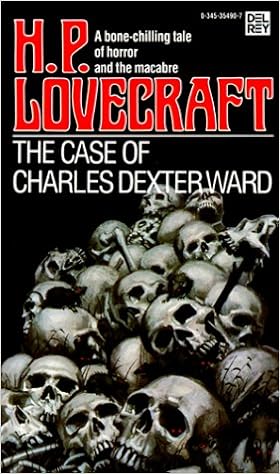
Appendix N Delving - Greyhawk, H.P. Lovecraft's 'The Case of Charles Dexter Ward' & 'A0-A4 Against The Slave Lords' By David "Zeb" Cook, Allen Hammack, Harold Johnson, Tom Moldvay

"Incantations of black magic unearthed unspeakable horrors in a quiet town near Providence, Rhode Island. Evil spirits are being resurrected from beyond the grave, a supernatural force so twisted that it kills without offering the mercy of death!"

Thinking back to the Eighties the unassuming paperback stared at me from the spinner rack in Dobson's Tobacco Mart in '87. The cigar & smoke shop was a head shop if there ever was one on the Massachusetts Connecticut border. There was a smattering of horror paper backs & the occasional gaming product. We used to stop there on our way back from making runs up to New York state.  'The Case of Charles Dexter Ward' was of particular interest to me. This paperback was under the Del Rey imprint


'The Case of Charles Dexter Ward' is particularly important if the dungeon master is going to run '
Driven young antiquarian Charles Ward investigates his ancestor, the necromancer Joseph Curwen, and gets more than he bargained for.' routine. The novella could easily be turned into an epic Sword & Sorcery campaign with little issue. There are a bushel of monsters , corpses, ruins at midnight  and haunted  labyrinths. 
Charles Dexter Ward.jpg


What really makes 
'The Case of Charles Dexter Ward' so pivotal for a Sword & Sorcery dungeon master is the fact that there's a whole cloth history of a group of secret Illuminati style necromancers who are raising the dead for nefarious purposes. The implication is that this organization exists across the world. Their resurrecting  is horrific & deadly its perfect as an add on for 'A0-A4 Against The Slave Lords' By David "Zeb" CookAllen HammackHarold JohnsonTom Moldvay as a sort of back handed adventure subplot. 


The necromancers of the slave lords are resurrecting old wizards & rivals to pry their secrets from them then send them back to the grave or turn them into mindless undead travesties or guardians. This leads me back to some of the NPC's that are in the Rogues Gallery book, they make excellent fodder for this angle of the Slave Lords. 


Hell several of the NPC wizards, clerics, etc from the Advanced Dungeons & Dragons  Rogues Gallery might be victims of this group of necromancers & black wizards. What really sets this off the chain is the idea that this organization in 'The Case of Charles Dexter Ward'  might be operating both in the 1920's & the world of Greyhawk. In fact Count Dahlvier the master of Castle Dahlvier and head of the hexad of liches, might be perfect as an addition to this Lovecraftian cabal. 
Greyhawk Box Set - from 1983. All materials included (2 booklets ...

Because numerous  cross Lovecraft references the whole cloth of the 'Case of Charles Dexter Ward' is great to spin as the DM wants or needs for his players. And I think this is one of the novella's strengths is how adaptable these stories are. 


This is also one of the strengths of the old school modules as well. They flex & bend to the dungeon master's needs & wants for his or her players. If you wanted to really do the player's heads in one of the wizards of the party might be a member of such a cabal sent to spy on the player's PC's. 
Any love for The Rogues Gallery - TSR 9031 ? - Page 1 - Dragonsfoot

Sunday, October 27, 2019

Deeper Readings Into Dungeons & Dragons - The Ranks of The Succubus


Now I've spoken about the Wraith of the Immortals box set before but I've been quietly on the side tracing a particular favorite type of demon that I love to use. The Succubus has been a staple of Dungeons & Dragons going all of the way back to Eldritch Wizardry:
"The succubus appeared under the demon entry in the Eldritch Wizardry supplement (1976)" Then they appear in the Advanced Dungeons & Dragons first edition Monster Manual in 1977.


 But its when we get into the release of 
the Wraith of the Immortals box set that things get interesting for me ;"This edition of the D&D game included its own version of the succubus, which is known as the whispering demon, first appearing in the Immortal Rules set, in the DM's Guide to Immortals (1986).[4] The whispering lesser fiend appeared in the Wrath of the Immortals set, in "Book One: Codex of the Immortals" (1992)"
The name 'whispering demons' describes a phenomenon on two levels of the name. The idea that these demons whisper forbidden secrets of magick & the occult to drive men mad. But the other idea that comes to mind is the idea that these demons whisper into the ears of rulers & kings. They whisper things to sew chaos, bloodshed, insanity, & insanity. A concubine or seductress ( or male paramour)  that shares the bed of a ruler or king's adviser could cause untold harm. Even the folklore & mythology behind the succubus supports this ; "
As depicted in the Jewish mystical work Zohar and the medieval rabbinical text Alphabet of Ben Sira, Lilith was Adam's first wife, who later became a succubus.[3][unreliable source] She left Adam and refused to return to the Garden of Eden after she mated with the archangel Samael.[4] In Zoharistic Kabbalah, there were four succubi who mated with the archangel Samael. There were four original queens of the demons: Lilith, Eisheth, Agrat bat Mahlat, and Naamah.[5] A succubus may take a form of a beautiful young girl but closer inspection may reveal deformities of her body, such as bird-like claws or serpentine tails.[6] Folklore also describes the act of sexually penetrating a succubus as akin to entering a cavern of ice, and there are reports of succubi forcing men to perform cunnilingus on their vulvas, which drip with urine and other fluids.[7] In later folklore, a succubus took the form of a siren.

Throughout history, priests and rabbis, including Hanina Ben Dosa and Abaye, tried to curb the power of succubi over humans.[8] However, not all succubi were malevolent. According to Walter Map in the satire De Nugis Curialium (Trifles of Courtiers), Pope Sylvester II (999–1003) was allegedly involved with a succubus named Meridiana, who helped him achieve his high rank in the Catholic Church. Before his death, he confessed of his sins and died repentant."

Right now I've talked about one of the more forbidden aspects of the succubus but their ability to reproduce could cause all kinds of havoc with the forbidden aspects of royal birth lines;

"
According to the Kabbalah and the school of Rashba, the original three queens of the demons, Agrat Bat Mahlat, Naamah, Eisheth Zenunim, and all their cohorts give birth to children, except Lilith.[10] According to other legends, the children of Lilith are called Lilin.

According to the Malleus Maleficarum, or "Witches' Hammer", written by Heinrich Kramer (Institoris) in 1486, succubi collect semen from men they seduce. Incubi, or male demons, then use the semen to impregnate human females,[11] thus explaining how demons could apparently sire children despite the traditional belief that they were incapable of reproduction. Children so begotten – cambions – were supposed to be those that were born deformed, or more susceptible to supernatural influences.[12] While the book does not address why a human female impregnated with the semen of a human male would not produce regular human offspring, an explanation could be that the semen is altered before being transferred to the female host. However in some lore, the child is born deformed because the conception was unnatural.[citation needed]
King James in his dissertation titled Dæmonologie refutes the possibility for angelic entities to reproduce and instead offered a suggestion that a devil would carry out two methods of impregnating women: the first, to steal the sperm out of a dead man and deliver it into a woman. If a demon could extract the semen quickly, the substance could not be instantly transported to a female host, causing it to go cold. This explains his view that succubi and incubi were the same demonic entity only to be described differently based on the tormented sexes being conversed with. The second method was the idea that a dead body could be possessed by a devil, causing it to rise and have sexual relations with others. However, there is no mention of a female corpse being possessed to elicit sex from men"

I want to go back to the origin point of original Dungeons & Dragons Eldritch Wizardry for a moment. Succubi are some of the most dangerous NPC villains a group of adventurers can encur the wraith of. These beings of the Abyss use every single trick in the book to sew the seeds & fruits of chaos within the hall of power & in the bed chambers of the elite. There were scores of these succubi in the Abyss according to the original demons entry in OD&D's  Eldritch Wizardry book. But where are these demons actually coming from?


What would happen if the endless planes of the Abyss are merely the production facilities for the demonic evil for all of the multiverse of the prime material  planes? The manufacturing point for every demonic entity that exists? These demonic horrors are traded & modified among the evil entities & overlords of the multiverse. While doing research into the succubi I remembered my Dante's Inferno & the Malebolge.  The Abyss could be thought of as the factory or production area for Hell. Hell is the main attraction for the damnation of man across the planes. The succubi & incubui are created from the lustful, the murderous, & the damned from the Malebolge; "In Dante Alighieri's Inferno, part of the Divine Comedy, Malebolge (/mælˈbl/) is the eighth circle of Hell. Roughly translated from Italian, Malebolge means "evil ditches". Malebolge is a large, funnel-shaped cavern, itself divided into ten concentric circular trenches or ditches. Each trench is called a bolgia (Italian for "pouch" or "ditch"). Long causeway bridges run from the outer circumference of Malebolge to its center, pictured as spokes on a wheel. At the center of Malebolge is the ninth and final circle of hell." 


Succubus often find themselves traded among demons, devils, gods of evil, etc. but their loyalties always belong to the Abyss. Why? Because the so called 'Prince of Demons' is their lord & ultimate master. Demogorgon might not seem like the likely creator of the Succubi. Make no mistake the Lord of the Ninetieth layer of the Abyss craves power & knowledge above all else. The succubi & incubui are hand picked from the most twisted souls of men & women his demonic lords can find. Then the bizarre & humiliating process of demonic transformation happens. I said his but in reality Demogorgon is beyond our human understand of sex or gender; "
In the World of Greyhawk campaign setting, Demogorgon sometimes goes by the ancient name "Ahmon-Ibor", or "the Sibilant Beast". He is responsible for corrupting the paladin Sir Kargoth and transforming him and thirteen of his fellow Knight Protectors of the Great Kingdom into Oerth's first death knights." And within Mystara, "Demogorgon is described as female in the 1986 Dungeons & Dragons Immortals Rules."

All of this corrisponds to Demogorgon's place in the Abyss & his alien demonic horror nature;

"
Demogorgon lives on the 90th layer of the Abyss, known as Abysm, the Brine Flats, or Gaping Maw. This is a layer consisting of a great sea of briny water broken by tall, sharp, ugly, rocky prominences rising out of the endless murky water into a sky of yellow mist. Demogorgon's palace is two twin towers shaped very roughly like tightly coiled serpents that are covered with sharp, ugly fin-like features and spines, and crowned at the top with skull-shaped minarets. The two towers are linked by a bridge near the top. Beneath the fortress are reefs and caverns where aboleths, kraken and ixitxachitl dwell, constantly warring with each other and worshipping Demogorgon in his palace above. His towers are said to extend so far beneath the sea that they connect to the layer beneath him where he speaks with the obyrith lord Dagon.
Numerous isles dot the layer, but they all resemble Demogorgon's palace: twin rookeries rising straight out of the sea and into the sky. The only significant landmass of the layer is a vast jungle-covered continent. Here, Demogorgon's capital city of Lemoriax is located."

What's really happening is that Demogorgon's heads are in telepathic contact with his vast spy network across the multiverse & planes. It rather enjoys spreading its own sinister brand of mayhem plus chaos where & wants to. In fact it loans out succubi to many other powers including various Great Old Ones & Outer Gods. 


DCS Demogorgon from the Advanced Dungeons & Dragons 
Monster Manual..

With such a demonic  spy network in place across the multiverse is it any word or turn of a phrase is instantly at the beckon & call of the Abyss. Suddenly those tidbits of information add up to nothing but trouble for those adventurers who come under the  baleful eyes of the Prince of Demons. For no good reason the succubi not only are in the bed chambers of the powerful but in the halls of damnation spying on the very essence of their prey. 

Wednesday, October 2, 2019

Matters of Divinity - The Angels of Original Dungeons & Dragons As Well As Advanced Dungeons & Dragons


Its about ten thirty at night & its after work, I've been doing a lot of thinking tonight about The Dragon magazine. I grew up playing original Dungeons & Dragons as well as  Advanced Dungeons & Dragons during the height of the Satanic Panic. The whole nine yards of my soul being up for grabs,suicide, & the whole cloth gamit  was shrieked on various television programs, religious phamplets,etc. during the whole of the late Seventies,  Eighties, & Nineties. To this day there's always some loony in the backwater New England  towns & cities that I live in whose still brings the Satanic Panic up when I mention Dungeons & Dragons. Actually it was D&D that got me into theology in the first place but that's another blog post.
Now over the past couple of months I've been delving into the gods, D&D divinity, mythology, etc. in both Dragon magazine & its earlier incarnation in The Dragon. But angels have been a part of the grand game going all the way back to Dragon issue #6 with John  Sulliven's 'Angel of Death' article; "DEATH ANGELS are highly intelligent and speak all languages telepathically. They act either as Oracles, warning a being or party of death; or they represent Death itself, being under a mission to kill a particular person or creature. When killed, DEATH ANGELS vanish entirely, leaving no remains whatsoever. DEATH ANGELS have the abilities of teleportation, as well as flying with their golden wings. Their teleport has no chance of failure, but they can not teleport out of melee. Everytime a DEATH ANGEL hits with its scythe, their opponent must save vs. Death with a -3 on their saving throw. Should the individual save, they lose one point of constitution, which can only be given back by a clerical ‘Restoration’ or a Healer ‘Energy’ spell."
Just incase you haven't gotten the point here angels in Dungeons & Dragons are nasty customers & never to be messed with. The angel of Death is neutral & very dangerous in the article. The first real mention & solid information  about angels that we get for original Dungeons & Dragons is in The Dragon issue 17 "MESSENGERS OF GOD: ANGELS IN DUNGEONS AND DRAGONS" by Stephen H. Dorneman;" In Eldritch Wizardry, Gygax and Blume have given nefarious Dungeon Masters a plethora of immensely evil, incredibly powerful supernatural beings, the demons. A worthwhile and logical addition to Dungeons and Dragons, and just the thing for trashing that arrogant twelfth-level’s castle. From Gods, Demi-Gods and Heroes a DM can draw for purposes of divine intervention that practically omnipotent being particularly suited to his or her universe. But something is still lacking in this panoply of other-worldly creatures. There is a need for beings powerful, yet not omnipotent, who would be in the service of the good gods. And so, in keeping with the Judeo-Christian tradition of D&D, propose the creation of a new class of supernatural beings, Angels. Angels, unlike demons, should only appear on Earth with a particular mission, a manifestation of a god’s will."
 "In response to prayer (with a base 1% per cleric’s level chance of response), if summoned by various holy artifacts, as guards for certain holy shrines or relics, or at the whim of the gods. Although the classical celestial hierarchy has nine members, the Chronicle of Bishop Matthews in Rudigore records the appearance on Earth of only four types of angels. All the types seem to be physically weaker than their demonic counterparts, though each is endowed with a number of magical abilities, many especial to a particular type. Abilities common to all the angels are: Teleportation (no chance of error), Continual Light (of varying degree), Bless, Fear and Detect Evil. All angels can speak any human tongue as well as Speak With Dead. The very presence of an angel turns undead as a Patriarch. Angels are immune to psionic attack and to the Finger of Death. "

These angels were savage, deadly, & complete instruments of their creator's will. They would stand in stark contrast to the infernal creations coming up in issue #20 of The Dragon;"A New Look at Witches in D&D; GenCon Photo Album; Imperium Clarifications & Addenda; D&D Death Stats; Mythos of Polynesia in D&D; Demonology in D&D; Demonic Possession in D&D"


 Once we get to The Dragon issue #35 the fallen angel meter gets cranked to eleven & the knob falls off with the 'Politics of Hell' by Alex Von Thorn. We get the following introduction; 'The following article cannot be considered the official doctrine of either Advanced Dungeons and Dragons or the Roman Catholic Church. However, it is compatible with AD&D, and except for the parts about Asmodeus it is not in conflict with works on demonology as generally accepted by Catholic exorcists, thus enjoying tacit approval by the Church. However, this article does not have a nihil obstat; much of it is original, and it approaches the subject from a different angle than a religious tract would and should not be considered as such. The rise of Asmodeus is not documented in any major text on demonology, but very little original work on the subject has been done since the Middle Ages, so it is possible that the situation has changed. Perhaps Mr. Gygax has more accurate sources of information'

We get intoduced to the Advanced Dungeons & Dragons creator myth, then  AD&D Satan, Astaroth, & Belial. Now before anyone goes flying off of the handle here this material is in keeping with Dante's Inferno, John Milton's Paradise Lost,etc. Needless to say that to combat this roving band of fallen angels you need a source of celestial good & some higher powered divine help. 


So let's contrast this with The Dragon issue #35 which gave us 'Angels' by William Fawcett & the writer goes into some background details; "AD&D. Though the information it contains is based on both religious literature and theological speculations, it is not intended to be representative of any religion’s actual beliefs. Its sources also include popular fiction such as Dante’s Inferno and Milton’s Paradise Lost. * * * There exists in AD&D a multitude of Evil spirits, including Devils and Demons of all sorts. Through these spirits, the powers of evil are able to act on many levels in many places simultaneously. Missing is the counterpart of the Devils to represent and protect Good. These messengers of goodness are often referred to as Angels. Angels will appear much more rarely than will devils or demons. This is primarily because, while the powers of Evil or Chaos are anxious to interfere at every opportunity, the powers of God are concerned with men developing goodness within themselves and by their own efforts. Angels are therefore less often participants in the struggle than they are messengers carrying needed information and inspiration. In most earthly affairs they are more like coaches than star players. This is to not say that they never take an active role in the conflict, for they are known to have done so before, especially in cases where their fallen brethren (Devils) are involved. The Angel as it is commonly pictured today is the product of a concept which has been evolving throughout most of the history of monotheism. When Amenhotep IV (Akhnaton) tried to replace Egyptian pantheism with a belief in one supreme deity, he was left with the problem of what to do with the other gods. Many of these gods had faithful (and powerful) followers who would resent having their god(s) eliminated by decree of the Pharaoh. Akhnaton’s solution was to demote the other deities from complete godhood to a lesser status as powerful beings in the service of the one god. A similar, and more permanent, fate overtook the Persian deities when the prophet Zoroaster (sixth century B.C.) declared that AhuraMazda was the supreme deity. During Zoroaster’s years of preaching, he found it impossible to completely eradicate belief in the older, traditional deities. Eventually the prophet began referring to them as “beneficent immortals” or condemning them as “demons.” The Angels of the early Hebrew religion drew upon the many different concepts of lesser deities to which they were exposed. These included not only the lesser gods of Persia, but also the Egyptian Kas and the Mesopotamian Genii. As with all of these predecessors, they were the intermediary between the one god and man. In the Book of Enoch (which is not part of the official Old Testament), some Angels were referred to as “watchers.” These Angels were designated to look after man, but some could not resist attempting to change what had been created. So, landing first on Mount Hermon they spread out among the lands of men. They then proceeded to teach men all sorts of “forbidden” knowledge and have sons borne by human wives. These sons were literally giants; they caused immense problems, and eventually men begged the other angels for help. They then had the Supreme Deity intervene. The “watchers” were forced to watch as their children slaughtered each other and then were cast into pits and covered with rocks (until the Judgement Day, when they shall be thrown into the “abyss of fire”). Enoch becomes involved when they ask him to intercede for them, but he is refused."
The article does a pretty brief & to the point of getting into the nitty gritty of the angelic hosts & really not playing favorites with the Western religions of Christanity, Judiusm, etc. But the angels themselves are absolute terrors at the AD&D table top level;
"The Cherubim The Cherubim are the first angels to be mentioned in the Bible (Genesis 3:22), guarding with a flaming sword the tree of Life in Eden. Their griffin-like form is often used in early Hebrew religious sculpture. They are the “flame of whirling swords” and are the guardians and protectors of Good’s greatest treasures. The Ruling Princes of the Cherubim are: Gabriel, Cherubiel, Ophaniel, Raphael, Uriel, Zophiel (and originally Satan). Frequency: Very rare Number: 1 Armor class: -5 Move: 12/30 H.D.: 166 Hit Points Number of Attacks: 1 Damage: With fiery sword, 12-34 (10 + 2d12) Special Attacks: Listed below Special Defenses: +3 or better to hit Magic resistance: 85% Intelligence: Genius Alignment: Lawful Good Size: Large (12’ tall)"
The article concludes in five pages with a very brief & too the point overview of the angel hosts but concludes with  the following;"Angels can be easily included in most campaigns. They can be viewed as serving the concept of Good, Love or whatever and definitely are not limited to use only in a Christian, quasi-Christian, or even pre-Christian theology. They can be as accessible as you desire, so long as their role and purposes are remembered. They do have a respect for men’s free will and will let a fool act foolishly if he disregards their warnings. Using Angels can greatly expand the scope of opponents and the activities of an Evil Player Character. They should be treated as the Good counterpart of Devils or Demons, as described in AD&D, and are considerably less powerful than is often portrayed today. Do not also forget to include the hatred that the fallen Angels have for their stillblessed bretheren and those who assist them. Having such a powerful friend can create powerful enemies. Angels in the Middle Ages were also often the inspiration of Quests"


Later these angels would become celestials & go through various incarnations much more papable to the masses for Advanced Dungeons & Dragons Monster Manual II as well as the various Planescape versions. It wouldn't be until Dungeons & Dragons 3.5 days when Necromancer Games now a part of Frog God Games would reach back to early days of Dragon magazine to create OGL D20 versions of  these angels in the various Tomes of Horror lines. These all tie directly into those early articles from The Dragon magazine under the editorial hand of Tim Kask.


Today for the OSR these articles present a set of alternative rules & settings that might find new life in a game of Dungeon Crawl Classics or another retroclone. They present a fascinating look into a series of mostly forgotten setting & cosmology for original Dungeons & Dragons as well as Advanced Dungeons & Dragons. 

Monday, September 30, 2019

Recollections of DM Raj, Dragon magazine issue 183, & The Taking of 'Rathgarus The Skull Taker'

Getting together with friends or family is often something that gets down to time. DM Raj just left my house about five minutes ago. We only see each other when time & schdules allow. Now I've know Raj since middle school. He actually played in my uncle's AD&D/Basic hybrid campaign starting in '86. But Raj's real speciality has been & continues to be his passion for the Advanced Dungeons & Dragons second edition Spelljammer campaign setting!
We began talking about two things today while his kids played in the yard and in no short order Spelljammer & Dragon magazine issue 183.


Dragon magazine issue 183 shudder. This is an infamous issue of Dragon magazine from July of '92 for us because our party of PC's died rather badly on the claws of a rather nasty Norse dragon from second edition. Dragon issue 183 was under the editorship of Roger E.Moore. Mr. Moore gets absolutely no recognition in my opinion for his many  contributations  to Advanced Dungeons & Dragons first edition not to mention the helming of the Advanced Dungeons & Dragons second edition. But I digress.
My uncle had gotten Spelljammer & dropped our party of adventurers into an asteriod field where a group of pirates was operating. We tracked them for days in our vessel across the skies
We were asked by the local royals to clear the pirates out but they were not alone?! The whole field was the domain of a particularly nasty Norse dragon called  the Corpse Tearer! The pirates were its minions & muscle under the dragon's purview.
So basically my uncle had taken the asteroid field sequence from Empire Strikes Back, mixed in the 'Avast, Ye Swabs, & Heave Too' article by Richard Baker, & then added in one of the The linnorm  worms from the second part of that series of articles from Dragon issue 181 & 182 respectively.


"The linnorm called Corpse Tearer is the most hideous of the Norse drag ons and one of the most feared. The only offspring of the godlike linnorm of the same name, this mottled-brown dragon has long front legs that end in broken but deadly claws. It has no rear legs. The creature’s slime-covered scales are small and weathered, and when the linnorm is at rest it looks more like a fallen, dead tree than a serpent. The linnorm's snakelike head is ringed with matted brown and gray hair. Tufts of the hair appear at random intervals over his body, in places so matted it resembles loose, rotting flesh. Despite its ragged appearance, the linnorm is very much alive, moving and striking quickly. Corpse Tearer is ancient, and because it has traveled greatly it has become fluent in nearly all human and demihuman tongues. Further, it is able to converse will all linnorms and many evil, intelligent monsters."
We were not just killed outright, no our party of eight adventurers were tortured for days, then to add insult to injury our corpses were impaled on pikes outside of the dragon's lair. We mounted another raid using our next characters & then we died again! My uncle cackled like a loon!
To say that we as players were pissed was an understatement! We made phone calls & got together other players from the Litchfield county area! Then we had a dragon slaying party to say the least! Twelve players got together one weekend to end the scourage of 'Rathgarus The Skull Taker'.

The Viking shieldmaiden Lagertha (Lathgertha, Ladgerda),
wife of Ragnar Lodbrok (d. c. 840-65).


There are no ballads sung in kingdom halls of Razeal'll the Field of Stones nor are we remembered in the halls of Vallhala. 'Rathgarus The Skull Taker' was a Corpse Tearer in its pride & this was a major undertaking.  Its weapons were many as my uncle used the worst of em on us;

"Corpse Tearer’s breath weapon is a cone of paralyzation force 10’ wide at his mouth, 300’ long, and 50’ wide at its apex. Creatures of less than 4 HD caught in the cone are automatically paralyzed for 4d4 turns. Creatures of greater than 4 HD are allowed a saving throw vs. breath weapons to avoid the effects. This breath weapon causes no physical damage. Corpse Tearer’s second breath weapon is another matter, however. The disease breath is a cloud 100’ long, 80’ wide, and 80’ thick. All creatures trapped within the cloud suffer 8d12 + 12 hp damage (save vs. breath weapon for half). Further, the creatures are subjected to a magical disease that slowly weakens them. The disease manifests itself within 1d6 rounds by cutting a creature’s strength score in half. Every three turns, the strength score is halved again until the creature’s strength drops to 1. A cure disease will stop the strength loss. However, a wish or limited wish is needed to restore all lost strength points. Corpse Tearer can breathe twice before needing to rest two rounds before it can breathe again. It can breathe as many times as it wishes within this restriction. This linnorm has the following permanent abilities, useable at will: fly water breathing, continual darkness 100' radius, feign death, polymorph self, and speak with dead. In addition, he is able to use the following once a day at will: protection from good, spectral hand, delude, vampiric touch, wraithform, enervation, dimension door, animate dead, and control undead. Corpse Rarer uses all magical abilities at 15th level."

There were many PC's character sheets that were rolled up that day & it was glorious! Raj was the one that came up with the cunning plan to defeat the worm finally after six attempts on my various PC's parts. He lured it into a tunnel & the magic users dropped a giant stone on its head! But we only got a third of the treasure as the royals claimed it in taxes on us! We got the experience but the king quickly came in to claim the credit! Our PC's got the experience points but it was the king whose reputation got the boost he needed. We found a Draupnir Ring of 60,000 gold piece value : "Although not a weapon this artifact produces a similar ring (golden) of 10,000- 60,000 gold piece value every night. Odin often gives these away to his faithful servants, the Einheriar, or those others that please him." We were not to keep that ring however which leads to another blog entry for another time.  The adventure took up a whole weekend from Friday afternoon into late Sunday morning. Pizzas, soda, & an entire AD&D sleep over was the norm for a weekend back then. Parents were thankful that we weren't boozing & causing probelms ( we were but only at the table top).