Showing posts with label Flying Buffalo. Show all posts

Sunday, November 1, 2026

OSR Adventure Commentary - How To integrate Flying Buffalo’s classic generic urban module Citybook I: Butcher, Baker, Candlestick Maker into David A. Hargrave’s Arduin setting using Adventurer Conqueror King System II (ACK II) mechanics,


To integrate Flying Buffalo’s classic generic urban module Citybook I: Butcher, Baker, Candlestick Maker into David A. Hargrave’s Arduin setting using Adventurer Conqueror King System II (ACK II) mechanics, you leverage the strength of each component:

  • Flying Buffalo (Citybook I): Provides 25 detailed medieval establishments, complete with floor plans, NPCs, and plot hooks.

  • Arduin: Provides the high-gonzo, multi-planar, wild science-fantasy setting (Phantasmagoria, Technos, Mana Storms, and high-lethality flavor).

  • ACK II: Provides the tight domain management, economic modeling, market classes, and campaign structure.


Step 1: Mapping Citybook Establishments to ACK II Market Classes

Citybook I fits seamlessly into ACK II’s urban campaign rules. Classify your Arduin city (e.g., Kha-Rhea or Khyrei) by Market Class to govern availability, revenue, and hireling supply.

  • Class I/II Cities (Metropolis / Major Port): Access to all 25 establishments, including specialized arcanists like The Mystic Eye or high-end exotic shops.

  • Class III/IV Cities (Large Town): Restrict magic shops and high-tier services; replace standard NPCs with regional Arduin equivalents (e.g., a Phraint blacksmith or Deodanth leatherworker).


Step 2: Injecting the Arduin Vibe into Citybook NPCs & Locations

Arduin is defined by multi-racial weirdness, volatile magic, and technological relics. Convert Citybook I locations into Arduin landmarks:

Citybook I LocationStandard Fantasy ConceptArduin Conversion
The Silver TrowelStandard Inn / TavernThe Shattered Crystal: Run by a retired Amazon warrior; serves Techno-Ale and hosts interplanar travelers.
The Shield & SwordLocal Armory / BlacksmithKrag’s Forge: Run by an Orcish master smith using Star Metal and Technos salvage.
The Magic ShopArcana & ComponentsThe Void Emporium: Run by a Rune Weaver specializing in Mana Crystals and volatile Arduin grimoires.
Public BathsSocial Hub / BathhouseThe Steam Sanctuary: Features thermal vents infected by minor Fire Elemental spirits.

Step 3: Mechanics Conversion for ACK II

1. System Integration

  • NPC Stat Conversions: Convert Citybook NPC levels directly to ACK II Hit Dice and Attack Bonuses.

  • Proficiencies & Skills: Map Citybook personality traits directly to ACK II Proficiencies (e.g., Bargaining, Lair Masonry, Healing, Craft).

  • Economic Conversion: Convert Citybook gold values into ACK II gold piece standards (where 1 gp equals standard silver/gold standards depending on your campaign baseline).

2. Handling Arduin Lethality & Volatility in ACK II

  • Critical Hits & Fumbles: Use ACK II's mortal & injury tables enhanced with Arduin's famous critical damage flavor.

  • Mana & Magic: Integrate ACK II spell slots alongside Arduin’s volatile Mana rules—casting spells near urban magic shops risks triggerable Mana Storms

Urban Market Module: The Bazaar of the Broken Moon

Location: Lower Ward, City of Oakhaven (ACKS II Market Class II City)

Atmosphere: Dense, aromatic, high-variance urban market where Flying Buffalo-style shopkeeper routines meet Dave Hargrave's gonzo magic and ACKS II campaign economics.

Market Mechanics & Economic Framework (ACKS II)

  • City Market Class: Class II (Monthly Mercantile Volume Limit: 250,000 gp; Market Demand Modifier: Standard).

  • Monthly Shop Revenues: Base retail revenue calculated per ACKS II Merchant and Trade tables; shopkeeper profits fluctuate based on urban stability and wild magic disruptions.

  • Wholesale Sourcing: Exotic meats, alchemical starches, and spell-infused tallow are sourced via Level 4+ Adventuring Parties or Level 5 Trade Routes.

Key Shops & Establishments

1. Grendel’s Cleaver & Carcass (The Butcher)

  • NPC Proprietor: Grendel Vane (Level 3 Fighter / Merchant, Neutral). A grizzled veteran who trades exclusively in monster harvest.

  • ACKS II Economic Profile:

    • Monthly Overhead: 120 gp (rent, refrigeration charms, staff).

    • Gross Revenue: 450 gp/month.

    • Inventory Value: 1,200 gp in exotic cuts and preserved monster parts.

  • Arduin Wild Flavor & Hazards:

    • Manticore Tenderloin: 25 gp/lb. Eating a full meal grants +1 to Save vs. Poison for 24 hours. Side Effect: 10% chance of sudden quill-sprouting (cosmetic, 1d6 hours).

    • Displacer Beast Flank: 80 gp/lb. Grants the eater Blur for 1 turn. Requires a Save vs. Poison (ACKS II) upon consumption; failure causes spatial disorientation (-2 to Attack throws for 1 hour).

  • Flying Buffalo Hook: Grendel suspects rival butchers are selling fake hydra meat padded with troll flesh that regenerates inside customers' stomachs. He needs adventurers to covertly inspect the stock.

2. The Star-Yeast Bakery (The Baker)

  • NPC Proprietor: Madame Elspeth (Level 4 Mage / Baker, Chaotic Good). Employs planar-infused yeasts and outer-realm grains.

  • ACKS II Economic Profile:

    • Monthly Overhead: 80 gp.

    • Gross Revenue: 380 gp/month.

    • Inventory Value: 500 gp in mundane baked goods; 800 gp in enchanted rations.

  • Arduin Wild Flavor & Hazards:

    • Phase-Oat Loaf: 5 gp/loaf. Acts as 1 week of iron rations that never spoils.

    • Spell-Resonance Hazard: Casting any spell of 2nd level or higher within 30 feet of the active ovens triggers a Wild Magic Burst: Roll 1d6 on the Bakery Hazard Table.

1d6Bakery Wild Magic Burst Effect
1Dough expands rapidly, filling a 20ft radius sphere (immobilizes targets, Save vs. Blast to avoid).
2Oven heat reverses: 30ft radius chilled to sub-zero temperatures (1d6 cold damage).
3All bread loaves within 60ft gain temporary sapience and shriek loudly for 1 hour.
4Flammable flour dust ignites into a mini Fireball (2d6 damage, 15ft radius).
5Yeast spores float out: creatures in 20ft must Save vs. Petrification or levitate 5ft off the ground for 10 minutes.
6Planar rift opens in the chimney: summons a minor Air Elemental (AC 4, HD 2, hostile).
  • Flying Buffalo Hook: Elspeth’s head apprentice went missing after accidentally stepping into an oven while baking a batch of Starlight Biscuits during a moon alignment.

3. Tallow & Thaumaturgy (The Candlestick Maker)

  • NPC Proprietor: Ignatius Finch (Level 2 Thief / Alchemist, True Neutral). Specialist in spell-bound illumination and occult candles.

  • ACKS II Economic Profile:

    • Monthly Overhead: 150 gp (expensive oils, rare wicks, holy water imports).

    • Gross Revenue: 600 gp/month.

    • Inventory Value: 2,000 gp in standard and specialized tallow products.

  • Arduin Wild Flavor & Hazards:

    • Grave-Wax Pillar: 15 gp. Burns for 6 hours. Undead within a 30ft radius take a -2 penalty to Morale and Attack throws.

    • Phantasmal Tallow: 40 gp. Illumines invisible objects and creatures in a 15ft radius while burning.

    • Extinction Mishap: Extinguishing an enchanted candle improperly (e.g., blowing it out instead of using a snuffer) triggers an Arduin-Style Mishap: Roll 1d8.

1d8Extinction Mishap
1-4Smoke forms a shadow sprite that steals 1d50 gp from the nearest pouch.
5-6Flash-blindness: All within 10ft are blinded for 2d4 rounds (Save vs. Paralysis negates).
7Sudden implosion of light deals 1d8 force damage to the person who extinguished it.
8The candle's stored spell backfires, dealing 2d10 disintegration damage to held items.
  • Flying Buffalo Hook: Ignatius bought a shipment of fat harvested from a defeated Gorgon. He needs protection while rendering it, as the fumes might turn the block to stone.

Sunday, June 2, 2024

Businesses As Usual - TRey Causey's Strange Stars & Citybook VI: Up Town From Flying Buffalo

 If you've been following our Strange Stars sessions then you know that at sometime everything is  going to go back to Circus. Circus.  With Circus I had to get a series of higher class up town sections. Fortunately, I had the answer already on my book shelf! 


Coming out in '92 Citybook VI: Up Town this is part of the iconic Cataylist series. Citybook VI: Up Town  is going to be an old part of Circus. 'The Lost Inn' is going to get a work out coming up! The idea of an inn that takes on the lost and the desparate harkens back to the 'Bygone Age' of Strange Stars. The Greenhargon's Museum is also going to be featured with the owner not knowing anything about the alien nature of the place. The museum is going to be a patron for the PC's coming up. 
Another business that's going to be making an appearance for obvius reasons is Iron Shield Financial Services. For adventurers Iron Shield is a must! And this includes space based adventures. The Age of Ravens blog has a complete review of Citybook VI: Up Town right over here. 

For Trey Causey's Strange Stars the businesses from Citybook VI: Uptown fit in very nicely. Given the weird and alien natures of the businesses there's some really solid businesses and NPC's to mine for games. Stars Without Number fits the 
Citybook VI: Up Town asthetic quite nicely. 

Tuesday, November 1, 2022

Butcher, Baker, Alien?! - Using the Citybook I: Butcher, Baker, Candlestick Maker series From Flying Buffalo For the Original Traveller rpg & Cepheus Engine rpg Expanded & Updated

  "25 City-based establishments with over 75 fully-described non-player characters, and scenario suggestions for use with any role-playing system. This book won Flying Buffalo its very first Origins Award in 1982. Maps, portraits, descriptions; everything you need. This book established that you COULD have a GM book that is genuinely for ANY Fantasy Role Playing System, and not just thinly disguised for one particular system. All the descriptions and mechanics are in generic terms so it will fit in with whatever campaign system you are using."

Citybook I Butcher, Baker, Candlestitck Maker for me is a trip down the memory rabbit hole. Even all these decades later I can still smell my Uncle's pipe smoke from across the table top every time the pages open. 

Tonight City Book 1 Butcher, Baker, Candlestick  maker from Flying Buffalo fell into my hands. Its been a few years since this book made its way into my hands. Most of the time, many people think that this is a Dungeons & Dragons campaign  setting book. But what if the City Book Catalyst  series was used as the basis for a science fantasy style game? No not Spelljammer something else. Roll back to the late Seventies & into the early Eighties. Early issues of White Dwarf magazine covered tons of rpg games, and especially the big three or as the White Dwarf wiki entry covers the subject very well;'During the early 1980s the magazine focused mainly in the 'big three' role playing games of the time: AD&D, RuneQuest and Traveller.

In addition to this a generation of writers passed through its offices and onto other RPG projects in the next decade, such as Phil Masters and Marcus L. Rowland. One huge attraction of the magazine was its incorporation of mini-game scenarios, capable of completion in a single night's play, rather than the mega-marathon games typical of the off the shelf campaigns. This would often be in the form of an attractive and interesting single task for either existing or new characters to resolve. These could either be slipped into existing campaign plots, or be used stand-alone, just for a fun evening, and were easily grasped by those familiar with RPG rules." 
And this is where I first learnt of the City series but it's possibilities for other games presented itself way back in White Dwarf issue #37 where we get the classic introduction to the  Traveller rpg. Within the article we get an overview of the iconic game of science fiction rpg. 


There were tons of potential for crossover with OD&D and its this crossover potential that our groups of players took full advantage of. Often times we would see players bringing in PC's from one game to another. City Book 1 Butcher, Baker, Candlestick  maker from Flying Buffalo 's series world setting became a back water world in our campaigns of Traveller. 
Why?! There were two reasons, one was psionics in Traveller & the second was that it was fairly easy to take the OD&D magic system & adapt it as needed. 


There were several in's with using the 'City' books for the Traveller rpg & the best one was the Spirit Boat from Flying Buffalo's Treasure Vault featuring an all too familiar catlike humanoid alien prince. Fans of Traveller will immediately recognize the alien feline  homage to the all too familiar iconic science fiction game. 


And this is just the tip of the iceberg when it comes to some possibilities of using alien NPC's stuck on some Traveller or Cepheus Engine rpg. There's an over arching plot of destruction & a terrorists cell  that runs through the Citybook series that could have wide reaching ramifications to a campaign. Everything comes to a head in Citybook Sideshow. 


This plot could send in the adventurers to investigate this cell before it grows to become an Imperium problem. We did when one of our party who had trained in the dojo featured in Citybook III: Deadly Nightside was called in when several of the thieves guild were murdered and the guilds were wiped out. The heads of two the thieves guilds were actually agents of the Galactic  Imperium. 


The Citybook series is a classic & works very well to bring together a shared universe but its value in my mind is its application & how it can be used to weave together a complete campaign even for a sector there's lots to offer. 

For the Cepheus Engine the Citybook series has a drag & drop group of NPC's,locations, & maps. This could easily be an exotic  backwater in the 'These Stars are ours setting. 


This gives the TSAO setting an almost Serenity like feel to the City book series. The Dark Ages backwater world that has the ear of the local star system. Legends of the Reticulans & the Citybook system could be even ported over ad hoc to the Sword of Cepheus rpg. 


So today we're looking back into this very topic because of the fact that there's got to be a top town method of looking deeper into these products & the late ancient Roman Empire. Many of the Flying Buffalo products for this series can be quite literately be used with any fantasy rpg system. And we've been thinking about the cross points for the most important & largest Roman cities as well as the Citybook I: Butcher, Baker, Candlestick Maker series of books. Here's a great list of the eleven most important Roman Cities of the ancient world. Notice that they have the population density & civilization infrastructure to support the businesses that are featured within that illustrious series of books. And this is something that even Independence Games & Zozer Games has a part of their frontiers. The idea that civilization is the key to the colonial infrastructure. Something that we see in other OSR & other  fantasy rpg's over & over again. 

Saturday, June 11, 2022

OSR Commentary On Citybook VI Up Town from Flying Buffalo For Your OSR & Old School Campaigns

 "16 fully-described businesses, organizations, and cultural establishments for use with any role-playing system, including over 70 completely developed non-player personalities to interact with your players' characters in City adventures"

So we've been looking into the possibillities of getting our usual lot of players into the deep end of higher society to take advantage of two of our fallen nobility PC's because they come from higher tiered society. And tonight we grabbed Citybook VI Up Town from Flying Buffalo.  Why?! Because of the fact that this is the perfect book to embody a late Roman Empire fantasy  style campaign. 


There's just enough of a hint of danger to keep the player's PC's from taking full advantage of some of the marks erm NPC's. Citybook VI Up Town from Flying Buffalo feels like fantasy Beverly Hills mixed in with ancient Rome with the intent of making the players sweat a bit. The businesses presented within Citybook VI Up Town are interesting & with more then a hint of the late Roman flavor I spoke of; 
Community Services: Marianrose Conservatorium; Amaranthine's Rest; Greenhargon's Museum; Ironshield Financial Services; The Reliquarium; and Lord Llewellyn Finster & Lord Wescott
Lodging & Entertainment: The Lost Inn; Gloriana Theatre; Harrow Downs; and Cydryn's Aerial Palladium
Personal Services
:
 Madrigan's Fine Catering; Exeter's Antique Emporium; Haprice's Golden Scissors; Feats of Clay; Hides Alive; The Cask & Bottle; and Jasmine's Fine Jewelry (and Explosives)
And because it clocks in at almost a hundred pages it has bit of something for everyone within it's pages. The DM & the players benefit from businesses that are both solidly done & yet more then a tad unsuaal to say the least. 
Citybook VI Up Town could be used with OSR game such as Adventurer, Conqueror, King with a far more high fantasy flare for a campaign to add both a bit of whimsy & a far more grittier grittier underbelly to the politic of an ACK's campaign. Back deal bargains & political intrigue going on board rooms of 
Ironshield Financial Services or the lofts or boxes of the Gloriana Theatre. 
For Castles & Crusades Citybook VI Up Town adds a bit of the sophsticated to the fantasy of the uptown fantasy aspects of a C&C campaign. 

Citybook VI Up Town from Flying Buffalo Is Available Here 

Tuesday, November 30, 2021

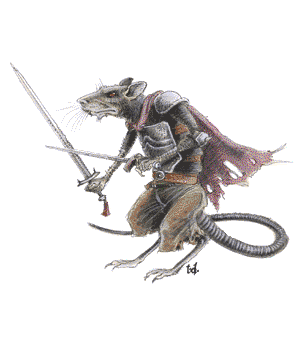
Some Thoughts on Wererats In Old School Sword & Sorcery Campaigns

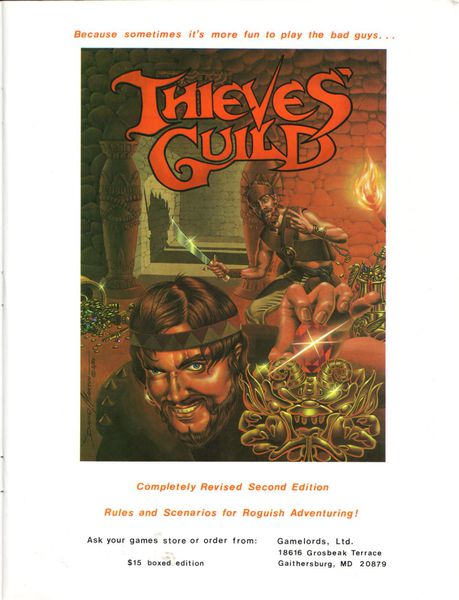
 So I started looking back at some of DM Steve's notes on Thieves Guild by Game Lord, LTD. Now back in June of 2020 I covered some of my experiences with Thieves Guild but then that business didn't go anywhere. And I shelved those notes.


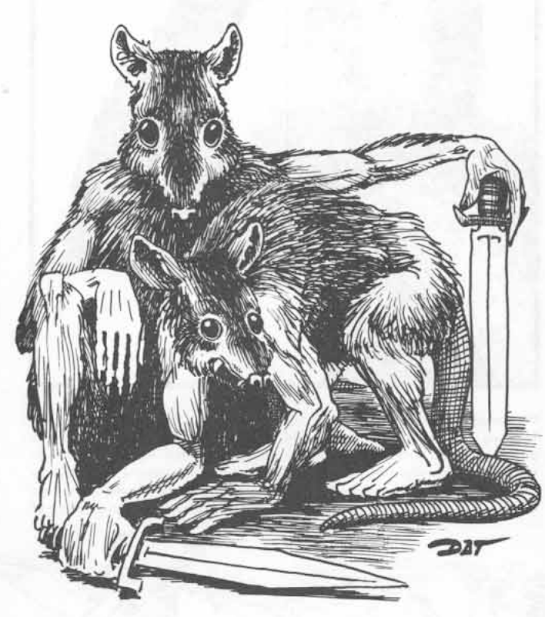
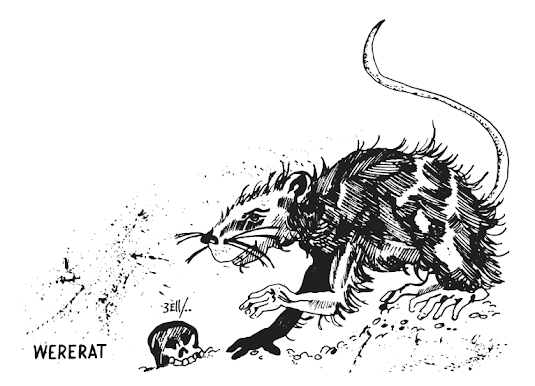
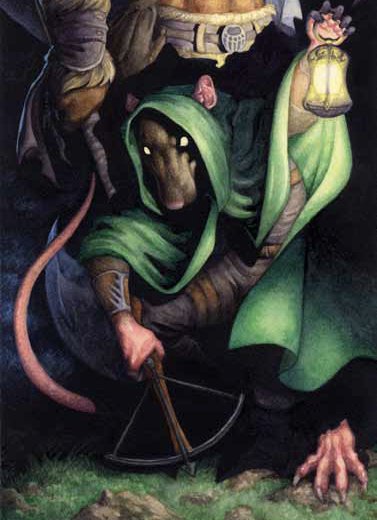
Zipping through the Stackexchange I came across this post about to 'To what extent were Dungeons & Dragons were-rats based on The Swords of Lankhmar?'  And the post got me thinking about using were rats controlled thieves guilds as their elite leadership & as one of the controlling forces for the local beggar's guild. And there's an Arduin connection where Daniel Boggs said, 'At this point, no one seems to remember, although the connection seems very likely. However it wasn't Gygax who introduced wererats to the game or coined the term. The were-rat was first one of the Twin Cities monsters introduced by Dave Arneson and his players. Who precisely is responsible is unclear, but wererat first appears in David Megarry's prototype Dungeon! game (1973) and next in Greg Svenson's Tonisborg Dungeon (circa Jan 1974).' 


So this begs the question, 'Are wererats the perfect monster hybrid to bridge the gap in a Sword & Sorcery' game?! I believe the answer is yes & there are several reasons why:
  1. Wererats are an urban monster & ideally suited to city life and flourish there. 
  2. Wererats are never alone and always socialize in packs. 
  3. They have inherit aspect that ties directly into giant rats which go all of the way back to original Dungeons & Dragons. 
  4. Wererats are masters of the sewers & the seedier parts of cities. This ideally suits the monsters. 
  5. Wererats are a dangerous part of an alien eco system that humanity simply doesn't understand. 


Flying Buffalo Catalyst system books coupled with Thieves Guild books gives legs to a possible network of wererat controlled thieves guild holdings. And as a part of an information selling network a perfect addition to a Sword & Sorcery campaign. 
According to the Forgotten Realms Wiki entry on Wererat's ecology;"Ratmen were cannibals, eating uninfected humans and subsisting on what they could scavenge or steal. Wererats were noted to rarely mate with other wererats, instead mating with uninfected humans. The progeny of a male wererat and a human woman was human, but the child would inherit many of the physical characteristics of its father in his human form. The child of a female wererat and a human male were giant rats with paws that resembled human hands known as ratlings. These ratlings grew to maturity by the age of two and had the ability to transform themselves into human children who appeared to be roughly three times their real age" 

So this speaks to the fact that wererats are being very careful to whom & where they're bestowing their curse or gift upon. 


The wererats are certainly masters of the night & given their abilities within urban environments make formidable NPC adversaries; " Wererats were weaker than normal humans but they were more intelligent. Only silver or magical weapons could harm them and they were adept at surprise attacks.[6]

Wererats shared the animal instinctiveness of all lycanthropes and were markedly more dexterous than humans as well as a little more hardy. Any damage caused by a weapon not made of silver or coated in alchemical silver would be reduced. Wererats were often carriers of filth fever due to the environments that they lived in". 
I have no idea what 'fifth fever' is but wererats are perfectly suited to the role of thieves guild leader or as chaos priest go between for the forces of darkness. In Astonishing Swordsmen & Sorcerers of Hyperborea they were the last surviving true Ancients according to them. An analog surviving hold over of some of the Hyperborean's human slaves. They used foul magicks to curse themselves with the wererat curse.