Showing posts with label Arduin Grimoire. Show all posts

Monday, December 15, 2025

Combining David Hargrave's Arduin (specifically, the proposed or developing ruleset of Bloody Arduin) with the streamlined, sci-fi O.G.R.E.S. rules engine of Jason Vey's 13 Parsecs Part II

 Combining the chaotic, high-fatality, multiverse-spanning fantasy of Dave Hargrave's Arduin (often associated with the "Bloody Arduin" moniker due to its lethal nature) with the adaptable, sci-fi-focused, OSR-inspired rules of Jason Vey's 13 Parsecs creates a truly unique Space Fantasy experience. This blog post picks right up from December 8th's post here. 


The synergy works well because Arduin already embraced genre-bending, mixing classic fantasy with elements of science fiction and super-science (like laser pistols and gates to other dimensions). 13 Parsecs is designed to be a versatile science fiction game, and its core system, O.G.R.E.S., is often compatible with OSR-style mechanics, making a mashup much smoother than trying to blend two wildly different rulesets.


The Arduin/13 Parsecs Hybrid Concept

The core idea is to frame the multiverse of Arduin's Khaas as a section of space that can be reached, explored, or even threatened by the futuristic elements of 13 Parsecs.

1. The Setting: Gonzo Space Fantasy

  • The World of Khaas: The traditional fantasy realms of Arduin exist, but they are now accessible via Jump Gates, ancient portals, or even time travel (rules for which are mentioned in 13 Parsecs). The setting embraces Arduin's "everything goes" philosophy, meaning Elves with laser rifles, psychic Mystic Knights facing off against Chaos Lords, and starships stumbling across forgotten dungeons.

  • The 13-Parsec Frontier: This is the realm of starships, alien species, high-tech gear, and interstellar conflicts. The characters might start here, only to find themselves accidentally shunted into the Arduin dimension, or they could be mercenaries specifically hired to explore the bizarre, dangerous Khaas Sector.

  • The Tone: Maintain the high-risk, high-reward, and highly lethal nature of Arduin (especially its infamous Critical/Fumble tables), but temper it with the pulpy sci-fi adventure of 13 Parsecs.

2. Rules Mashup: Using O.G.R.E.S. as the Foundation

Since 13 Parsecs is Powered by O.G.R.E.S. and is designed to integrate with other games (like Wasted Lands for fantasy elements), it provides the perfect structure.


Feature13 Parsecs (O.G.R.E.S.)Arduin Bloody Arduin ElementsIntegration Suggestion
Core MechanicClass/Level, d20 + mods vs. DC 20 (Attribute/Save), Roll-under % (Class Abilities)d20 and d100 rolls are common.Use the O.G.R.E.S. core mechanics entirely, replacing Arduin's disparate rules for consistency.
Classes/ArchetypesAugmented, Blaster, Mystic Knight, Slicer, etc.Classes like the Assassin, Chaos Lord, Shaman, or Rune-Caster.Re-skin/Reflavour: Mystic Knights become your Rune-Casters, Diplomat skills could cover Arduin's unusual interactions, and the Blaster class is perfect for using Arduin's super-science weapons. You can port in specific Arduin Classes as Heroic Touchstones or prestige classes.
Combat/LethalityStandard combat, Fate Points for agency.Brutal Critical/Fumble Tables for maximum chaos and lethality.MUST HAVE: Integrate Arduin's Critical and Fumble tables (perhaps triggered by a natural 20 or 1 on the d20 roll for attack/saves) to keep the "Bloody Arduin" feel. Allow Fate Points to mitigate or avoid the worst effects.
Magic/PsionicsPsionic/Mystical Powers rules.Extensive, sometimes bizarre spell lists, powerful artifacts.Use the 13 Parsecs system for Psionics/Powers to handle Arduin's spells, possibly requiring a new Mystic Warrior subclass dedicated to arcane Runes and Chaos Magik.
EquipmentTech, Starships, Custom Gear rules.Lasers, Power Armour, and ancient artifacts right next to swords.Use the 13 Parsecs gear chapter to classify all weapons and armor (whether tech or magic) with relevant stats. Starships become essential for getting to/from Arduin's dimensional gates.

3. Campaign Hook Ideas

  • The Lost Starship: A starship from the Solar Frontier crashes on the world of Khaas, and the crew must navigate the treacherous, magic-infused landscape to find a way to repair their jump drive or open a new gate home.

  • The Dimensional Incursion: A powerful Chaos Lord from Arduin's darkest corners discovers a permanent gate to the 13 Parsecs universe and begins to conquer a star system with his armies of Troll-kin and mutated horrors. The players are an interstellar defense force sent to stop the Arduin invasion.

  • The Artifact Hunters: The players are members of an interdimensional salvage crew, using their sci-fi gear to dive into the most dangerous and forgotten realms of Arduin in search of the potent super-science and arcane artifacts left behind by its original creators.


Monday, December 8, 2025

Combining David Hargrave's Arduin (specifically, the proposed or developing ruleset of Bloody Arduin) with the streamlined, sci-fi O.G.R.E.S. rules engine of Jason Vey's 13 Parsecs

 Combining the "gonzo," genre-bending, and famously lethal fantasy of David Hargrave's Arduin (specifically, the proposed or developing ruleset of Bloody Arduin) with the streamlined, sci-fi O.G.R.E.S. rules engine of Jason Vey's 13 Parsecs creates a game of chaotic, multi-dimensional, high-risk, "kitchen-sink" science-fantasy.


Since 13 Parsecs is already designed to be highly customizable and runs on the modular O.G.R.E.S. system, and Bloody Arduin is an attempt to create a cohesive, modern (but still brutal) Arduin ruleset, the combination should focus on integrating the flavor and lethality of Arduin into the framework of 13 Parsecs.

Here is a proposed framework for the Bloody Parsecs (or Arduin's Solar Frontier) RPG:


 Bloody Parsecs: Arduin's Solar Frontier

1. Core Rules: Powered by O.G.R.E.S. (13 Parsecs)

You would use the core mechanics of 13 Parsecs, which is a Class-and-Level system with three main checks:

  • Class Abilities/Skills: Roll a percentage (d100) and try to roll under your percentage chance.

  • Attribute Checks (Including Combat & Saves): Roll a d20, add your attribute bonus/mods, and try to roll 20 or better.

  • The Rule of 2 (GM Tool): For quick, non-critical checks, roll a die (like a d6) and a 1 or 2 is a success.

The Key Arduin Injection (Lethality):

The most iconic element of Arduin is its lethality. This is best integrated by modifying the d20 combat and saves:

  • Critical Hits/Fumbles: Use the infamous, highly detailed, and often deadly Arduin Critical Hit and Fumble tables from Bloody Arduin (or a streamlined version thereof). A Natural 20 on an attack roll results in a Critical Hit roll, and a Natural 1 is a Fumble roll. This introduces the chaotic, visceral violence Hargrave was known for.

  • Wounds and Damage: Retain 13 Parsecs' vitality (HP) system, but make saves more difficult and failure more punishing (e.g., using a modified Constitution Save from Arduin to resist poisons, radiation, or being instantly killed by a massive Critical Hit).

2. Character Creation: The Gonzo Multiverse

Combine the options, with an Arduin bent:

ComponentBloody Parsecs IntegrationSource Priority
AttributesUse the standard 6 (Str, Dex, Con, Int, Wis, Cha) and add Arduin's 7th attribute: Ego (for psychic/willpower saves).Arduin/D&D style
Races/SpeciesBlend them! Include the 13 Parsecs species (Androids, Felis, Saurians, etc.) alongside classic Arduin races (Deodanth, Great Grey Beasts, Lizard Men, etc.). Assumption: Any species can take any class (a core 13 Parsecs philosophy).Mixed
Classes/ArchetypesBlend the lists. 13 Parsecs archetypes (Augmented, Blaster, Psychic, Slicer) become the core framework. Integrate Arduin classes (Star-Powered Mage, Tekno, Martial Artist, Assassin, Runelord) as specialized subclasses or "Advanced Training" options.Mixed
Skills & TrainingUse the 13 Parsecs Skill System (percentile rolls), allowing players to train Skills from both a fantasy-magic base and a sci-fi/tech base.13 Parsecs

3. Magic, Psionics, & Technology: The Kitchen Sink

This is where the Arduin flavor truly shines in a sci-fi setting.

  • Magic and Psionics: Use the 13 Parsecs rules for Psionics and Mystical Powers. The spell lists, however, should be the famously voluminous, chaotic, and often strange spells from the Arduin Grimoires. A Star-Powered Mage might cast a spell called "Greg Stafford's Dismay" right after a Psychic attempts to hack a starship computer.

  • Gear: Blend the tech lists. The players will have access to both laser blasters, energy shields, and advanced cybernetics from 13 Parsecs, as well as the unique, often cursed or insanely powerful magical/technological artifacts of Arduin (like the "Tekno" gear or unique Arduin armors).

4. Setting & Campaign Tone

The setting becomes a "Gonzo Science-Fantasy Multiverse."

  • The World: Arduin itself is just one highly-magical, dimensionally-unstable planet within the Solar Frontier (the setting of 13 Parsecs). Characters move between high-tech space stations and deep-fantasy dungeons, often within the same session.

  • Tonal Goal: Gritty Sci-Fi Fantasy. The system is rules-light and fast-playing like O.G.R.E.S., but the high chance of a devastating Critical Hit or a disastrous Fumble maintains the unpredictable, high-stakes chaos and danger that defines the Bloody Arduin experience. Death is always a roll away.


Thursday, March 20, 2025

OSR Thoughts on David A. Hargrave's Arduin Triliogy by Empire's Choice Games


One of the things that David A Hargrave did was to bring a ton of optional rpg systems that can be used with both classic 'worlds most popular fantasy role playing' game & your modern OSR rpg's. Why because the Arduin trilogy takes on Mr. Hargrave's original works; "The original three books:

* The Arduin Grimoire (Arduin Grimoire volume 1)
* Welcome to Skull Tower (Arduin Grimoire volume 2)
* The Runes of Doom (Arduin Grimoire volume 3)

Plus: The Arduin Adventure

BY: David A. Hargrave

"These are the books that started it all. These books inspired tons of RPGs, authors and fans alike. Let your imagination set wild and come back to the old Arduin Grimoire series to re-inspire you from old or create inspiration of new! There will certainly be something of value in these Grimoires for all. New rules, monsters, items, spells, character classes, races and more all from the World of Arduin, for use in any and ALL role playing game systems past present and future!" The campaign world of Arduin is very much a world filled with dungeons & ruins from the ground up from the beginning and the premises of the ideas of these ruins are baked right into the writing by Hargrave. This is because Arduin is a bit of a parasitic campaign setting. Meaning that Arduin can be glued right into the Greyhawk campaign setting easily. Because of the fact Arduin embraced the idea of the Arduin 'multiverse' back in mid 70's. 

According too the Wiki Arduin entry; "The Arduin books attempted to add many interesting and notable features to the fantasy role playing milieu. In addition to new rules, the Arduin Trilogy contained unique new spells and character classes, new monsters, new treasures, maps, storylines, extensive demonography, and all sorts of charts and lists which detailed the Arduin "multiverse", many of which were new to role-playing gamers of the time."

  The old Arduin Grimoire series is an old favorite & it works on two levels for me as a dungeon master because the Grimoire is like a glimpse into the process that another dungeon master goes through to create their own campaigns. There's a lot of personal touches that hint at what's in the mind of Mr. Hargrave. Because Arduin is a passion project of the highest order. Races, maps, rpg options etc. all hint at the mind at work and the continuing to evolve project that became Arduin within this book.  
The themes of Arduin are the fact that adventuring and dungeoneering are of paramount on the mind of the author. Everything (well mostly everything0 is geared around the goal of getting the player's PC's deeply involved within the meat and potatoes of the old school campaign.

And this I think is the strength of the Arduin Trilogy when it asks the DM to bring optional and interesting ideas to the table top level. David A. Hargrave was according to those who actually had him as a DM was a very conservative dungeon master. Mr. Hargrave kept his campaigns going and really enjoyed both the experience and depth of gaming. You can see this as a fan and consumer of all of all things Arduin. 


Thursday, September 15, 2022

S3 Expediation to the Barrier Peaks, Gamma World 1st or 2nd edition & the Arduin Grimoire By Dave Hargrave

 This blog entry is going to pick up right from our classic Gamma World & Dungeons & Dragons crossover blog entry from here.  But after talking with a bunch of my gaming buddies this morning I began to talk about a very distinctive idea using the Arduin Grimoire triliogy with Gamma World. 


Arduin artwork used without permission 

Screwing around with the classic Bloody,Bloody, Arduin rpg books. There's a few things that come to  mind off the bat. The artwork for the Lost Grimoire leaps out and that's a Phant with an submachine gun talking with his barbarian friend. 


The thought of using the Arduin Grimoire as a Gamma World secret weapon hadn't occurred to me until it was mentioned by DM Peter. DM Peter was one of my friends growing up locally who also played in my uncle's madcap games. And  DM Pete  remembers a couple of orignal Gamma World 1st edition  sesssions in which the Arduin  Grimoires were the secret lore behind my uncle's version of Gamma Terra. 

And this makes a ton of sense because of the mix of material that he threw at us as players. This makes a certain amount of sense because of the fact that the mixing & matching of Advanced Dungeons & Dragons & Gamma World was in The Dungeon Master Guide first edition. 


If we look at the S3 Expediation to the Barrier Peaks as the source for many of the issues that plague our version of Gamma World. Then it becomes clear that this mix has the potential to explain some of the most dangerous of Arduin's monsters. These are not merely monsters but possibly alien  bio weapons that have been unleashed on an unsuspecting world. And it also goes a long way towards also explaining a possible other source on Arduin besides the nexus gates. 


Note that this is by no means taking away from the legacy of Gary Gygax, David Lance Arneson, James M. Ward, or David Hargrave. It's idle speculation my own part using some of the ideas that my friends threw my way. 


Friday, November 26, 2021

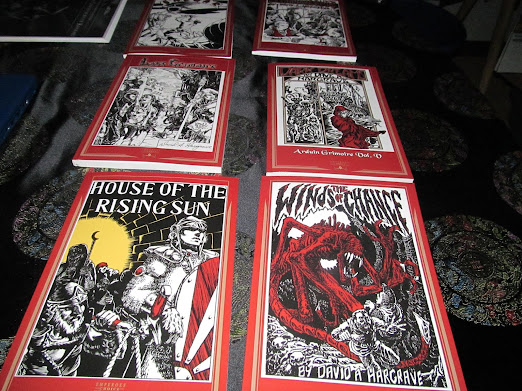
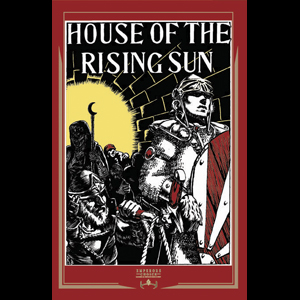
Underworld & Underclass Issues - Commentary 'House of the Rising Sun' (Arduin Grimoire volume 6) By Dave Hargrave From Emperor's Choice

 House of the Rising Sun (Arduin Grimoire volume 6) By Dave Hargrave has been one of those missing pieces of my Arduin Grimoire collection. Well, no more thanks to Emperor's Choice Miniatures & Gamers. 
And this goes back to October when I found a copy of the contents of House of Rising Sun on The Ruins of Murkhill forums here. 


According to the poster oldskolgmr who posted a break down of the contents of the Dragon Tree Press version of the book; 
"Arduin Grimoire Vol. VI; House of the Rising Sun  [Note all writing and spellings in the original except bracketed, italicized material, by the poster].
By David A. Hargrave
Copyright 1986
Illustrated by Roland Brown
Published by Dragon Tree Press
Second Edition 1988 
Pg. 2           Foreward, Dedication, Undedication, and Special Thanks to Dragon Tree Press [Ben & Mary]
Pgs. 3 - 7    The Adventurer Class (A new character class)
Pgs. 8 - 11  The Street Urchins of Arduin 
Pgs. 12 - 14 The Beggars Guild (And New Character Class?)
Pg. 15         The Assassins of Arduin [general]
Pg. 16         Arduin Law and Redress by Assassination 
Pgs. 17 - 20 Unique Weapons of Arduin Assassins
Pgs. 21 - 23 Poisons of Arduinian Assassins
Pgs. 24 - 25 Commercial Medicines of Arduin
Pgs. 26 - 28 Arduin Food
Pgs. 28 - 29 And Beverages
Pgs. 30 - 31 The Natural Denizens [animals/fauna] of Arduin
Pgs. 32 - 37 Arduinian Avians 
Pgs. 38 - 39 The Special Pets of Arduin
Pgs. 40 - 44 More Monsters of Arduin
Pgs. 45 - 46 New Magiks [mages]
Pgs. 46 - 47 New Druidical Magik
Pgs. 47 - 48 New Priestly Magik
Pgs. 49 - 50 New Runesinger Magik
Pgs. 51 - 54 Dragon Magik
Pgs. 55 - 59 More Arduinian Alchemical Goodies
Pgs. 59 - 60 Special Alchemist's Note, Alchemists Character Individualization Chart
Pgs. 61 - 65 More Orcish Alchemical Mayhem
Pgs. 66 - 68 New Mystick Artifacts and Treasures 
Pgs. 69 - 70 Bardic Oddities of Arduin
Pgs. 71 - 73 Rare and Legendary Gems and Jewels
Pgs. 74 - 75 Old Legends of Arduin
Pgs. 76 - 83 The Old Gods [of continents five and three]
Pgs. 84 - 88 The Noble Families of Arduin
Pg. 89         Super Heroes and Sword Swingers
Pg. 90         Final Note [from David A. Hargrave] and Abbreviations [used]      
From the World of Arduin [advertisement for Arduin Grimoires published by Dragon Tree Press]
    More Arduin books by Grimoire Games [advertisement]
      From the World of Delos [advertisement, Dragon Tree Press publications not related to Arduin]"
       There are two PC classes that have me intrigued, 
       'The Adventurer Class (A new character class)' & '
      The Beggars Guild (And New Character Class?)'. Both of these classes are mostly two classes that form a hodgepodge of abilities for the player's PC . The adventurer class goes all of the way to level 100 and the beggar does as well.  The adventurer is a highly trained & dangerous profession with the PC starting training at age ten to fifteen years of age. The training is very serious. And the PC is something akin to a D&D rogue but far more of a tomb breaker. They have elements of assassins, courtesans, and alchemists. The adventurer class is a child of the urban environment and they compliment the beggar quite nicely. This is a rough & tumble class and its by invite only. Mostly human & Elven types go for the adventurer class. Proto  Adventurers  are taken away for training a minimum of seven years. 


      Beggars can be of any race, color, creed, etc. with any physical deformity and they go through a training course of three years. And they are one of the most respected guilds on Arduin because they are information brokers par excellence. And they have incredibly close ties to the Arduin Thieves Guilds. A beggar gets three thieves skills They are not real thieves per say. And gain levels as traders & they often have rats or creatures of the rodent variety as trained pets. Beggars eyes are everywhere on Arduin. 
      So what do these PC classes say about Arduin?! Well to me it says volumes about Arduin's urban underworld & how its cityscape is interconnected in with the criminal element.  'House of the Rising Sun' also contains 'The Street Urchins of Arduin' which has incredibly strong ties the beggar's guild within the cities. The PC's are incredibly wise to keep on the good side of these social & adventure element. 
      Adventurers are whole different level with life being an adventure as a part of their credo. And its very possible that there are any number of abandoned ruins, cities, & even urban  dungeons where & when their particular skills are needed. The adventurer's class strikes me as 'Laura Croft' years before a proper 'Laura Croft' game ever debuted and far less of an 'Indiana Jones' style adventurer. The adventurer speaks volumes of treasure seeker and far less of deadly thief of Advanced Dungeons & Dragons fame. That being said I can see these three PC & NPC  classes working very well together to form another pillar of the underworld that crosses over into certain circles of academia on Arduin. 

      'House of the Rising Sun (Arduin Grimoire Volume 6) Is Available Right Here...