Showing posts with label science fiction. Show all posts

Sunday, September 13, 2020

Review And Commentary On The Free Old School Science Fiction Download - Rocket Jockey (1952.Winston) - Philip St. John For Your Old School Space Opera

 Rocket Jockey 1st Edition Dust Jacket.jpg

 Grab it Right Over
Need a fast overview of a retro future nineteen fifties style tour of the solar system? Complete with a real settlers of the solar system vibe. This book was part of the Winston series of science fiction books for boys and girls back in the 50's. They make a great addition to a DM's arsenal of books that can be turned into instant adventures simply add water or monsters! The plot according to Wiki :
The story follows the heroic efforts of young man Jerry Blaine in his efforts to win the famous rocket race, the Armstrong Classic. Rocket Jockey is a part of the Winston Science Fiction set, a series of juvenile novels which have become famous for their influence on young science fiction readers and their exceptional cover illustrations by award winning artists.


Most often these novels are man vs man sorts of affairs of science fiction while sneaking in some science 'facts' about the planetary locations featured in the books.  Believe it or not these books are great for OSR games like X plorers or Stars Without Number when you don't have a lot of time for doing preparation for a campaign. 

Believe or not this one was by Lester Del Ray under the pen name of Philip St. John. It had a few reprints and its worth taking a look at. The story is pretty well done. The situations, ideas, and overview make a solid campaign.
 In depth Plot Overview(With Major Spoilers) according to Wiki : 
Jerry Blaine, a young man studying at the Space Institute, is kicked out just after his second year exams at the request of his brother, Dick, in order to help him get his ship, the Last Hope ready for the 18th Armstrong Classic. Jerry is initially bitter, but realizes that how he conducts himself in the classic will go a long way toward proving himself as a spaceman, and eventually being readmitted to the institute.
The Last Hope is a refitted asteroid mining ship using the Jerry and Dick's father's experimental fuel which is supposed to be a radical improvement upon existing technologies. Their parents were both killed in the first test of the fuel however, and it is only now, years later, that improvements in materials and engine design will allow the fuel to be tested again safely.
Just before liftoff, Dick is injured when fuel splashes in his face, temporarily blinding him. Jerry is forced to take control of the Last Hopewhile his brother is incapacitated below decks. The qualification run to the moon is begun, and Jerry is racing against 10 other ships from earth for the right to represent their home planet in the classic proper. Jerry manages to win, but only after he witnesses the first fatality of the classic; a fellow earth pilot pushes his engines too hard and his ship overheats and is destroyed.
After some political wrangling on the Moon that puts Jerry officially in charge of the Last Hope despite his brother's seeming recovery, they head out to touch on the 4 Galilean moons, Mars, and Venus. Heading for Mars first they make good time and land with high spirits.
The Martians are not happy to see them, however. There has always been a bitter rivalry between the two worlds, and Mars has a reputation for winning the classic at all costs and through any means, scrupulous or otherwise. When they try to refuel the Last Hopethey discover their shipment of fuel has somehow disappeared from the warehouse in which it was stored. A long drawn out search finally locates the missing fuel in a pile of garbage that was ready for destruction. Jerry, Dick, and Tod all believe that Mars was intentionally responsible for the delay of 18 hours searching for the fuel. They take off from Mars and head towards Jupiter.
Halfway however, Jerry discovers that Dick has not fully recovered from his injuries. He becomes sick and delirious, and they are forced to turn back to Mars to get Dick the medical care he needs. By the time the Last Hope leaves Mars for the second time, they are nearly 100 hours behind schedule, and their carefully planned course is now useless.
En route to Jupiter for the second time the Last Hope loses power due to a blockage of the rocket tube. Losing more time, they coast while making repairs. Unfortunately, they coast so far, they no longer have the distance necessary to decelerate to rendezvous with the Jovian moons. Jerry is forced into a nearly suicidal braking maneuver into the Jovian atmosphere known as the "Dead Man's Orbit". Despite Jerry's vague recollections, such a feat had never before been accomplished, and he receives admiration and applause upon arrival on Io.
After visiting the other 3 Jovian moons and experiencing an unfriendly reception on Ganymede, considered by many to be a puppet of Mars, the Last Hope set course back to the inner planets: Venus, Mercury, and Earth. While approaching the asteroid belt, they intercept a distress call, and come to the aid of what appears to be the Martian racers. After rendering assistance and parting ways, Jerry realizes his asteroid chart has been stolen. He must now navigate the belt by memory and luck.
After some close calls and an actual impact with a small pebble, the Last Hope makes it through the belt relatively unscathed. Because of the delay with the decoy Mars racer, they are no longer in a position to rendezvous with Venus. Mercury is now their best stop.

Once  Again Wiki: 
As a part of the Winston Science Fiction set, Rocket Jockey has helped lay the foundation for many young science fiction readers. The dust jacket was illustrated by Alex Schomburg, a prolific comic artist, and Hugo award nominee for Best Professional Artist in 1962.


 The plot concerns a desperate race against odds put against the backdrop of interstellar politics and spacecraft. The book is well written and a fast read. The ideas still ring well and the book isn't that well known at all today. So borrowing plot elements for old school campaigns is a breezy.  It  would also make a great campaign for the old Buck Rogers T$R era game or for Star Frontiers as well.

Rocket Jockey takes a realistic scientific look at rocketry and space navigation, utilizing technologies that were understood at the time of publication. It extrapolates the advancement in chemical rocketry to a point where constant 1-2g acceleration is possible, making travel through the solar system a matter of days rather than years.


All in all I was pretty happy to have stumbled upon this one while doing some research for an upcoming game!

Friday, March 4, 2016

Commentary On The Free Post Apocalyptic Download ' The City At The World's End' By Edmond Hamilton For Your Old School Post Apocalyptic Campaigns

So earlier tonight Trey over at From The Scocerer's Skull posted a really solid blog post about one of my all time favorite author's public domain books. He posted about an rpg setting based upon William Hope Hodgeson's Nightlands. You can read about this post right over here. The blog post reminded me of one of my all time favorite books by Edmond Hamilton called the City At The World's End. This is another public domain science fiction book with a ton of material to mine for a post apocalyptic rpg setting. The book's tag line really sells this one; "In one split second, a group of ordinary people was catapulted by a mysterious explosion across time into a terrifyingly strange world a million years away."


YOU CAN DOWN LOAD THE NOVEL HERE 

Imagine growing up in the 1950's Midwestern America small town U.S.A. and you find that right above your heads an atomic weapon has gone off. Suddenly there's a blinding flash, and your someplace else. Not simply some place else in space but time. This is the story of a small town and its dawning realization that they're entire existence has been thrust deep into time way into the future.
After the opening chapter the truth confronts scientists with the unthinkable: a superatomic bomb has fallen on Middletown, a small American city hiding a secret anti atomic laboratory, severing it from its surroundings; the sun is now red and drawn out, the moon is unrecognizable, the temperature is low. Various hypotheses are considered to explain all of this, and the most unlikely might well be the one closest to the truth. After the initial event has occurred, transmission of knowledge proceeds in a myriad of interesting ways: between scientific and non-scientific Middletownians The text and dialogue are a quick two step of science fiction. There's lots going on here with the main male character dealing with not only the implications of what's been happening but a fight for survival as the town itself tries to cope with the dawning revelations that something extraordinary has taken place. Earth is covered with acre after acre of strangely abandoned domed cities.The perfect place to stage a mega dungeon or ruined urban center for a post apocalytic game such as Mutant Future or Mutant Epoch.  The sense of loneliness and weirdness in these chapters is high pulp and the novel shares many instances of things in common with William Hope Hodgeson's the Night Lands. Earth is in the throws of the far future death grip , this is a similar location to that which is hinted at in H.G. Well's The Time Machine, the Earth has cooled, & this is a dying world. There's lots of weird bits in this novel  for example. Mankind has spread among the stars and has been genetically modified to live on various world  in the vast interstellar empire. The aliens are in fact us. This makes this novel an excellent excuse to introduce all kinds of mutates, mutants, and alien races that have been adapted to live on other worlds and yet must cope with being thrown together aboard a ship or exploring the ruins of Earth's past.
These aliens however have far more in common with the so called primitives then they do with the citizens of the Galactic Empire. The story is great from a post apocalyptic perspective because it allows on to really get into quite a bit of cross over with out actually giving up the fight for survival on a dying Earth. The vast unexplored cities are perfect mega dungeon locations and are great for putting whatever little twisted creations you might want to throw at your players as a DM.


I remain a huge Edmond Hamilton fan and there are some issues with this book. There are plenty of 1950's mores and norms here and that has to be taken into account. This novel is ground breaking in the sense that there is a strong female star ship captain and though she falls for the male lead there's more behind this then simple sexism. 
Hamilton and Leigh Brackett are two of my all time favorite writers from the age of pulps and there's a wealth of material that can be pulled and mined from The City At The World's End.


YOU CAN ALSO LISTEN TO THE BOOK HERE

Monday, October 19, 2015

Using The Dark Albion OSR Setting Book & Stars Without Number For Your Old School Science Fiction Campaigns

Its been a very long while since I've dipped my oar into the Dark Albion OSR setting book by Rpg Pundit. The book is a dark fantasy campaign set within his dark and twisted version of a fantasy England and Europe during an alternative War of The Roses campaign. The work is sprawling, massive, a work of passion and love. And its been created to work with just about any of the editions and retroclones of OD&D and AD&D on the market. The fact is that its a bit intimidating but that's never stopped me before tackling OSR books.


As I said the book is expansive and creates an entire Dark European realm of incredible detail and filled to the brim with adventure possibilities. But the various D&D clones are not the only rule sets on the block. Lately I've been looking at Stars Without Number From Sine Nomine Publishing  by again because its sitting on my shelf staring at me. Stars Without Numbers handles hard science fiction very, very, well. It includes everything  you need straight out the gate to run a campaign from character classes to space ship rules. It also includes a free version for download. It will work with Dark Albion very easily and there's a reason that I bring this mash up in point of fact. I've recently been reading the Russian science fiction classic   Hard to be a God (Russian: Трудно быть богом, Trudno byt' bogom)  a 1964 sci-fi novel by Arkady and Boris Strugatsky set in the Noon Universe.  Its a dark and bloody universe that the book was set in and its myth soaked, tyrannical planet of the novel reminded me of the setting of Dark Albion.
According to wiki, 'the novel follows Anton, an undercover operative from the future planet Earth, in his mission on an alien planet that is populated by human beings whose society has not advanced beyond the Middle Ages. The novel's core idea is that human progress throughout the centuries is often cruel and bloody, and that religion and blind faith can be effective tools of oppression, working to destroy the emerging scientific disciplines and enlightenment. The title 'Hard to be a God' refers to Anton's (known as his alias Don Rumata throughout the book) perception of his precarious role as an observer on the planet, for while he has far more advanced knowledge than the people around him, he is forbidden to assist too actively as it would interfere with the natural progress of history.'  Dark Albion is a setting that doesn't play it safe and never talks down to its audience, its by Kasimir Urbanski aka Rpg Pundit. The setting is dark, weird, and plays with the author/designer's passion as both historian and rpg designer so its the same with 'Hard To Be A God'. The novel goes for the audience's jugular vein and its relentless in both its setting details, message, and work as a piece of science fiction. The system of Kevin Crawford's Stars Without Numbers easily works with Dark Albion drawing as they do from the same well of the D&D system.  As always there might have to be some modification on the dungeon master's part but for one experienced in this sort of a thing this should be pretty easy.


The darkness of the Dark Albion setting echoes the details and fire of the setting itself. This is a Europe where the myths and legends of an alternative historical  age are in full effect. This is a mythic place where the forces of Chaos and Hell nip at the heels mankind at every turn. The flames of ignorance threaten to turn into the bonfires of war at any moment. The visuals of the Hard To Be A God film from 2013 are stark, brilliant, and have some of the same style. The film is worth seeing for the visual reference into itself. Here's the film Hard To Be A God's trailer.


The stakes in the novel have never been high for a society and Dark Albion plays on the idea of the soul of mankind being at the center of its campaign. The PC's are movers and shakers of society regardless the social strata that they find themselves in. All of this is of course a thought exercise because I already have a campaign in play but in terms of match up this isn't a bad marriage at all. This  campaign could be carried out using any of the retroclones with Dark Albion. But the inclusion SWN I thought lent a certain ring of science fictional respect and yet maintained the weirdness of the Dark Albion book itself. This is not a campaign idea for the faint of heart. Its a dark look into the underpinnings of a planetary society on the edge with a razor to its throat and its waiting for just the right push. Science fiction and dark fantasy never play it safe but for a break from the hum drum of the usual this might make an excellent alternative. I'm filing this one away for a future date.

Friday, September 25, 2015

Classic Free Sci Fi Reference - Starlog Photo Guidebook:Weapons For Your Old School Campaigns

There is a long tradition of the sci fi weapon in the entertainment venues of science fiction television shows and films. Ray guns, laser swords, and a variable rainbow of ray weapons and blasters has been one of the staples and traditions of sci fi fandom. When it comes to Starlog magazine the Photoguide book series of magazines were the references to have. Now the internet archive has had one of my favorites for a free download. The Starlog Photo Guidebook:Weapons is a relic from 1979 that's always been one of those books that somehow were out of reach to comic book and film fanatic in the middle of the North Western Hills of Connecticut. This isn't really so much a technical manual, the Starlog Photo Guidebook:Weapons is a reference book from 1979.

GRAB IT RIGHT OVER
HERE


What it contains is weaponry from film and sci fi television shows starting with Planet Algol from 1920 all the way through an overview of the weaponry of Space 1999 and Battle Star Galactica. There is a brief overview of the show and film that their covering followed by a note about weapon prop. Don't let this fool you sci fi dungeon masters there's plenty here to use, Science Fiction Weapons covers a ton of off the radar or half forgotten film or television shows. The middle section also has some very nice color inserts of Luke's light saber, the Martian War of the Worlds manta ship,a Logan's Run pistol and more. While much of this material might seem like its easily within reach of a dungeon master with an internet connection. All of this material is in one book that happens to be a free download. But there's actually more to this book.

From Dr. Who to Fire Ball XL5 these all get their own sections including Battle Star Galactica 1979 and Space 1999. There's lots of bits and pieces on the weaponry of these shows and their application into an OSR retrofuture campaign. For me the Battle Star Galactica Colonial laser blaster was worth the price of admission because of the details of this weapon. This isn't an elegant weapon, its one that was designed to take out armored non CGI Cylons in battle gear. Players wanted details on this weapon and this book has a pretty solid break down of the original props.

The  Starlog Photo Guidebook:Weapons also has a whole section on the original Flash Gordon serials and series along with the weapons for reference.Given the fact that pulp magazines and retro science fantasy campaigns are white hot right now this is another section that has some top shelf potential for the right Dungeon master. The Star Trek sections follows from the original series up through the Star Trek The Motion Picture weapon systems. And proves a nice overview.


So how can this material be used by a DM for a fast adventure turn around using this Starlog resource? Easily this material can provide a DM who needs to pepper a retro future adventure with sci fi relics and artifacts along with back fitted Easter Eggs for their favorite retro post apocalyptic or sci fi adventures. The Starlog Photo Guidebook:Weapons has you covered.


Once upon a time Starlog and Starlog Photo Guidebooks were the only game in town for a sci fi fan long before the internet was even a twinkle in the eye of a defense contractor and the Army. The magazine always sat next to my copy of Traveler and Gamma World first edition. So this book is an echo from another time but its got plenty to offer the enterprising DM who wants to cash in on that retro future and sci fi vibe of yesteryear.

Wednesday, September 23, 2015

Classic Free Sci Fi Reference - Starlog Photo Guidebook: Spaceships New Enlarged Edition! For Your Old School Campaigns

The Starlog Photo Guides are a relic from another era, the Starlog Photo Guidebook: Spaceships covers many of the spacecraft from the classic sci fi science fiction eras of the Fifties to the Eighties from motion pictures, television, and science fiction. As a reference for retroclone sci fi dungeon masters and players this provides a really wonderful work for inspiration, possible adventure locations, and retro sci fi gaming. 
Grab It HERE
As a free download this Starlog Photo guidebook, this version has been enlarged for easier detail and reference for the reader. This version of the book covers everything from the original Buck Rogers spacecraft to the Star Trek The Motion picture making it a rather impressive book clocking in at ninety eight pages including full color spreads of space craft from Close Encounters, Star Trek, Star Wars, The Black Hole, and more. This book also includes spacecraft from the classic era of television as well with years including 1949 thru 1959. The more modern eras include 1970 thru 1980 include full color spreads of Battlestar Galactica, Alien, and cult classics like the First Men In The Moon. The bibliography is damn impressive and worth the price of admission alone.
  According to Wiki  the history of Starlog is one tinged with sci fi history-

"Starlog was a monthly magazine devoted to science fiction films, television series, and books published by Starlog Group, Inc. One of the longest-running and most popular publications of its type, the magazine was created in 1976 by publishers Kerry O'Quinn and Norman Jacobs. Starlog was one of the first publications to report on the development of the first Star Wars movie, and it also followed the development of what was to eventually become Star Trek: The Motion Picture.
Many fans[who?] of the long-running magazine considered its heyday to have been the 1980s, with very little substance to the content in later years, and many of its long-time contributors having since moved on. But it continued to boast some top-flight genre journalists, including film historians Will Murray, Jean-Marc Lofficier, and Tom Weaver."


So what makes the Starlog Photo Guidebook: Spaceships valuable to the sci fi retro gamer? Well besides having all of the various space craft of classic era sci fi at your finger tips, it provides a valuable window into another era of science fiction and science fantasy motion pictures. It can also provide tons and tons of possible relic space craft for adventure locations and settings all in one place and allows a DM to have instant inspiration at their finger tips. These books were from another era of science fiction fandom when there wasn't an internet and sci fi fans had to do a bit of rooting around. This book puts everything right into your hands for easy access.


Some ideas for using this book include using the Photo guidebook's more obscure sci fi space craft as used vehicles for a sci fi campaign at used space craft lots, as possible derelict space craft in space grave yards, this book could serve as a reference point for various space ships and craft around Sargasso of space locations & even other ideas. Other ideas are use for domain level play where high level cosmic or interstellar craft are used for adventure play. The possibilities for this book are only limited by your imagination.


Monday, July 13, 2015

Reconsidering The Nega Dungeons Of Algis Budrys's Rogue Moon For Your Old School Campaigns

Take your favorite fun house dungeon or adventure location and make it a nefarious alien artifact out of it, this concept isn't new at all. In fact back in the heyday of the Fantastic Four in 1961, Rogue Moon by Algis Budrys debuted. This took the concept of Jame Raggi's Negadungeon  and refines it into a different class all its own. According to Wiki: "Rogue Moon is largely about the discovery and investigation of a large alien artifact found on the surface of the Moon. The object eventually kills its explorers in various ways—more specifically, investigators "die in their effort to penetrate an alien-built labyrinth where one wrong turn means instant death", but their deaths slowly reveal the funhouse-like course humans must take in moving through it"

Those who enter the alien artifact either are killed or go insane. This is all done by matter transmission of a special type, the adventurer is on Earth safe and sound in a sensory deprivation tank  while his doppelganger is transmitted to the moon and to the artifact. The explorer of the maze is in second hand contact with his doppelganger on the moon exploring the artifact. This is the 1960's and at the height of the Cold War so this is a military project. According to Wiki :
"Dr. Edward Hawks runs a top-secret project for the U.S. Navy, using the facilities of Continental Electronics to investigate a large, deadly alien artifact found on the Moon. Volunteers enter and explore it, but are inevitably killed for violating the unknown alien rules in force within the structure. Hawks "must continue to send duplicates into the artifact, however, because each one moves a little closer to finding a way through the alien labyrinth" " But our hero is the flawed and very dangerous thrill seeker who is manipulated into joining the project by Clair Pack
"Al Barker, an adventurer and thrill-seeker. Hawks also meets Claire Pack, a sociopath of a different kind. Where Connington covets power, and Barker seems to love death, Claire enjoys using sex, or the prospect of sex, to manipulate men. Connington wants her, but she stays with Barker because he has no weaknesses in her eyes. Hawks has to appeal to Barker's dark side to persuade him to join the project. Claire tries to get under Hawks' skin while simultaneously playing Connington off against Barker."


And what about the alien artifact or  object itself? Its only talked about through the narrative of the protagonists exploring, dying, and continuing with the exploration of the artifact. Once again wiki:
The reader is told about the artifact only through dialogue, which adds to the mystery. Hawks describes it to Barker:
There's only one entrance into the thing... it is a place where the nature of this formation permits entrance by a human being, either by design or accident. It cannot be explained in more precise terms, and it can't be encompassed by the eye or, we suspect, the human brain... Other men have died to tell us the following things about its interior: "A man inside it can be seen, very dimly, if we know where to look. No one knows, except in the most incoherent terms, what he sees. No one has ever come out; no one has ever been able to find an exit; the entrance cannot be used for that purpose. Nonliving matter, such as a photograph or a corpse, can be passed out from inside. But the act of passing it out is invariably fatal to the man doing it..." (Chapter 5)
This isn't a hard book to get through the but the characters are very,very, flawed and broken in various ways having many of the qualities that allow them to continue the exploration of the artifact as they die in the process to bring the data back to Continental Electronics. I've thought of Rogue Moon over the years as the anti 2001, the explorers enter the artifact and deal with its puzzles and deadliness in various ways. This isn't an easy book to get through at all but well worth the trip and that trip is the key to the whole thing. During the 1960's the themes of transcendence, evolution, and the thrill of the journey. Kinda horrific in a way and very interesting, but throughout the book, the adventurers are playing no only with the alien artifact but with themselves. Case in point is this little tid bit from Jeff King that Wiki sights:
A reviewer for SFF World disagreed with Jeff King, considering the novel to be about death or dying; he referred to Arthur C. Clarke when he opined, "Rogue Moon seems to be initially a great exploration puzzle, about a large alien artefact found on the surface of the Moon. All attempts to explore it leads to the intrepid explorers being killed or going insane in various ways, but their deaths slowly reveal that the process of dying is the point: that and by dying in various ways by moving through it humans learn something about themselves, as presumably would the aliens, should they still exist. It is a Clarkean test, an ordeal that humans must pass in order to evolve and develop beyond their present state. As this shows, Rogue Moon is a deeper and more complex novel than we expect at first."

A more contemporary series of films that goes down similar but not quite the same territory are the Cube films. Strangers find themselves trapped within a negadungeon and one by one 'Ten Little Indian style' their picked off.


Now you might be thinking to yourselves what sort of sick and twisted mind would use such a means of starting a basic adventure party and level them up over and over again. My answer would be very simply I'm  a dungeon master. Well, believe it or not I've used this method in the past with Gamma World 1st and 2nd edition as well as with Metamorphosis Alpha 1st edition as a right of  passage. And now with the release of Mutant Crawl Classics it seems that the Negadungeon or funnel depending upon how you look at it will be getting a second breath of life again. This same method is one which I employed whist DMing Stars Without Number and Lamentations of the Flame Princess.


But what kind of mind might have discovered such a relic? Much less conceive of using this sort of artifact for testing on human subjects? No less in my campaigns as the head of the Fantastic Four himself, Dr.Reed Richards!
Richards and the FF have always had dealings with the dangerous areas of the Blue Area of the Moon. This is the same Dr.Richards who subject himself and his friends to cosmic rays and has used very risky dimensional travel technology including exploitation of the Negative Zone, and had dealings with the Watcher & the monoliths from 2001 a Space Odyssey.

This is of course fan speculation but Earth's moon in fiction has been busier then Grand Central station and the point here is that since this is mere speculation and that the FF made its debut a year earlier then Rogue Moon there has always been a connection between the two. Is it possible that the artifact maze from Rogue Moon might in fact be another type of artifact along the lines of the monolith? Possibly there are some on the surface similarities. Both artifacts use unique energy and matter technology in there operation. There are the various mind blowing or expanding experiences used during their operations one through a cosmic trip and the other through the use of alien death traps, their agendas are completely alien, and their alien masters are unknown. This leaves in my mind more questions then answers. In the end Rogue Moon by Algis Budrys remains an old favorite and is somewhat unknown to the general population of both new and old school role players.

All properties and rpg systems discussed in this article remain the trademark and copyright of their respective owners, this article is the speculation and opinions  of the author and used for educational and entertainment purposes only.

Sunday, June 7, 2015

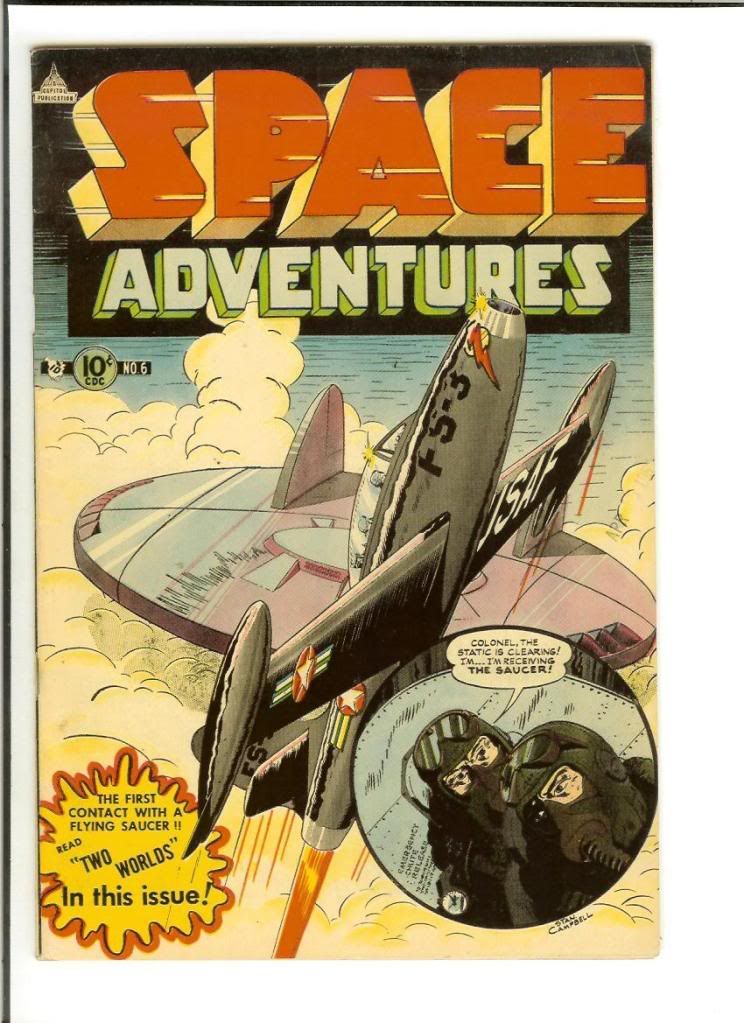
Revising The Free Comic Book Download - Space Adventures #6 As Inspiration For Your Old School Space Campaign

The boys from Derby cranked out any number of  space and science fiction comics but one of my favorite Charlton Comics series was Space Adventures. Back in the 1980's I came across this title in a friend's attic, the one issue that sticks out in my mind issue six. The title is now in the public domain and it makes a perfect resource for your old school space campaigns.
Grab It Right Here 

To start off with the reason why I chose to revamp this issue is the fact we've got a number of stories that fit perfectly in to the notion of adventure background or one shots allowing the DM to draw on these for a quick background fix for his OSR games. These are especially good for doing convention style one shot adventure encounters for lower level parties without destroying the cohesion of his campaign.
In the first story, Two Worlds we get a complete race of refugees from one of Saturn's moons who have settled on Mars. They come complete with retrofuture technology, a complete background, and motives for an invasion of Earth, and a plight for the DM to exploit for adventures. This is a great story to use as the basis for a jump point into a retro future campaign. The ending is unresolved and needs to be addressed. Commander Gort and co are a really nice bunch to add into an old school campaign as NPC enemies, friends, or whatever the DM needs. Because the story is left unresolved there's plenty of action and milage that can be gotten out of this one.
Invasion From Venus has New York as the center piece of the museum of the future. Can you say mega dungeon raiding area? Yeah there's plenty here to work with for the creative DM. Viceroy Dox and co. are a bunch of colonial terrorists perfect to drop right into the mix as a bunch of NPC's with axes to grind and giant mutant sunflowers to cause havoc with. We've even got the space ranger angle in this one as well. 
The Uncharted Planet has plenty of atomic rocket future action and a bit of twisted space exploration to be had. And perfect trap for PC's to fall into. This one has Robinson Crusoe angle to it with a bit of a twist. Save vs death on this one space adventurers! Black Doom is a quick little tale of alien invasion with a twist of weirdness, here the retro future action of the black ray whose effects can easily be simulated with the Darkness spell from D&D just add in the power sapping effects and your good to go. Roj and company are a typical gang of minor mid level rank and file space criminals whose race have a weakness to sunlight. To make them a bit more of a challenge I'd in some connection to the negative plane and then run this as an evening one shot adventure. They've got a whole alien city floating in space for PC's to get into trouble with.
 There's another quick angle with this adventure in the form of the Earth's space  hero Rex Clive and his atomic rocket guys. They're very well organized and make a nice back drop for any retro future game.
A bit of background on the Space Adventure series from Charlton comics  According to Wiki:
Space Adventures, a science-fiction anthology comic book from the Derby, Connecticut-based Charlton Comics, was initially published for 21 issue (cover-dated July 1952 - Aug. 1956). Issues #9-12 (Winter 1954 - Aug. 1954) were cover-titled Science Fiction Space Adventures. The following two issues were cover-billed Space Adventures Presents The Blue Beetle, and featured reprints of the defunct publisher Fox Comics' superhero, from 1939. Issues 15-18 (March-Sept. 1955) carried the rubric Space Adventures Presents Rocky Jones, and featured that children's television character in licensed TV spin-off stories. These were primarily illustrated by penciler Ted Galindo and inked by, variously, Dick GiordanoRay Osrin, or Galindo himself. Giordano penciled at least one "Rocky Jones" story, "Gravity-Plus", inked by Jon D'Agostino, in issue 18. Issues 19 and 21 reverted to Space Adventures, interspersed with another licensed tie-in, Space Adventures Presents First Trip to the Moon — a retitled reprint of writer Otto Binder, penciler Dick Rockwell and inker Sam Burlockoff's adaptation of the movie Destination Moon, from Fawcett Comics' 1950 one-shot of that name.

One thing about Charlton comics is that you got a lot of bang for your buck from this series, from the opening story right on through. There was plenty of action to get the reader interested and even now reading through these its easy to see using the stories in this issue for any number of old school science fiction or science fantasy games. The fact that its free and in the public domain is an added plus in my book, not bad for a ten cent book from the Fifties. 

Wednesday, October 29, 2014

Free Science Fiction Resource - Martian Homecoming By Frank Belknap Long 1951 For Your Old School Martian Campaigns


 "Through the veils of illusion, and waves of terrible remorse, they set out to slay the deadly creatures ..."

Grab it Right 


Frank Belknap Long weaves an interesting tale of Post Colonial Mars that might neatly fit into my on going Post Apocalyptic Mars campaign. The spin here is about some colonists upon Mars. We've got a washed up boxer and his wife, lightning guns, strange Martian monstrous races and more. Here we've got a Mars filled to the brim with ruins and ancient megadungeons waiting for the coming of colonists from Earth. The story weaves a tapestry of charming pulp adventure but really there is a ton here to pull from for a one shot adventure. An illusion causing proto telepathic race, echoes of history darting through the story and an almost Lovecraftian vibe slithering just under the surface of this tale. Even though its a quick read there's lots of little nuances that can be pulled from to make this into a touch stone for a Martian style campaign, something I'm planning on taking full advantage of. All in all this is rather interesting little relic created by one of the masters from the Lovecraft circle. 

Monday, August 18, 2014

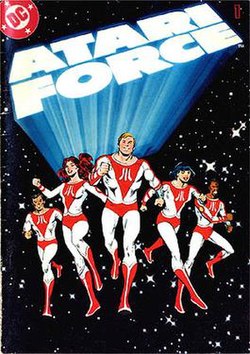
Atari Force Comics As Fodder For The Stars Without Number Rpg And Old School Science Fiction Campaigns


Way, Way, back in the annels of the 80's I played in one of my best friend's Star Frontier rpg campaigns based on this DC series of comics back in 1984.
The comic had some incredible artwork, followed the Star Raiders graphic novel and was loosely connected with the video games. I had no idea about the DC implosion or anything about what were going on behind the scenes at DC at the time. Later, I met some of the folks behind the scenes in the 90's but that's a story for another day.
 The second comic series is perfect fodder for the Stars Without Number game.
According to wiki : 
The first Atari Force comics, which only counted 5 issues, were published in 1982 and were created mainly to illustrate story lines for home consolegames being released by fellow Warner Communications subsidiary Atari, Inc. The comics were packed in with the games DefenderBerzerkStar RaidersPhoenix, and Galaxian. The comics were written by Gerry Conway and Roy Thomas and the artists included Ross AndruGil KaneDick Giordano, and Mike DeCarlo.
An Atari Force special insert appeared in two comic books cover dated January 1983[1] and served as a prequel to the ongoing series launched a year later. The insert was the story previously published in the Phoenixcomic, but the story title was changed to "Code Name: Liberator" and featured ship's name became Liberator. In addition, the art for the aliens showed them as more frog-like. Atari released a Liberator arcade game featuring Commander Martin Champion and the Atari Force name.
The second series (Jan. 1984 - Aug. 1985) was released monthly, in conventional comic-book format, and lasted for 20 issues
The second series of comic books is where I come in, and the mood,introspective Martin Champion takes off with his crew which resembles an Old School science fiction group of misfit adventurers if there ever was one. There are ties to the older DC comics as well in the second series. 

The original Atari Force was a team of humans from different nations using the multi-dimensional starship Scanner One to search for a new planet for humanity to inhabit as the Earth was facing ecological devastation. The team was handpicked by A.T.A.R.I. (Advanced Technology And Research Institute), and consisted of Martin Champion as mission commander,Lydia Perez as pilot and executive officer, Li-San O'Rourke as security officer, Mohandas Singh as flight engineer, andDr. Lucas Orion as medical officer. A semi-sentient alien creature named Hukka because of the noise he made later joined as team mascot.

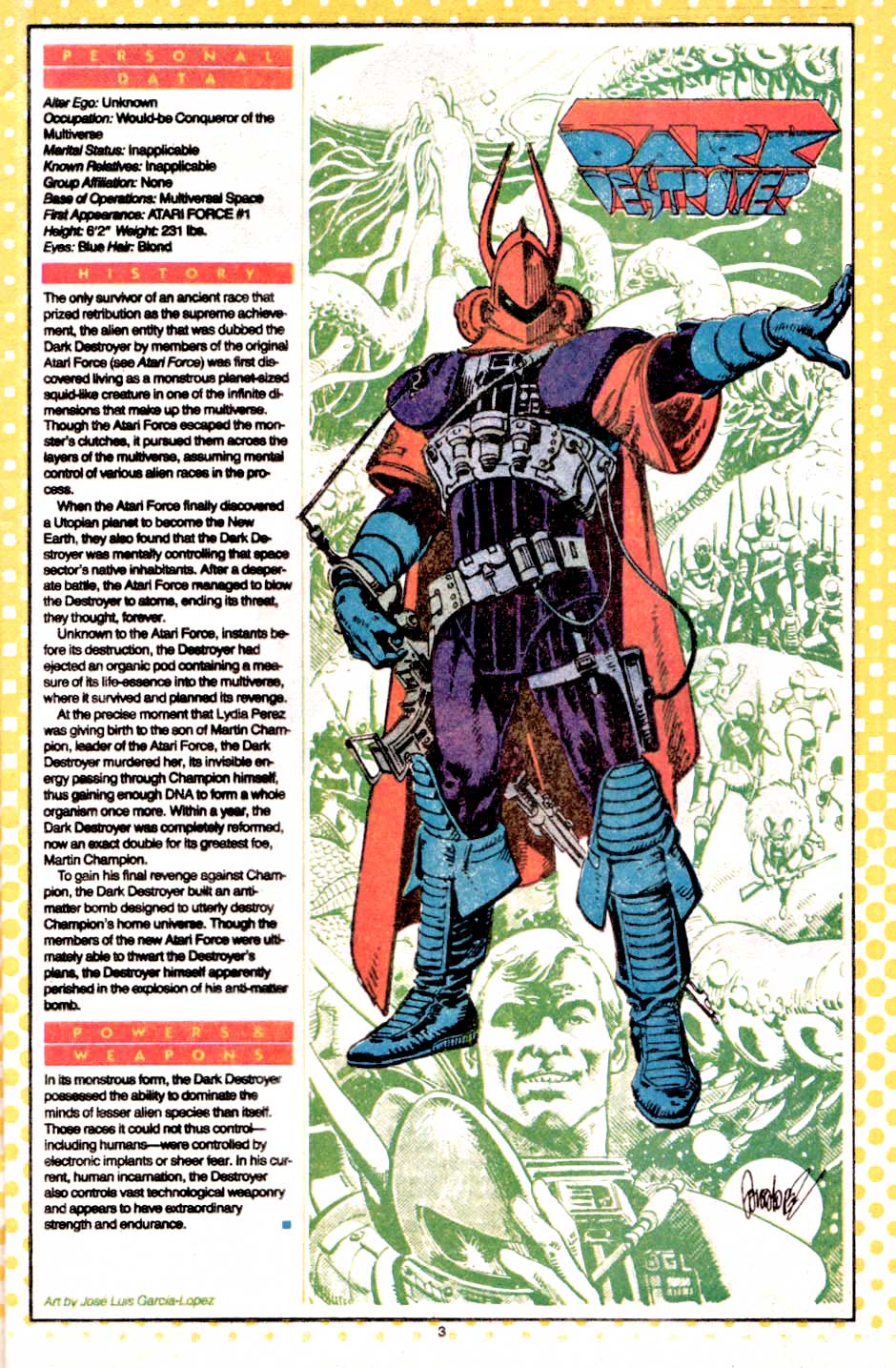
The second team, formed approximately 25 years after the first, was also led by Martin Champion. He was convinced that the original team's nemesis, the Dark Destroyer, still existed. Although he was correct, most of the rest of humanity did not believe it, but humored him due to his heroic status in successfully leading the original Atari Force to find New Earth. Other team members included Christopher "Tempest" Champion, son of Martin Champion and Lydia Perez; Erin "Dart" Bia O'Rourke-Singh, daughter of Mohandas Singh and Li-San O'Rourke; Hukka; Morphea, an insectoid empath; Babe, an alien toddler of immense size and strength; and Pakrat, a humanoid rodent thief. Later additions to the team were Blackjak, Dart's human lover; Taz, a short alien warrior; and Kargg, the Dark Destroyer's former chief underling.
Don't let the kid friendly artwork fool you, this was a pretty nice little DC science fiction series with some very interesting science fantasy concepts lurking in the background. They  work for an SWN or old school campaign.

Using Atari Force As Fodder For A
Stars Without Number  Campaign 
Here's how the Atari Force breaks down into Stars Without Numbers, the original team has  Erin aka Dark as a Fighter/Assassin, Tempest 'psychic', Morphea alien/psychic,Babe fighter, Pakrat expert/thief, Black Jak cyborg/fighter with shades of an expert, Taz alien fighter, Karg alien fighter.
Martin Companion is a fighter/leader who leads the team. 

Elements from Stars Without Number that over lap the comic, the spike drive as the multiverse accessing drive system. Much of the technology,backdrop, etc. all easily fit into the background of Stars Without Number and there's the additions of other books from SWN easily dove tailing into the backdrop.


I was just reminded of this campaign by my friend Peter the other day. We handled the party as survivors who ran into the minions of the Dark Destroyer after we were sent after Martin after he stole his star ship and crew. The party tangled with the Dark Destroyer's forces and lost badly. We were sold into slavery and lost among the debris of the alien despot's empire. After escaping we gathered our own crew and carved up some of the alien's forces. You see there are more then one Dark Destroyer lurking out there. The thing is a Lovecraftian alien horror in power armor taking over chunks of the universe. The party did manage to rescue the other slaves because hey we were heroes and that's what we did.
The Dark Destroyer is still lurking out in the multiverse and heroes are needed.
If you wish to read a good chunk of the Atari Force comics the Internet Archive has a bunch for download HERE
 There's a dedicated web page right over  HERE
I think the whole series was available right HERE

Please note that this blog entry is for entertainment purposes only and is not a challenge to the copyright & trade mark holders of Atari Force, DC comics, or Stars Without Number. The creators of Stars Without Number are not responsible for the contents of this blog entry. This is for my own personal rpg campaign and used under educational and entertainment purposes only.
All materials contained belong to their respective owners.  


Wednesday, June 4, 2014

Commentary On The Free Old School Science Fiction Classic - The Ant Men Eric North 1955 For Your Old School Science Fiction Campaign


Grab It Right Over
HERE

 The Ant Men from the pen of Eric North is another Winston science fiction book offering and this one is a great pulp old school resource. The book would make perfect fodder for both a space based game and a post apocalyptic old school romp.
The book screams pulp from the moment you open it and launches into its high weirdness. There's everything a DM could want to grab a group of adventurers.

 The Blurb On The Inside Flap Of The Book : 
There's a feeling about this desert which frankly suggests...impossible things. That's the only way I can put it."


The feeling that Professor Silas Orcutt, an American geologist, refers to early in this story, is one that every reader of this rugged and thrilling science fiction novel will share with him after the very first page. The professor, head of a party of five studying geological formations in the Central Australian desert, thought back on the nightmare of shifting sand and crackling electrical charges that had wrecked the truck in which his party was traveling. He thought, too, of the skeleton of a freshly killed crocodile - found hundreds of miles from the nearest river - and the stench of formic acid that remained around its picked-clean bones.


The professor's intrepid little group was prepared to find fossils in the Australian rock strata - but not the living kind that shocked them into believing the impossible of the burnt-out lands of the continent down under. Trapped in a desert valley under the pitiless sun, the five found themselves face to face with six-foot-tall ants and deadly giant mantises: survivors from before the dawn of history. Locked in a harrowing war for survival, these deadly creatures had little use for the puny men who found themselves in the midst of an insect war!


How Professor Orcutt was captured by ants with curiously manlike characteristics; how the members of his party found him and investigated the huge underground ant city; how they helped defend the ant men's ghostly underground caverns make this a completely gripping novel capped with a taut and electrifying climax sure to please readers of every age.

Let's start with 
Professor Silas Orcutt, an American geologist who seems like he's stepped out of an adventure party. Everything about this guy just jumps out with a great NPC to get a party of adventurers into all kinds of trouble. Transport him into a space base game like X plorer and he's the type of guy who will have alien ruins around one corner or a lost planet of insects around the other.
Speaking of insects the antmen themselves make a great alien species for Stars Without Number or as a wasteland find in Mutant Future. The book goes into some very nice graphic details about these humanoids and their world. The praying mantises are perfect nasties to pick off your adventurers. All in all this is a pretty nice free resource that can be used for a wide variety of venues. Because it's from 1955 there are very few folks who've actually heard of this one. 

Tuesday, June 3, 2014

Review and Commentary On The Free Old School Science Fiction - Earthbound By Milton Lesser


Grab It Right Over
HERE

This is another Winston collection of Juvenile science fiction put out by the Winston publishing company in 1952. This novel is rather well done and its perfect as fodder for your old school science fiction games like Xplorer. This one also works for Stars Without Number as well for a retro future campaign.
The plot according to wiki :
 Cadet Peter Hodges is washed out of space academy due to an old collar bone injury. From the thin thread of this disappointment and its aftermath in his irritability, and a dishonorable discharge for picking a fight he didn't pick, he falls into a den of thieves who blackmail him into helping them spike the rockets. Before he gets his just desserts-there are sundry events like the Interplanetary Fair, the acquisition of a space suit in the nick of time. 
From the space pirates working behind the scenes to the Interplanetary fair this novel is full of ideas, events, and little bits  that can easily be lifted to provide your campaign with lots of minor background events that can easily give the PC's hours of enjoyments. The idea of 'spiking' the rockets in this novel is a novel idea and given the 1952 ideas of science this is certainly a possibility.  
Given the space and rocket action in this one. There's lots of little ideas here and there incorporating some interesting space ship background ideas as well. There's lots of potential here to expand upon several bits space action to build up a campaign. The novel is perfect as fodder for X plorers but many of the ideas about the space pirates operating on system and interplanetary scale is an interesting one. I was not impressed with the main character who still seemed to need a bit more seasoning. His whining throughout the first half of the book made want to shake the character. He needed a lot more grooming to his position with the whole of the book making want to slap him sensible. 
Many of the ideas in this book can be incorporated into existing campaign sets and could give hours of play. The book is not well known and the players are unlikely to know the points of adventure  and possibly one of the better books that is out there. A simple and rather elegant book that has a myriad of uses for an old school game. Not bad for free.